I never met my Uncle Chwan. I’ve only seen a small sepia-tinged photo of him on the altar at my Aunty’s house, next to photos of Ah Ma and Ah Kong, my paternal grandparents. The second youngest of eight siblings, he was kind and gentle. My Dad and Aunty talk of their little brother as the nice one of the family. I can sense the truth in this.
All eight of my Dad’s siblings moved from Malaysia to Australia to go to university. After graduating with an accounting degree, Uncle Chwan decided to become a Buddhist monk in the Thai Forest tradition. This was the time — the family was healthy and well, he’d finished his studies, and something called him to live a different life.
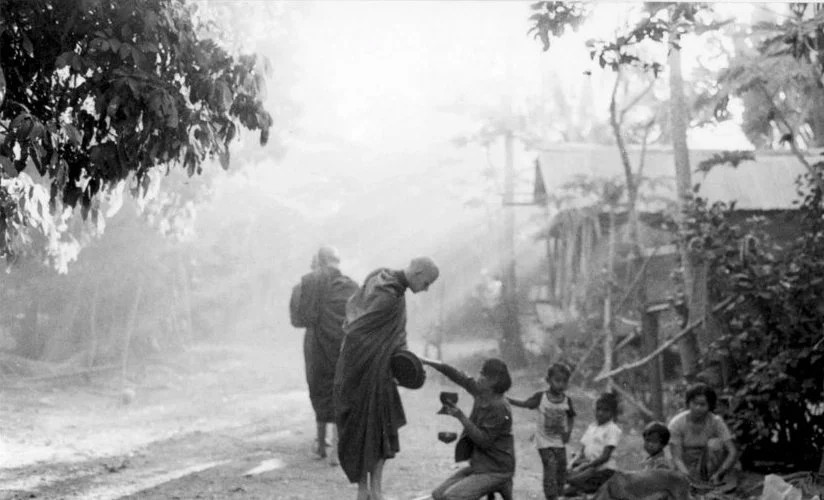
He travelled to Thailand to ordain in the Ajahn Chah lineage at Wat Pa Nanachat — known locally as the monastery for westerners. The details are cobbled together from stories I’ve heard from family and from a monk who was there at the time. To ordain he was required to arrive with few possessions and no money, taking motorbike rides through jungles, giving up everything he knew to live with strangers. He turned his life upside down at 24 for a chance to dedicate himself to something greater.
Uncle Chwan’s Dharma name was Nyanaviro in Pali — meaning “courageous in wisdom” or “one whose courage is knowledge”. This Thai Forest tradition is characterised by austere, relentless dedication to the path.
A couple of years after ordaining, Uncle Chwan became ill. The abbot of the monastery had encouraged the monks to be equanimous with their illnesses rather than seek medicine, a reticence to which Uncle Chwan was already inclined. When his illness got worse, he continued meditating in his kuti. After he didn’t come to the morning chanting and meditation, he was found dead by another monk.
It was incredibly rare for a monk to die so young. The monastery held a special ceremony and dozens of monks travelled from the surrounding towns to pay their respects. But almost all of my family couldn’t travel to such a remote place at that time. The cause of death was said to be encephalitis caused by malaria or rabies. If caught early, this could have been treated. Death by equanimity.
I’m haunted by his ghost. He first came to me in meditation cautiously, hesitantly. I was unsure of opening to this dimension and the image flickered and faded in turn.
Eventually I allowed the image to come. Uncle Chwan visits me — adorned in ochre robes, shaved head, thin-framed glasses. He sits by me. Sometimes he offers me a smile, or a gentle hand on my shoulder. I sense that he is always with me, a phrase I’d dismissed when hearing others talk about these presences. I feel held in a kind embrace, watched over. During a month-long retreat, I experienced so much pain and mental anguish that I felt close to giving in, but I continued on, comforted by his presence in my imaginal sangha. He sat among my field of support.
I can’t explain the tenderness and kindness I feel from this image. What I feel is love. I feel heartbreak. I feel a family that was shattered at his death and maybe never recovered. I feel both endless grief and limitless compassion. I break down into tears when I see his half-smile. I’m held in his Loving Presence.
— In loving memory of Uncle Chwan and Kow Ee Poh.