If you’re reading this, chances are you hear the call. The silent scream rings in your soul. The call tells you there are still unanswered questions. It’s the feeling that the universe itself is not yet resolved. A distant cry prickles your senses. As you hear it, you become aware of your own yearning. Like the open strings of a guitar, your pain and dissatisfaction resonate sympathetically with what sounds around you. There’s a longing for more understanding and intimacy with life itself.
When they are ready, the student arrives with their particular expression of this yearning. They appear in the meditation hall or by the side of their teacher. While the yearning is uniquely theirs, it is also the same yearning of the students in the suttas of the Pali Canon and the koans of Zen. Just as Neo asks “What is the Matrix?”, so Zhaozhou asks “What is the way?”
The student has been sitting, contemplating, trying, faltering. With humility, they admit their struggle. They let their yearning form into a question. They say, in effect: “This can’t be it. What can I do?”
While the call sounds out to all people — all beings experience suffering — some are less affected. They are more adept at ignoring it, the way people who live in the flight path tune out the sound of planes. Rather than respond to the call, they get used to it or avoid it through busyness. Cypher, who had seen all of it, went back into the Matrix to eat steak in blissful ignorance.
Others are shown the call in such a way that they cannot ignore it. They are initiated through an event that brings great suffering. This may not be their choice or intention, but it is an initiation nonetheless. In a single moment, they are brought into a different life where they cannot hide. They have heard the call and now it rings loudly. Whenever they slow down, there it is, in the background of silence.
The call fills my ears and heart, even as life gets better. I bow down, humbled but not humiliated.
In the path of Zen, the practitioner may be given a koan. This is a phrase or story that they stay with and explore, letting it change them. The first koan in Robert Aitken Roshi’s The Gateless Barrier is Mu, a single word that takes a stand against conventional reality.
How the koan stays with the student is the magic. Aitken shares how Wumen Huikai implores the practitioner:
So, then, make your whole body a mass of doubt, and with your three hundred and sixty bones and joints and your eighty-four thousand hair follicles concentrate on this one word “Mu.” Day and night, keep digging into it. Don’t consider it to be nothingness. Don’t think in terms of “has” and “has not.” It is like swallowing a red-hot iron ball. You try to vomit it out, but you can’t.
Gradually you purify yourself, eliminating mistaken knowledge and attitudes you have held from the past. Inside and outside become one.
This is how we channel the call into practice. It splinters open a great doubt. “There is a crack, a crack in everything / That’s how the light gets in”, sings Leonard Cohen.
Opened to rather than treated as a problem, the call becomes the question. It’s a fortune cookie that contains all fortunes, but no note.
The student in the zendo, sitting before the teacher, allows a question to form. Neo follows the white rabbit. The meditator practises sitting in uncertainty.
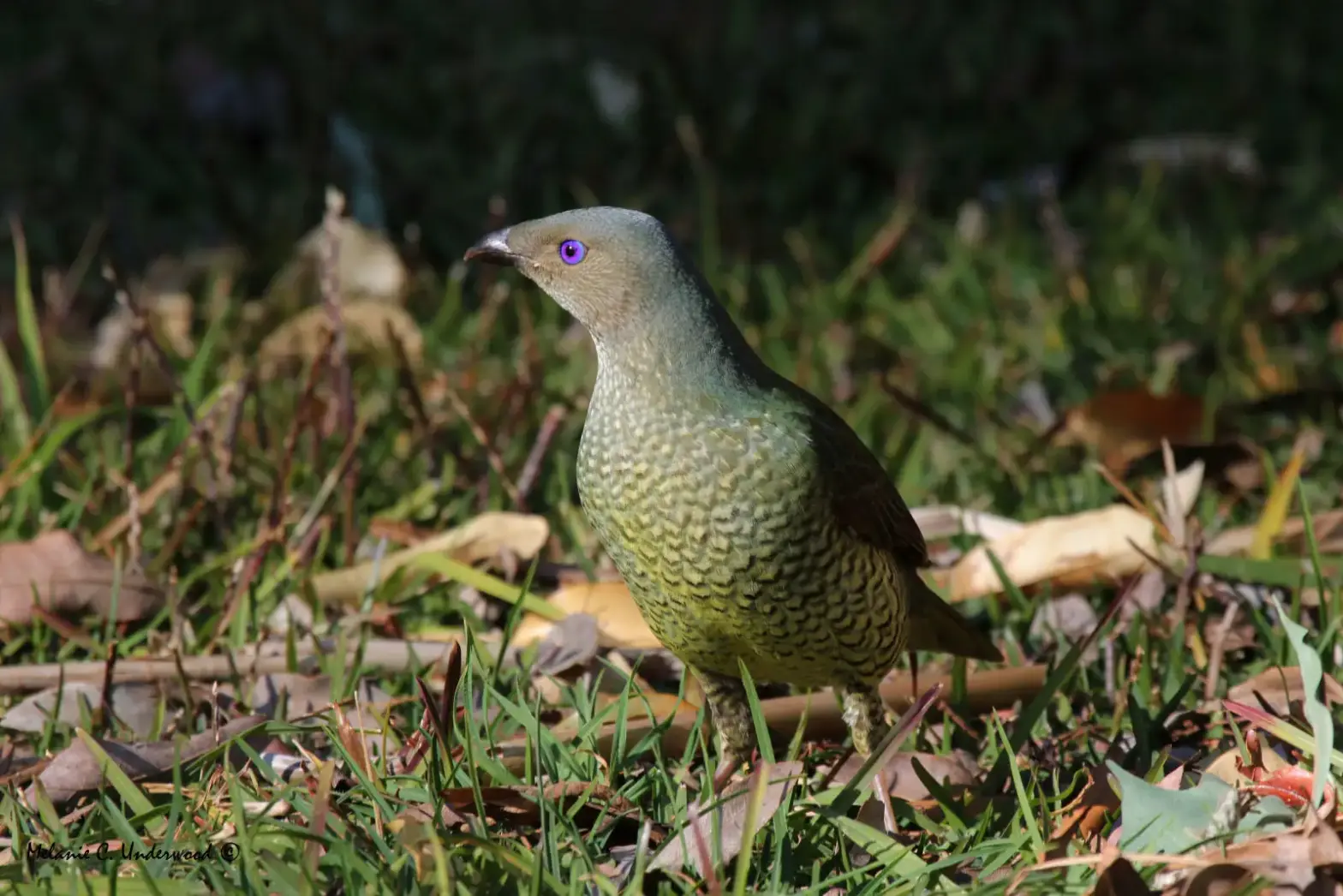
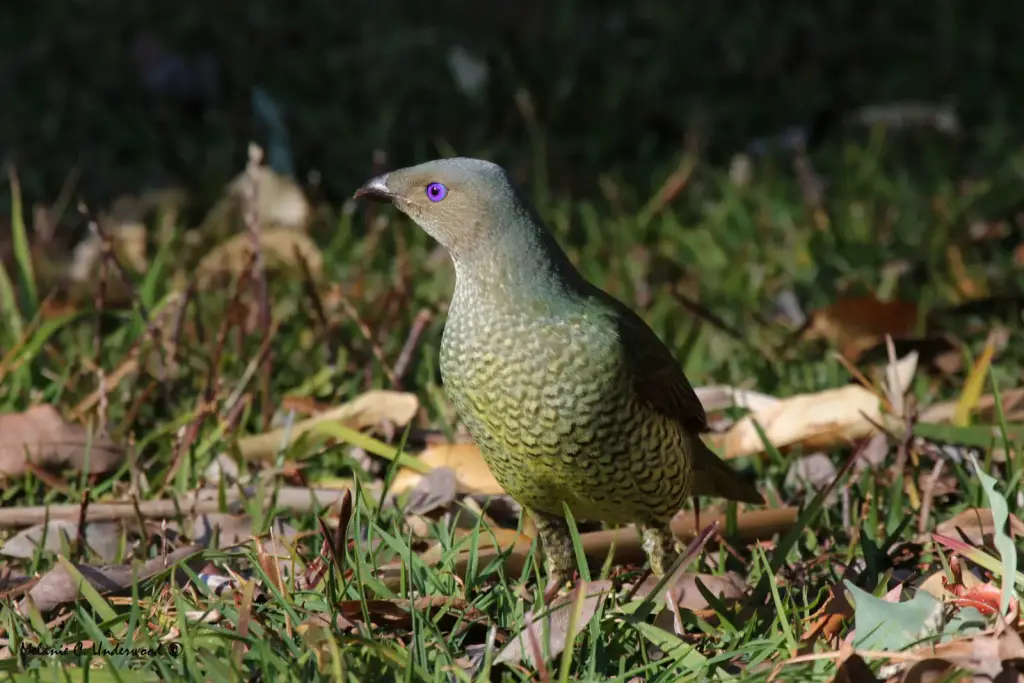
A funeral for a satin bowerbird at the end of a retreat.
The clothes we wear to bed at night to sleep is just pyjamas This flesh we roam this earth in is a blessing, not a promise I bow with those who bow to the creator and pay homage
— Jay Electronica, A.P.I.D.T.A
I hear a crash. Looking up from my tea, I walk over to the source of the sound. On the path outside the meditation hall is a female satin bowerbird. Having flown into one of the windows, she now lies twitching on the ground. I check if she is still alive. My heart races and my mind scatters. I think about what I need to do in each given scenario: if she is injured; dying; dead. When I see that she is badly injured I find my two close friends who are holding the retreat with me. We are all shaken up together. My thoughts go to the suffering that she might be in and what we can do to help alleviate that pain. One friend offers the wisdom that we let the wildness of nature unfold in its own way and only interfere when necessary. We hold this space of uncertainty as witnesses to the transition from life to death.
A memory arises of another speckled satin bowerbird peeking out at me from the broad leaves of a longan tree while I ate breakfast at a long silent retreat. At the time I felt like I had lost my way and the cheeky, monkey-like sounds of these birds felt like an invitation into the cosmic joke.
We go to move her away from the main building and realise she has died. She is so frail in my gloved hands. A delicate arrangement of green speckled feathers, a short beak, two dark eyes, two limp legs. It seems ridiculous that this creature was only minutes before creating a racket as she flew in and out of the plum tree, finding food and evading the retreatants who sought out her beauty. I feel a wave of sadness. As we close the retreat, I lead a guided mettā meditation where I invite everyone to sense into a love for the wildness of nature, for nature’s freedom. On listening back to the recording, I hear my voice crackling with my unfolding emotions, strained through my own sickness and weariness.
After the retreatants leave, the three of us hold a short funeral. We find a patch of land away from the main house where we can bury her and allow her to return to the earth. A rosella watches from a nearby tree, a witness to this sacred transition. I dig a hole and place her in the ground. She has become stiff and dense, seemingly already hardening into earth. The ants quickly move in to begin their work.
I’m nervous as I haven’t led a funeral before. I say a few words that a teacher passed on to me:
Let this bird’s life and death remind us of the preciousness of life. Aniccā vata saṅkhārā. All formations are impermanent.
I notice a peacefulness, an otherworldly quiet stillness. I recall seeing my partner’s grandmother moments before she died and moments after, and how I had noticed this same sacred stillness.
I’d always wondered when I heard that people go to a better place after they die. In this moment, I feel open to something more than an acceptance of death as fact, more than the promise of another life.
The death of the individual body doesn’t mean the end of us when we are “actualized by myriad things”, as Dōgen says.[^1] Yet we forget our connection to the divine, this great gift of life bestowed on us. We forget that we move and speak and dance as part of this great body, the total interdependence of all phenomena.
Each moment of life, each a step in the transition to death, is another opening to walk this path of great wisdom.
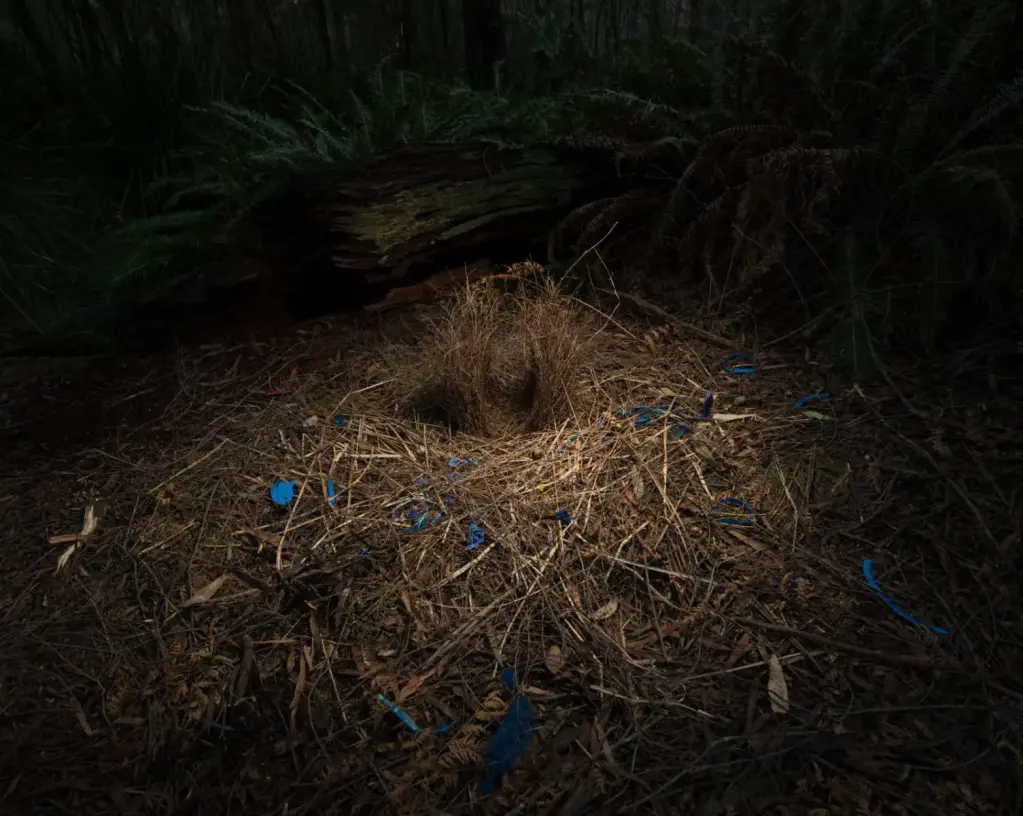
She is in the ground now. Somewhere nearby a male is still arranging his blue things — bottle caps, beetle wings, flowers — setting his stage, waiting.
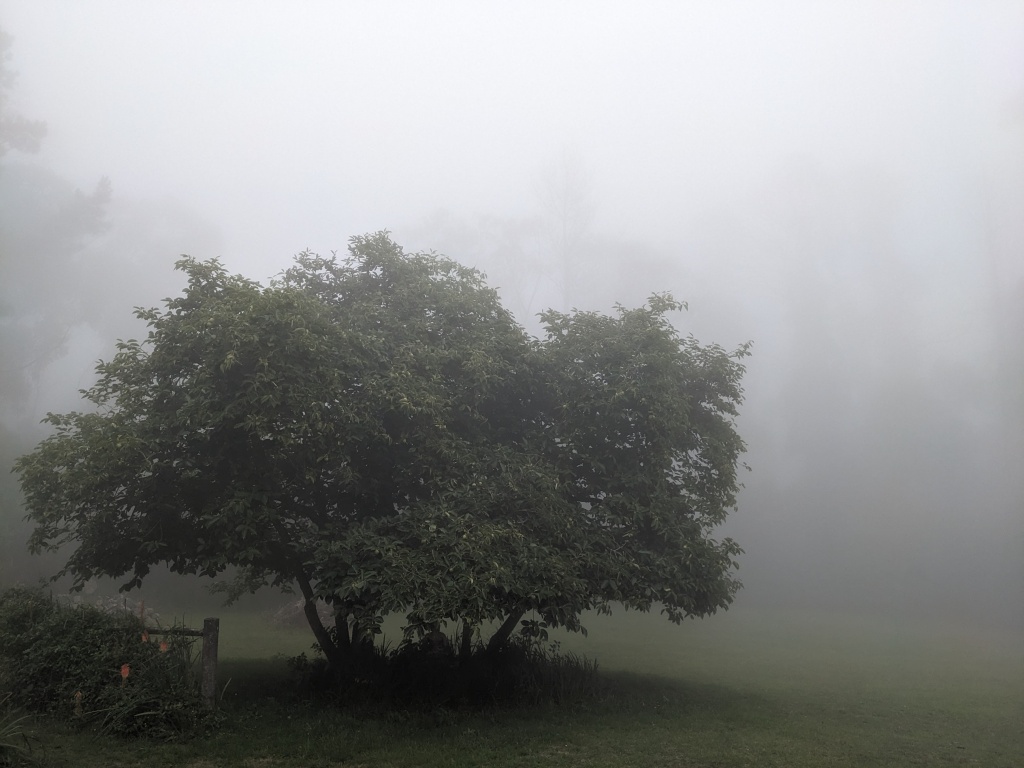
Vejjasala, our retreat home, shrouded in fog.
This song continues playing in my head and in my playlists, each time unravelling a little more.
I go to my Lord quietly, teardrops on our faces Teardrops on my face, it’s like teardrops become waterfalls by the time they reach my laces My eyelids is like levees but my tear ducts is like glaciers As I contemplate creation, the salt that heals my wounds pour out my eyes just like libations
[^1]: Dōgen, Genjōkōan: “To study the self is to forget the self. To forget the self is to be actualized by myriad things. When actualized by myriad things, your body and mind as well as the bodies and minds of others drop away.” Robert Aitken and Kazuaki Tanahashi’s translation is here.
A family holiday, and the thing I didn’t want to feel
I’m on holiday, staying with my family. I realise that I’m drifting in all the activity. I chat with others, go to the beach, eat food, play Settlers of Catan. Occasionally I’ll get stuck on my phone, but overall it’s pretty wholesome stuff. In the midst of all this I sense that I’m losing something of myself. I’m gradually disconnecting from my feelings. I’m sliding into going through the motions. I haven’t had much time alone, not to mention sitting quietly. On the one hand it feels like time by myself isn’t what’s needed right now, that sitting silently would be going against what I came here to do. On the other hand I’m starting to feel an itch not scratched, a vague and shadowy undercurrent of feeling beneath all of this that isn’t allowed to surface.a
I’m sitting on the couch as we watch a movie. It begins in comfort with cosiness and snacks. Then I get a little restless and fidgety. I sink into the couch, unable to move. It’s like I’ve turned into a log, dead inside. I’ve gone past boredom into zoned out; I stare at the screen like a zombie. When that becomes too much, I pull out my phone and stare at a smaller screen. All the while I’m drifting further into a mire. Eventually there’s a sinking feeling deep in my body, like a void or black hole, the sense of something being really wrong but I don’t know what. It’s a sense of missing something. A wave of tiredness pulls me out of this, and I get up from the couch, only to get stuck scrolling in bed.
All of these are pretty standard ways to be busy and to not pause and feel. There’s a move here of turning away from feeling and immersing in doing. Even when sitting on the couch there’s a lot of doing happening — choosing to direct attention to the external: the TV, scrolling on the phone. It’s a fairly mild form of the second arrow. However, in these mundane actions is something more profound, hiding in plain sight.
The move away from feeling is trying to get away from something. This is why sitting still is so hard for so many people — sitting and being with themselves leaves little room for escape. Being human sometimes requires feeling things that are unpleasant and even painful. The natural tendency is to turn away from this — moving towards what is more pleasant, getting rid of the unpleasant experience, or zoning out.
There’s a tendency to take a feeling as saying something final about who we are. Not just that I am experiencing a feeling of sadness, but that I’m a sad person. I’m not just feeling a sense of hopelessness — I am hopeless. I am broken, incapable, unlovable. From this perspective it makes sense that this is unbearable, and that moving away from the experience seems like the only option. It seems to say something about who we ultimately are. The second arrow is a reaction to feeling like the first arrow means something permanent and solid about us. The feeling becomes a life sentence.
Yet feeling something is not the same as being it. The feeling is the weather, not the sky. The clouds move, rain comes and goes, the sun shines and then doesn’t. All the while the sky remains.
I take a pause in the guest bedroom, creating a makeshift meditation cushion from a stack of pillows on the fold-out bed. I stop doing and sit still. I notice the urges to check my phone and to go out and see what other people are up to. I set the intention to be with this, just as it is. There are waves of restlessness and stress. I yawn and feel my shoulders release as the tension begins melting.
I discover a thread of feeling that bubbles up. It’s indistinct, murky, amorphous. I explore it, like a deep-sea diver sinking down past the well-lit shallows. I navigate a layer of distraction, then agitated worry. I steady my breath and stay with it. I follow a glimmer of sadness to a feeling that lives deep inside my chest. There’s a sense here of something being wrong, of just not being okay. It’s a yucky, grating experience, like a bodily feeling of nails on a chalkboard. I acknowledge the part of me that is bracing against this, and open to what is here as fully as I can. If I can feel it, then it cannot be me. I let go into it, each moment of surrender a little death. I allow the feeling, and it unfolds itself. The resistance gives way. The feeling empties out; my being is hollowed out. The feeling shifts — fading, then disappearing completely.
I breathe a deep sigh and notice that my sense of being feels different. There’s an awareness that is present and clear. I open my eyes to the space and feel ease with everything around me. The space, the objects I see, the activities we have planned, the feeling in the body — all a coherent field. I get up with a sense of trust and okayness. I surface once again, having let myself go through the feeling to find that I was still whole.
Feeling is both what we are scared of and the opening to a different sense of being. Feeling calls us to inhabit the depths, to feel all of it, then to return to the surface. Then it becomes possible to rest in this sense of being. After all, you don’t have to do anything to be what you already are. The feeling I couldn’t bear wasn’t something to be removed or replaced — feeling itself was the way in to presence.
This Sunday I’m leading an online workshop, Liberating Feeling, on exactly this — turning towards what we’d rather not feel, together, in a space made for it. Come explore with me if it calls to you.
How I learned to attune to me protective and judgemental parts
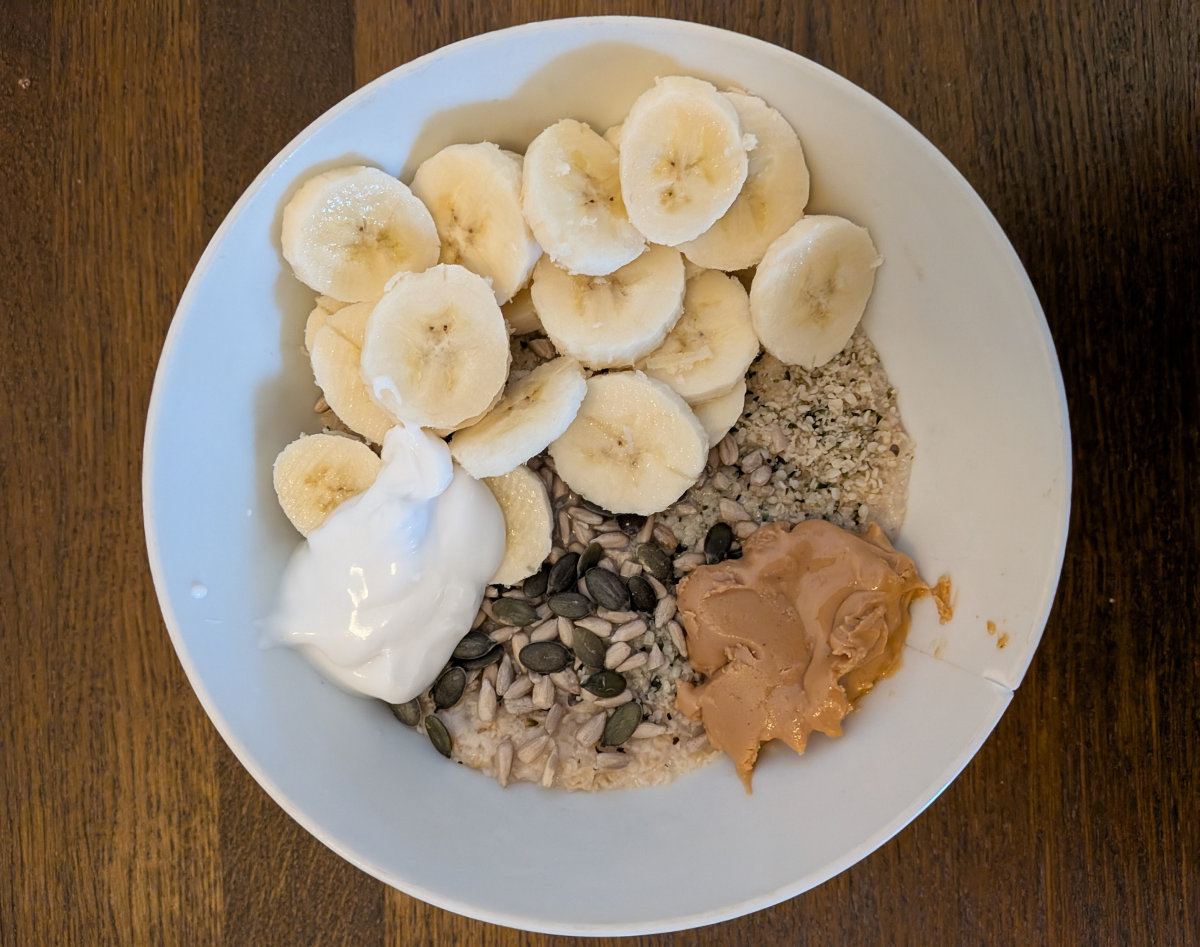
Recalling a time on solo silent retreat… I’m sitting on the sofa in my friend’s apartment, with full-length windows opening onto the balcony and the coolness of the winter air penetrated by rays of sun. Breakfast is oats, topped with peanut butter, banana, and coconut yoghurt, a favourite of mine. I take a moment to appreciate the scene, then go to finish eating quickly, feeling a sudden hurried pull. I get up with the thought ringing out in my head that I had somehow “done breakfast wrong.” I get back to meditating and trying to make the most of the retreat time.
Later that day, I’m practising walking meditation up and down the long corridor. The apartment is still and quiet; there’s barely a sound from the surrounding inhabitants. I step slowly on the carpet. My external world is calm and serene; my internal world is turbulent and chaotic as I start getting caught up in thoughts and emotions. Memories come to mind of times in my life when I felt like I didn’t act as well as I could. I start feeling a sense of guilt and shame. My mind seems to be gaining momentum in the way it presents these to me — one after the other, memory after memory. I see myself acting in an unkind way to others, failing to know things, falling short of the mark. It’s like my mind has taken the role of prosecutor and is presenting evidence at a trial to prove I’m a bad person. I can see a caricature of the proceedings: the lawyer holds up a memory for the courtroom to see, saying, “Here we have Exhibit A demonstrating just how unkind and uncaring Kynan is.” I see myself on retreat as the defendant, with no chance to speak.
I’d known a sense of self-judgement in everyday life as the driving force that pushes me both to do things well and to get things done. But the intensity and constancy of this experience surprise me. I realise how much I normally try to avoid or placate this pattern of criticism — either by turning my attention away, or by attempting to appease this part through trying as hard as I can. I’m also on retreat, so it’s not clear what I should do better to really succeed at breakfast, or how I can improve upon these memories of the past. I recall my colleague Upali telling me “everything that happens on retreat is good,” but I can’t find a way to fold this into that saying. The barrage continues. It seems genuinely bad and I feel like I’m actually a bad person. There’s a continual sense of pressure and frustration.
As the hours continue, I’m crushed under the weight of this sense of not being good enough. I do what I can to be mindful of the sensations and unpleasant feeling tone. The avalanche continues picking up speed, leaving me a wreck as the night draws on. I try skilful ignoring. Paying attention to the breath feels hopeless; investigating the sensations impossible. I curl up into a ball.
Then another memory surfaces: I’m ten years old and going to my very first extension class after being selected to represent my school. I’m so excited — I get whisked away to another school to meet other kids like me, hopeful to make some new friends. In the first class we do a science experiment — placing Smarties in a dish of water and observing the time it takes for the colours to spread and blend into new shades. In the excitement, I barely write anything down; at the end of the class they ask us to hand in our report. I quickly jot down a few notes and put my piece of paper in the pile on the teacher’s desk.
The next week I’m back at the class and the teacher has a stern look. The first thing they do is make sure everyone is listening. Then they hold up a piece of paper. I recoil – it’s my report from the last class. They say that this is inappropriate, unacceptable; this work is simply not good enough. My heart sinks. I’ve never felt so embarrassed and ashamed. I collect my piece of paper. I’m crushed. I never tell my parents, or anyone. I continue with the class, but I’m just going through the motions. The spark has been lost.
I internally vow to never let this happen again. I make sure that anytime there’s something to do, anything that might be judged or assessed, it will be done well enough that I won’t have to feel this way. This is a big job that part of me takes on: to always be good. To push myself so that I won’t be caught out by others.
Seeing this memory has a different feeling. I stop trying to observe the sensations from a distance and fully embrace the felt experience with compassion. My heart opens for this younger self. I sit with him and hear his frustrations. I recognise that bright-eyed ten-year-old and can see that he was just trying his best. It was at best an honest mistake, and at worst he was set up to fail by the adults who expected things without giving clear instruction or support. It’s clear that he didn’t deserve that, and I don’t deserve that. I hold these feelings, lovingly attuning to all this pain and difficulty.
Suddenly I can tune into why there’s such a strong sense of wanting to do things well. I see how this part of me pushes to do well to avoid feeling embarrassed and ashamed. This part of me formed to prevent this hurt. It uses internal criticism to never be caught out. It believes that I need to always be striving to do better to live up to some unreachable standard. I can see how hard this part is working. I feel its pain and exhaustion — all alone in this endless battle to always be better. I understand why it believes this is the only way forward. I feel a tenderness and warmth towards this part of me.
The lawyer, the inner critic, eating my breakfast wrong — all the same movement of protection. Each a pattern of trying to pre-emptively do something better in order to not feel judged, hurt, or attacked later. This part of me just wants to be seen and understood, to know that it isn’t alone. I offer appreciation for how hard it has been working for me. The part, previously so hard and jagged, softens and melts. The intense self-criticism shifts into understanding. I offer kindness and love to this part of me, welcoming it when it arises, appreciating its good intentions. With this, a long-neglected aspect of my being moves towards integration. I feel the spark of being alive and playful return, even if just to enjoy my breakfast and kick my legs as I sit in the sun.
I found my way through this by accident, while suffering more than I needed to. I wish I’d had a map of how to meet my parts through relationship. In the upcoming Liberating Feelings online workshop we’ll explore together how to bring the relational dimension of parts work into meditation.
I recall being on a meditation retreat and seeing someone who was practising diligently but continually running up against a wall in their practice. Over and over they raised their hand and asked what they should do if they weren’t at the level of understanding emptiness. They appeared defeated. Their tone communicated a sense of self-deficiency — that they were failing at the practice. The teacher patiently asked them about their experience, explained the instruction to them again, and tried to give them pointers of what to try next. They praised them for continuing to attend so many of these retreats and tried to encourage them by framing it positively as dedication and perseverance. But I felt like something important was missed. There was an obstacle arising that couldn’t be addressed through insight practice. That felt experience couldn’t be seen through with emptiness practice. I could sense there was a better way, in which the doubt could be explored and felt into, related to differently. I wanted to offer attunement and compassion for their sense of being stuck. My sense was that something wasn’t being touched by the meditation practice; a part of their experience was crying out to be acknowledged and kept being met with silence.
Contemplative traditions, Buddhism among them, offer something genuinely liberating and beautiful in the move from the mundane to the profound. These ways of practising can radically shift how we experience being alive. But the way most traditions and lineages operate falls short for a human being in the world today. This largely comes from setting life and practice in opposition. It sets up a dichotomy that separates and contains rather than integrates.
We might hear this distinction between the ultimate and relative levels of experience. On the ultimate side we place the universal, transcendent, nondual, unconditioned, and “pure”. On the relative side we place the specific, everyday, conditioned, and messy. We can also see this when an experience is taken to belong to the domain of psychology rather than meditation — some content arises and it is thought to be something to ignore, or deal with another time and through different means, such as in therapy.
This separation can be immensely helpful. We need distinctions to make practices clear and usable. At times, skilful ignoring of the content of the mind allows for a powerful deepening and opening. The limitation is that integration is stifled when these are seen as separate concerns, without overlap, and without common ground for bringing practice forward.
—
The image I want to put forward is the double helix. Picture DNA. Two strands spiral around each other as they move forward. They are connected by rods at intervals, lines that bridge and bind them together. The structure is two distinct strands that have a pattern of movement and points of connection.
The ultimate strand is the path of insight. This is insight into emptiness — opened through doorways such as impermanence, unsatisfactoriness, and not-self. This path of insight develops through ways of seeing in which the solidity of experience begins to shift and melt, dropping us down into a different sense of existence. These practices reduce fixation and solidity. Eventually, this opens up into recognising that our own nature is beyond what we conventionally experience as mundane existence.
The relative strand is the path of content. This includes feelings, emotions, psychological content, conditioning and upbringing, patterns and behaviours. Rather than being universal, this refers to something specific about our individual experience. It includes our likes and dislikes. It’s also the ways we react and get triggered. It is our style of being, what we are in our humanity, and what it means to be you rather than somebody else (or no one). The side of content also includes the things we desire, that we engage with most deeply, and what we love. These practices contribute to a healthy sense of self that is grounded and stable.
There’s a way of relating to both that brings them onto the meditative path, so that all of experience can be integrated. Sometimes we frame meditation only as the fair-weather practice, when the body, heart, and mind are amenable. A meditator might be cruising along until things start surfacing and they’re left saying “I can’t meditate any more!” The implication here is that we are meditating until we run into something too difficult, then we have to stop and take that into a different domain. Instead, I’m proposing that from the beginning we can learn to relate well to whatever comes up, so that working with content actually deepens our practice. Rather than being a detour or a sidetrack, this is the path.
To do this, we find connections across the spiral. There are moments in practice where we jump from one side of the spiral to the other. We might be practising a specific meditation technique, such as śamatha (calm abiding), and realise that there’s something in our experience that needs tender care rather than to be ignored or calmed. Or we may be engaged in trying to understand our psychology, and realise we’ve become fixated on our past and the self-image that came from it — recognising that we can instead use insight to see through it and find space and relief. We find a bridge to the other strand of the helix and it allows us to deepen.
Eventually this opens to a smooth flow between insight and content, between ultimate and relative. In this sense, we flow along in the centre of the helix, with both sides arcing and spiralling, allowing us to unfold more and more. To do this, bring a loving attunement to your present-moment experience. All content is seen as practice.
—
An example. I was practising the śamatha meditation technique according to The Mind Illuminated. I’d been chipping away diligently, increasing my sitting duration, gradually working on ignoring distractions and coming back to my object. Eventually I had a taste of stability — a clearing where the mind settled and I could stay with the meditation object for a while, able to return quickly when distraction arose. It was really nice! I thought to myself: “Finally, some fruits from all the time I’d put into the practice.”
I wanted to get back to that state and was excited to return the next day. When I sat down, I found myself at Stage 2. The mind was completely off track, wandering like a box of frogs, or like a wild elephant. I found this incredibly frustrating. Where was all this stability I had so carefully cultivated? What did I do wrong here?
In this stark contrast I cognitively recognised that this was the experience of not-self that I’d read about, taking place before my eyes. I could see how I’d been mistaken in thinking the mind existed independently, something I could control and identify with as a self. Rather than relief, this insight brought up frustration. It kicked up old stuff and spun me into a loop. At this point the teachings became an annoyance rather than a source of wisdom. Upon seeing the frustration, I recognised that my experience was also coloured by a kind of sadness. I intuitively let go of my meditation object and went towards the frustration and sadness. I opened to them and let them be there.
This was a great sadness at not being able to control the mind, to will something into existence. I was coming to terms with the fact that even in my own mind, I didn’t have agency. I had lost control of what had felt like the only thing I could control. I’d lost what had felt like me. For the first time, I saw it clearly. I felt the grief of not being able to make something happen through will. As I opened to those feelings and emotions, the grief crystallised as this loss.
I felt into the grief as it appeared in my body. I fully allowed it to open and unfold. Then something shifted. The mind, which had been scattered and restless, settled into a state of calm. A wave of emotion passed through and left a clear space in its wake.
As I continued meditating, I recognised that I’d dropped down into a deeper level of experience. I no longer felt like I was a separate self meditating and controlling the mind. All experience was unfolding on its own. I rested in this state. Everything became so easy and clear, with no sense of needing to do or control anything. Awareness had become spacious and open. Afterwards I realised I’d dropped past Stage 4 into something more like the effortless stability of Stage 8.
Surprised at the efficacy of this, I realised that insight becomes embodied and integrates through these mismatches of experience and opening to emotions. Not only did I shift my way of being and access that resource, but the insight into non-controlling also deepened and became more available.
—
This also works in the other direction from content to insight. I’m thinking back to my first call with an experienced coach who was working in Aletheia,[1] the system I am currently studying. Aletheia is a methodology that integrates psychological modalities such as parts work with the tenets of nondual meditation.
To begin the session, I brought in that I’d been feeling stressed and that there was a “get things done” part of me that I associated with a sense of pressure and tension in my head. We worked on this in real-time direct experience as a form of meditation. We felt into the present-moment experience and contacted this part through the sensations, emotions, and thoughts. We got to know it, asking some gentle questions, making sure we were relating to it from presence with a welcoming, kind attunement. This took some navigating as even just contacting this part of me brought up other parts, including a sense of frustration and a concern that this pattern of stress was causing me difficulty. We acknowledged and felt these, waiting for their okay before going on.
Once the “get things done” part felt seen and understood, there was a turn. Gradually the pressure shifted toward sadness. Underneath was a sense of hopelessness, as if all my efforts are futile. After I stayed with the sadness for a few minutes, a hole opened in my chest like a dark void, an absence. I felt as if I were slowly imploding, sucked into a black hole at the centre of my being. Acknowledging the fear that arose, I stayed with this absence, gently opening to it.
Suddenly it shifted. Instead of an absence, it was a presence of stillness and peace. Rather than a bleak vacuity, there was openness. I rested in this spaciousness. It was serene and profound. I felt a wave of calm and contentment. I distinctly remember sitting and watching the birds outside the window afterwards, in awe of the coexisting movement and serenity. I felt whole and complete. Gratitude spontaneously arose. My life was totally fine. The stress of existing in this world couldn’t damage the core stillness and peacefulness of my being. I could be stillness and also live and act in the world.
I was amazed that in a 50-minute call I’d dropped into what had previously taken me three days of silent retreat to reach. Since then this stillness has become more and more accessible, not by cultivating perfect conditions for silent meditation, but by going through the content and emotions.
—
Aletheia names this as the cycle of deepening and surfacing. When we drop down in depth of being, content often surfaces. Parts of us arise that have concerns, or don’t feel comfortable without a job. When we work with these parts and patterns of mind by allowing the emotions, we can drop further into our depth. Surfacing happens repeatedly in meditation. It also happens just by going about life. To see this as surfacing and deepening is to appreciate that all experience is unfolding meaningfully.
Seen this way, the two movements have names. The deepening is wisdom — dropping into a depth where we recognise that we are Presence. The surfacing is love — turning toward what arises to meet and hold it. Life takes place in between.
This is the flow Nisargadatta points to: “Love says: ‘I am everything.’ Wisdom says: ‘I am nothing.’ Between the two my life flows.”[2] If we think of this flow as the unfolding of life through the double helix, we move between love and wisdom, we connect them, we find the union. When we open to emotions and difficulty with love, it brings forward wisdom; when we open to wisdom, it brings forward compassion.
Integration isn’t a phase of practice — the practice is integration. It only asks that we learn to relate to our experience in new ways. We can honour the liberating power of the traditions and still bring nuance and care to the full range of human experience.
This path lets us open to and choose the direction we move in — to be both released and integrated, to find freedom and meaning, and to discover new dimensions of being right here in this life, in this world
Warmly, Kynan
This is the work that matters most to me. Where I can do it most fully is one-to-one. If something here speaks to you, I’d be glad toexplore it together.
P.S. Retreats are currently being planned for the rest of the year — save the dates! Look out for registration opening in the coming weeks.
4 days, 10-13 September
10 days, 6-15 November
Aletheia is a coaching method founded by Steve March that brings psychological work together with nondual meditation. Its teaching centres on unfolding — letting experience open and integrate as a way of being. I’ve found it deeply helpful. You can learn more here: https://integralunfoldment.com/learn-more↩︎
Sri Nisargadatta Maharaj, I Am That (The Acorn Press, 1973), 269.
You do not have to be good. You do not have to walk on your knees for a hundred miles through the desert, repenting. You only have to let the soft animal of your body love what it loves. Tell me about despair, yours, and I will tell you mine. Meanwhile the world goes on. Meanwhile the sun and the clear pebbles of the rain are moving across the landscapes, over the prairies and the deep trees, the mountains and the rivers. Meanwhile the wild geese, high in the clean blue air, are heading home again. Whoever you are, no matter how lonely, the world offers itself to your imagination, calls to you like the wild geese, harsh and exciting— over and over announcing your place in the family of things.
(emphasis mine)
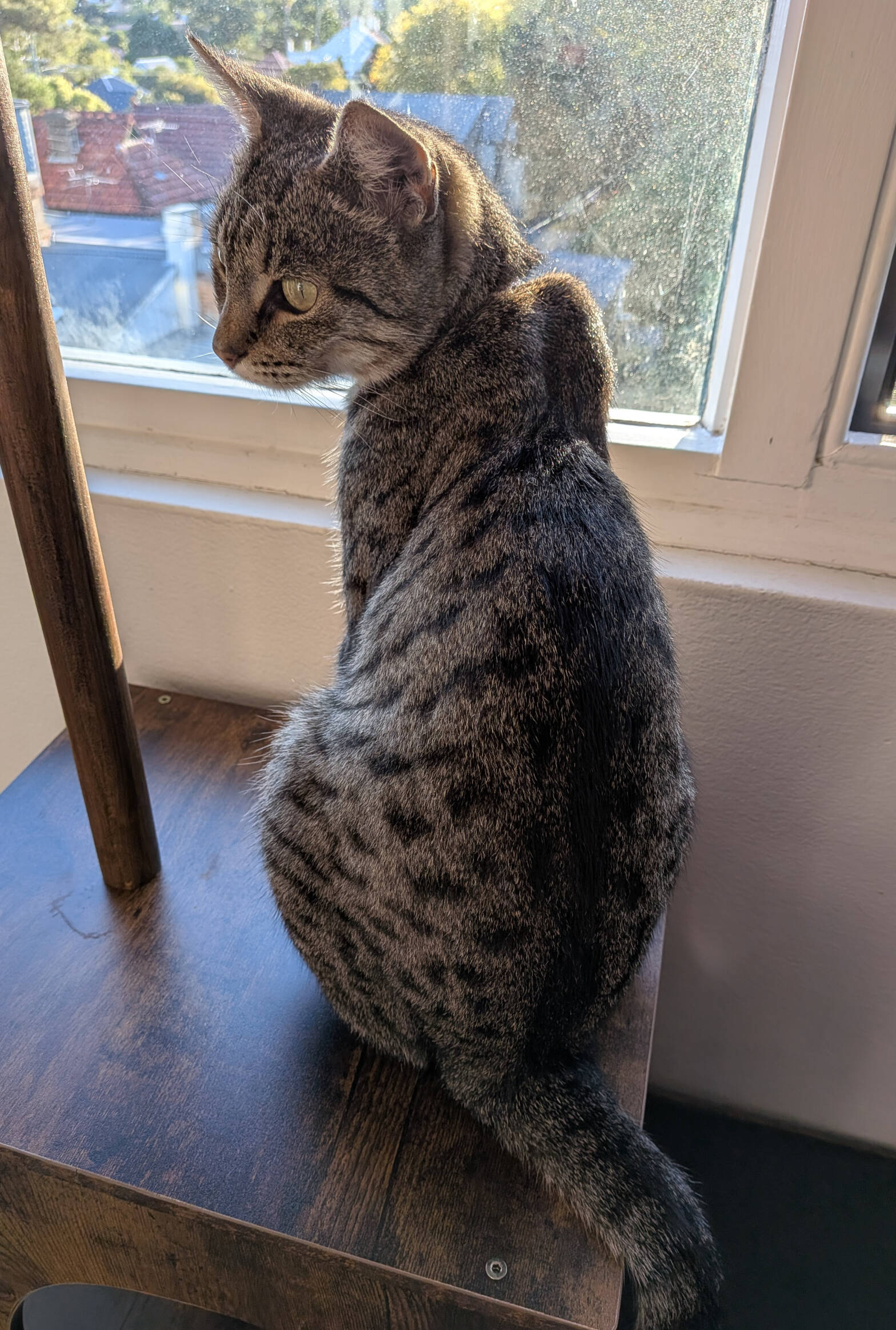
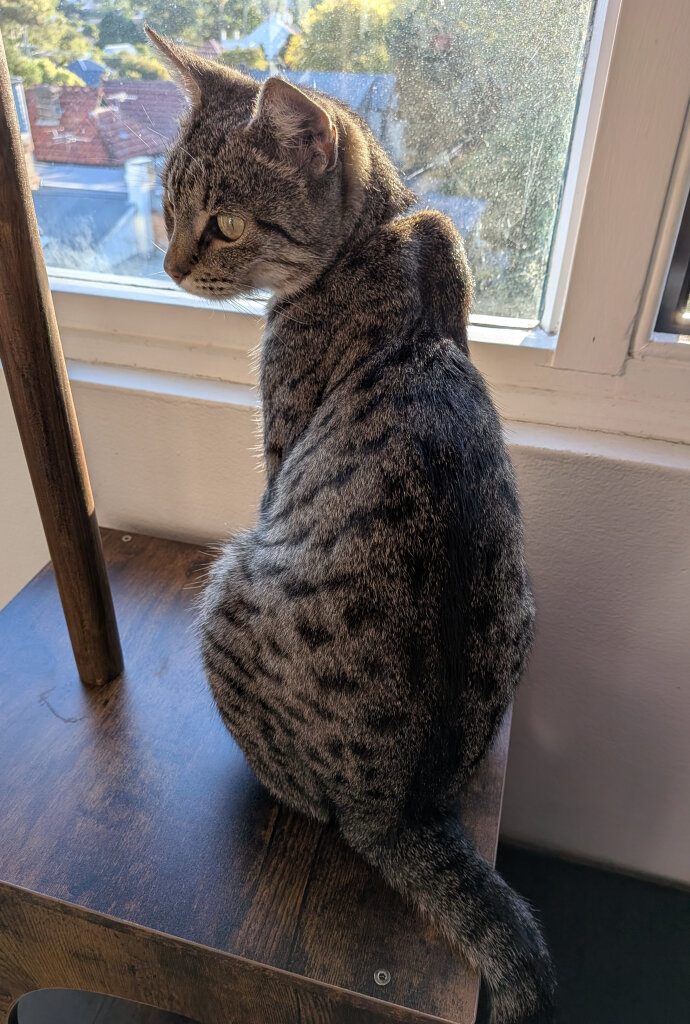
We adopted a cat five weeks ago. Her name is Mimi and we affectionately call her Memes. She celebrated her 1st birthday this week.
I wonder about her life. About her past as a stray on the street. About what she really thinks of this apartment and these two humans that are now her loving companions.
Mimi is vicious when pouncing on a bee soft toy; tender when snuggling to be brushed. She closes her eyes and nudges her head towards the window to smell the outside air. She perches on a shelf and watches us go about our busyness. I bow to her while blinking slowly, doing my best to communicate love and safety.
Since Mimi has come into our lives, I’m moved by her softness and the raw animal of her being. I’m touched by the divine aliveness that fills her graceful movements.
I’m humbled by this creature that depends on me to survive. I come across a reddit thread asking what to do in their cat’s last days. I know it’s likely I’ll outlive Mimi and be witness to her death. The sadness I feel is poignant and clarifying: I choose to move closer and to love her more even though it risks greater pain.
I sit quietly and consider this imaginally. Mimi offers herself to my imagination. The image of self, other, and world has shifted to include her. The threads of my life are now interweaving with Mimi’s. A new meaningfulness unfolds, felt but not named.
Where there is love there is image. When we open to something and find this sense of love, we can recognise that the imaginal is working away in the background, concocting a sense of things, finding our place in the world.
This is a different move from reducing suffering or letting go of clinging. Sometimes it also opens us to grief and pain — there is always that risk. What it promises in return is deep meaningfulness, found in the particulars: softly breathing curled up in a ball, meowing in excited greeting, yawning after a long nap.
—
The meditation workshop on Imaginal Practice I’m leading is coming up next week. If you feel the world offering itself to your imagination, come explore with me.
I never met my Uncle Chwan. I’ve only seen a small sepia-tinged photo of him on the altar at my Aunty’s house, next to photos of Ah Ma and Ah Kong, my paternal grandparents. The second youngest of eight siblings, he was kind and gentle. My Dad and Aunty talk of their little brother as the nice one of the family. I can sense the truth in this.
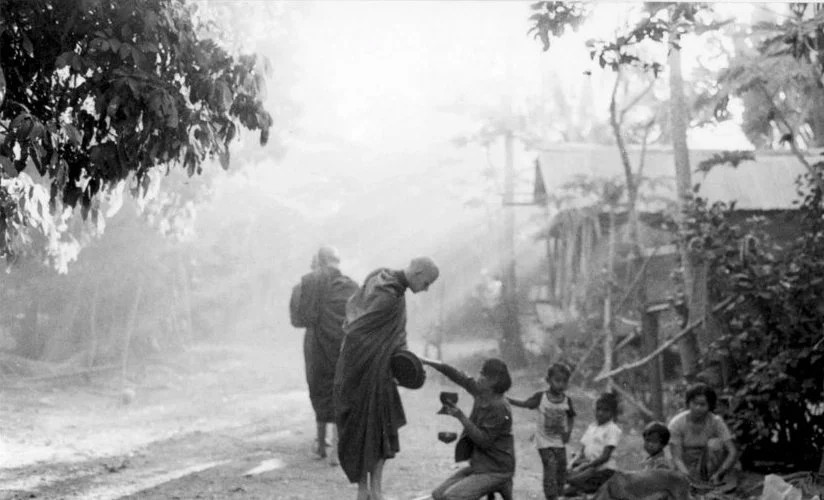
All eight of my Dad’s siblings moved from Malaysia to Australia to go to university. After graduating with an accounting degree, Uncle Chwan decided to become a Buddhist monk in the Thai Forest tradition. This was the time — the family was healthy and well, he’d finished his studies, and something called him to live a different life.
He travelled to Thailand to ordain in the Ajahn Chah lineage at Wat Pa Nanachat — known locally as the monastery for westerners. The details are cobbled together from stories I’ve heard from family and from a monk who was there at the time. To ordain he was required to arrive with few possessions and no money, taking motorbike rides through jungles, giving up everything he knew to live with strangers. He turned his life upside down at 24 for a chance to dedicate himself to something greater.
Uncle Chwan’s Dharma name was Nyanaviro in Pali — meaning “courageous in wisdom” or “one whose courage is knowledge”. This Thai Forest tradition is characterised by austere, relentless dedication to the path.
A couple of years after ordaining, Uncle Chwan became ill. The abbot of the monastery had encouraged the monks to be equanimous with their illnesses rather than seek medicine, a reticence to which Uncle Chwan was already inclined. When his illness got worse, he continued meditating in his kuti. After he didn’t come to the morning chanting and meditation, he was found dead by another monk.
It was incredibly rare for a monk to die so young. The monastery held a special ceremony and dozens of monks travelled from the surrounding towns to pay their respects. But almost all of my family couldn’t travel to such a remote place at that time. The cause of death was said to be encephalitis caused by malaria or rabies. If caught early, this could have been treated. Death by equanimity.
I’m haunted by his ghost. He first came to me in meditation cautiously, hesitantly. I was unsure of opening to this dimension and the image flickered and faded in turn.
Eventually I allowed the image to come. Uncle Chwan visits me — adorned in ochre robes, shaved head, thin-framed glasses. He sits by me. Sometimes he offers me a smile, or a gentle hand on my shoulder. I sense that he is always with me, a phrase I’d dismissed when hearing others talk about these presences. I feel held in a kind embrace, watched over. During a month-long retreat, I experienced so much pain and mental anguish that I felt close to giving in, but I continued on, comforted by his presence in my imaginal sangha. He sat among my field of support.
I can’t explain the tenderness and kindness I feel from this image. What I feel is love. I feel heartbreak. I feel a family that was shattered at his death and maybe never recovered. I feel both endless grief and limitless compassion. I break down into tears when I see his half-smile. I’m held in his Loving Presence.
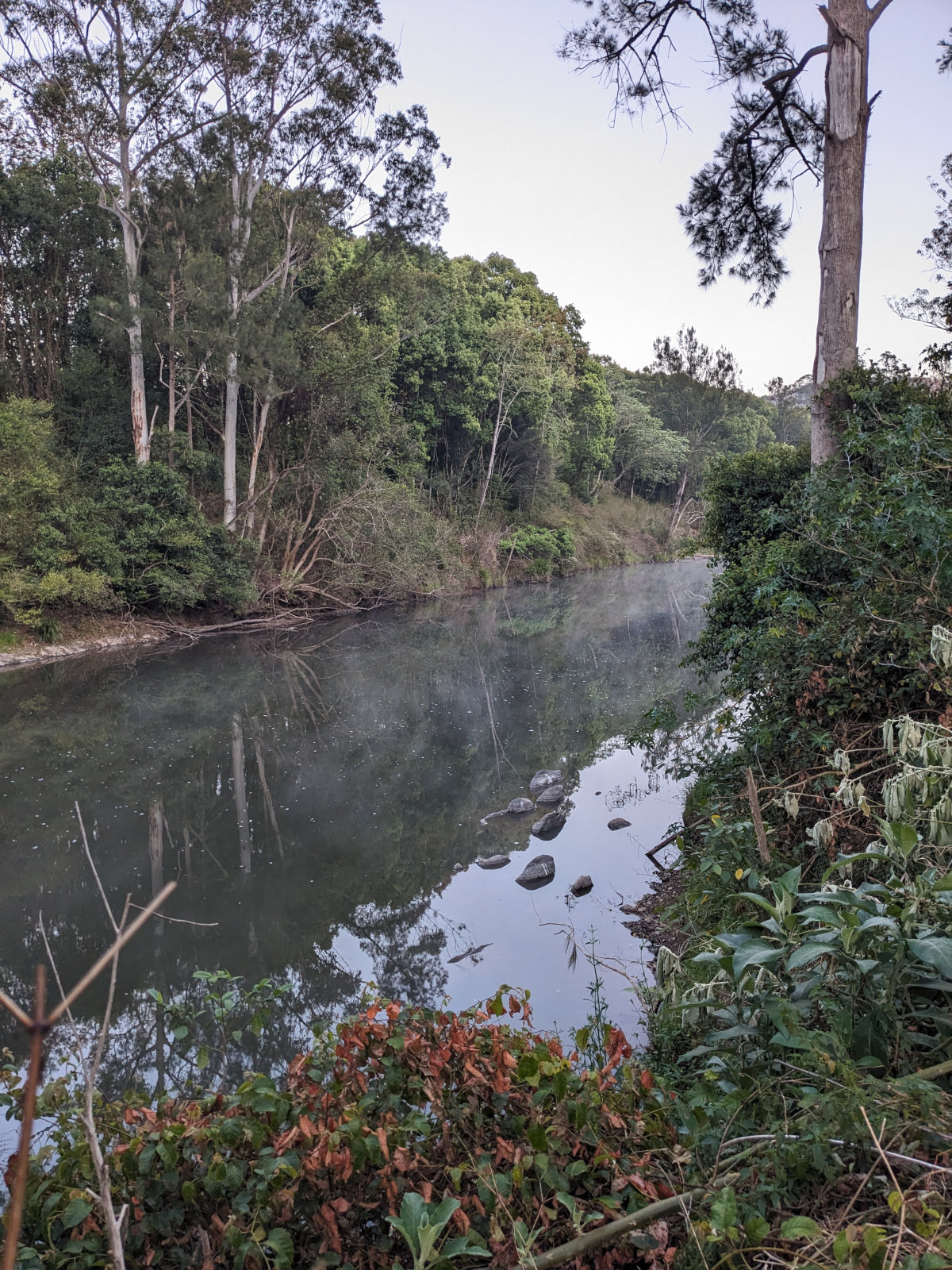
I’m 10 days into a 21 day silent retreat. Here with one dear friend, at another friend’s property on Birpai land. Each dawn and dusk my friend and I quietly make our way to the riverbank to try to get a glimpse of the platypuses playing in the water. They are shy and smaller than I expect – while keeping our distance we can only just make out their beaks and heads as they coast along the water, dive under, and resurface.
My friend leaves in the morning and we share a warm goodbye. I spend the rest of the day in a daze. Night falls and I settle in to sit. I reach for my shawl and find my friend has left me a parting gift: a block of vegan chocolate and a note of encouragement. I break down into tears, an overwhelming sense of being lost, lonely, and undeserving of such kindness.
The following day I stumble around. I question what I’m doing there on retreat. I wonder why I needed to leave my life in order to go be quiet somewhere far away. I doubt the value of practice and my own place on the path. I lose interest in the birds, the trees, the animals. My mind becomes a solipsistic, harsh desert. I realise I’m in a mini existential crisis. I hope it stays mini.
For solace, I turn to Rob Burbea’s Dharma talks. I bring my headphones and a cup of tea to the riverbank and find a stable rock to sit on, carefully watching for snakes. Rob’s soft, kind voice reaches across space and time, carried by scratchy audio recording. He speaks of being “in love with the way”, of cherishing the path itself, and how there are many different fantasies and myths of the path that we inhabit and take on. These images form the sacred ground of practice. We move between images of being healed, to the reverence of tradition, to being a scientific researcher, to seeing all of the path and life as art. I sense into how my own sense of the path had become small and contracted, not able to hold what was asking to come through. I sit with this, testing out different images of myself on the path.
I am an explorer of consciousness. I am a student of Dharma. I am a lover and mystic. I am an artist, creating a life. I am a servant of the divine.
I see all of these as true, as false, as empty, as image. They are vivid like rainbows in the sky, appearing but without solidity or fixed location. They have no independent existence, no basis of their own, yet they are alive and animating. They shift my way of looking. Each time I reorient myself I notice a different North Star, a different direction to head, new aspects to love and cherish about this life and path.
This immediately moves something deeply in me. I rediscover a love of practice. I see myself in a different light and realise that I don’t want to be nobody, and that my attempts have obviously failed.
In the years following the retreat, I continue unfolding imaginal practice. I notice that practitioners each have their own unique fantasy and myth of the path. To a large degree this image influences, if not determines, their engagement, fire, dedication, and passion for practice. It sets up how they will respond to difficulty, uncertainty, and suffering. I see students grind away, stuck between traditions, as well as those who happily dwell in the in-between spaces, letting their fantasy shift and grow.
I realise I’m being called to teach imaginal practice. I recognise that teaching this is challenging, and perhaps even disturbing for many people. However, the response has also shown that it is validating – confirming that people already encounter the imaginal in practice, without a name for it. There’s already a sense of the beauty and love available when allowing this in. The practice and teaching of the imaginal becomes part of my own image and sense of my own path. I want to point to something, to gesture towards this, to make something visible that is quite likely unexamined and unexplored.
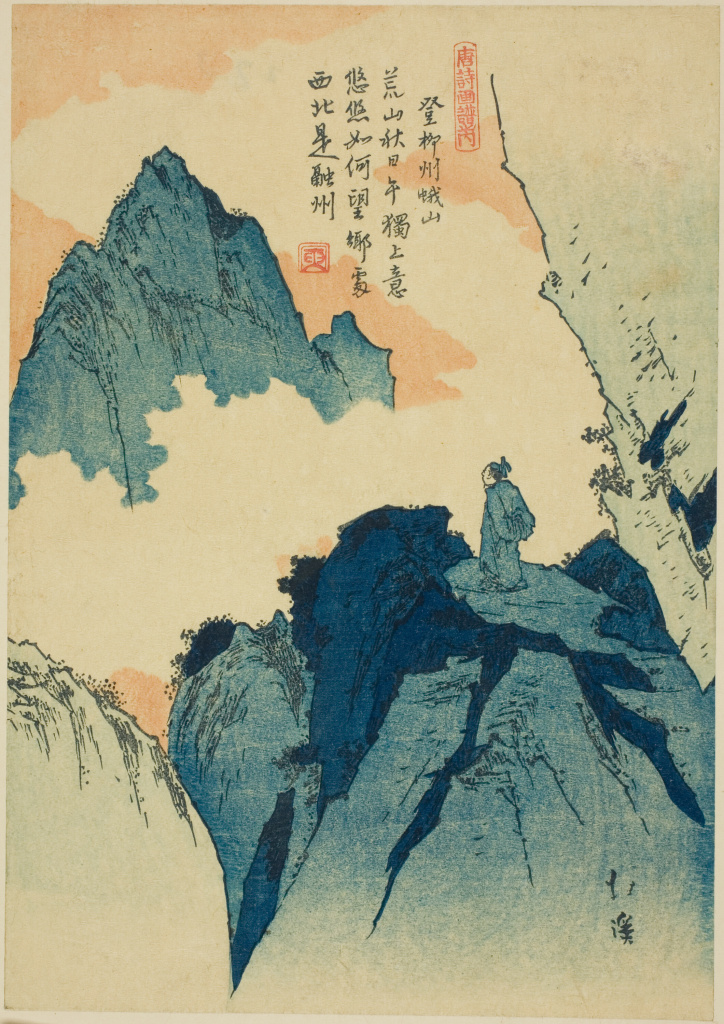
Imagine yourself atop a misty mountain, fog obscuring every direction. As you stand here, you know the terrain is complex — mountains and valleys, rivers and ravines. You gaze around and see only haze. Peaks rise over clouds, the way there shrouded in mystery.
“Wow, that’s some nice mist. Now mist that nice must be covering something pretty specky.”
Climbing a mountain in Liuzhou, from the series “Picture Book of Chinese Poems (Toshi gafu no uchi)” by Totoya Hokkei Original public domain image from Art Institute of Chicago
You know that you aren’t on the highest peak, yet it was a long climb to get here. It took everything you had, for all of your life, to move higher, to do better. Hesitant to begin descending, you take off your bags. You get cosy where you are. Thoughts arise in pensive moments: “well, this isn’t so bad, I’ll just make the most of this” as you open a can of beans from your stash. You’ve become stuck in a good place. Then something calls to you. The possibility of higher peaks. More mountains to climb. To more deeply know yourself. To see what you are capable of. To experience the full range of freedom and meanginfulness.
When you go to take the next step you realise it must be downwards. Stepping down is awkward and your feet hurt when landing on uneven rocks. Trying anything from here is a tad uncomfortable. Whatever comes next challenges you and makes you question whether to stay or try for the next peak.
This is where a guide comes in handy: someone who’s been to a higher mountain can share tales of that place, the path to get there, and what the view looks like from the next peak.
To follow the guide you have to be willing to trust — to set off on a journey that first leads down the mountain, then hopefully up the next one. You commit to following the path long enough to really see if it leads to a higher mountain. Without momentum, you’ll take a few steps then turn back. A good guide instils trust and confidence that each step has its place in the whole journey.
Rediscovering the Joy of Being Taught
For a long time, I attended teachings but they somehow didn’t land. Even when talks were interesting and enjoyable, I sat thinking “this won’t change my meditation tomorrow.” Worse yet, techniques would get mixed and I’d find myself looking for landmarks that were off in the other direction entirely. Something changed in the past 18 months. I’ve attended retreats and workshops where the teachers were doing something genuinely different. I rediscovered the joy of being a student and having things to learn. I delighted in the voyage to get to the next peak.
One time I was learning a new framing of the practice of calm abiding. I was already very familiar with this practice from another set of teachings. I found the first few meditations challenging — I was grinding through, trying to make sense of it, comparing and contrasting to what I already practised, thinking I’d made a mistake to ever leave my cosy hilltop. I was homesick. Realising that this was a golden opportunity right in front of me, I gave in to the new instructions; I trusted the guide. Once I stopped resisting, I quickly landed in effortlessness — not through sitting a long time as I had been taught, but through following elegant, efficient moves. This felt experience of tranquility is now right there, just a few steps away.
Rather than learning from a book, I was being welcomed into a new landscape and invited to play there. I was given new frameworks and maps, but more importantly, I was told where to step so I could feel it in my body. I could sense, in real time, how my understanding shifted and opened up.
From this experience I realised I could do more to show others the views I’d seen myself.
The guide first meets you exactly where you are. Then they point out the way to the next vista. Each step unfolds into the next. When you really land in where you are, the questions begin to form of where to go next, the fog opens up with each step you take until you are steady on the path under your feet.
Meditation Workshops
Let’s unfold a path of meditation that feels alive in your bones. We can walk the trail to the next summit.
My new offering is Meditation Workshops — a full day deep dive. The ask is a full day of your time for a chance to explore the teachings, coming out with a view from the top of a new mountain, and a map to guide you back there.
Feb + Mar — The Elephant Path of Calm Abiding Apr + May — Exploring Imaginal Practice Jun + Jul — Meditation, Emotions, and the Nervous System Aug + Sep — Cultivating Insight Through Ways of Looking Oct + Nov — Insight into Emptiness and Nonduality Dec + Jan — The Freedom of Spacious Awareness
These are on the first Sunday of the month, alternating in-person and online. There’ll be a curriculum with teachings on specific topics: instruction, guided meditation, q+a, practice pod chats, plus recordings and resources. Lots of chances to get support and guidance. Coalescence Sangha will also explore each theme in the lead-up to each workshop.
Okay that’s enough talking, let’s go explore some trails. I’ve got the map and I’ve packed plenty of snacks. Come join me and I’d love to show you some of the views that I’ve had the pleasure of exploring.
I’m sitting on the beige, scratchy carpet in the spare room of my unit in Maylands, a quaint-yet-growing suburb of Boorloo (Perth). I’m trying to meditate and have a growing sense of failure. I gaze at the light slowly crawling across the carpet. Restless and bored, I get up and do something else. Maybe meditation just isn’t for me.
Much earlier, I’m sitting on another carpet. This time I’m young, maybe nine years old, and Dad has offered to teach me to meditate. I’m thrilled, it’s all so mysterious to me. What happens when Dad goes off and sits quietly in the evenings? It could be anything! We sit on the floor in the front room of the house with the lights dim. Dad guides me to notice the sensations of my breath. I picture it like I’m watching an animation: breath coming into my body like flowing coloured lines moving through my nose, filling my lungs, then releasing on the exhale to rejoin the atmosphere. I enjoy the feeling of being calm, but I get sleepy straight away. I also feel like I’m somehow doing it wrong — I’m picturing something but it feels like I’m making it up, using my highly active imagination instead of doing it “properly.” Is this what meditation is meant to be? In the ensuing years I only meditate when in bed as something to do while waiting for my mind to drift off. I don’t recall us sitting together again.
I’m in a chair gazing over a busy Sydney street on a cloudy weekday afternoon. The recent move has been challenging and I’m in the middle of a spell of depression and anxiety. I can’t seem to break out of feeling this way through my usual methods and I’m starting to feel desperate. I come across a book: “The Mindful Way Through Depression.” While it sounds like it’s just what I need, I’m short of spoons and can’t summon the energy to get further than the title. Instead I read a short article online, remember yoga teachers talking about mindfulness, and try to do a practice. I bring my mind to the present moment sensations. I watch myself from a more objective viewpoint. I see myself drinking tea, walking up the stairs, feeling sad, obsessing about a stressful event. I watch a thought arise and pass and suddenly feel a freedom and relief I haven’t felt in ages: I don’t need to be so caught up. But this is only fleeting, fading away mere moments later. After I stop practising I’m right back to rumination. I know that if I could continue this mindfulness it would help but have no idea how to make it stick. It feels like I opened a doorway to a vast beautiful view that closed again in the blink of an eye. I have no idea what the key is to get the door open again, or to keep it open.
In each of these scenes, I felt like I had started school without books, anything to write with, or language to communicate with others. Without a framework and map, I got lost at every turn.
//
Once I got my head above water from the period of depression, anxiety, and burnout, I had a moment of insight. I realised that I needed to find some way of working with the mind. It was suddenly clear that my mind was turning an objectively good life situation into something miserable. I felt like I was stuck playing a cursed game that I had invented; I was trapped in a prison of my own creation. Something in how I was relating to experiences wasn’t working. I knew I needed something that would help me learn from these experiences.
A friend happened to give me a copy of the book The Mind Illuminated and I began practising consistently. I moved up and down the stages of The Elephant Path. The guidance I received in that book, combined with a few chats with more experienced practitioners, brought the practice to life. As I sat, I felt more calm and clear. I learned how my mind could so easily shift into criticism and place blame on myself, or feel responsible for things I couldn’t control, such as a moment of distraction. I saw, moment-by-moment, how my mind constructed this prison.
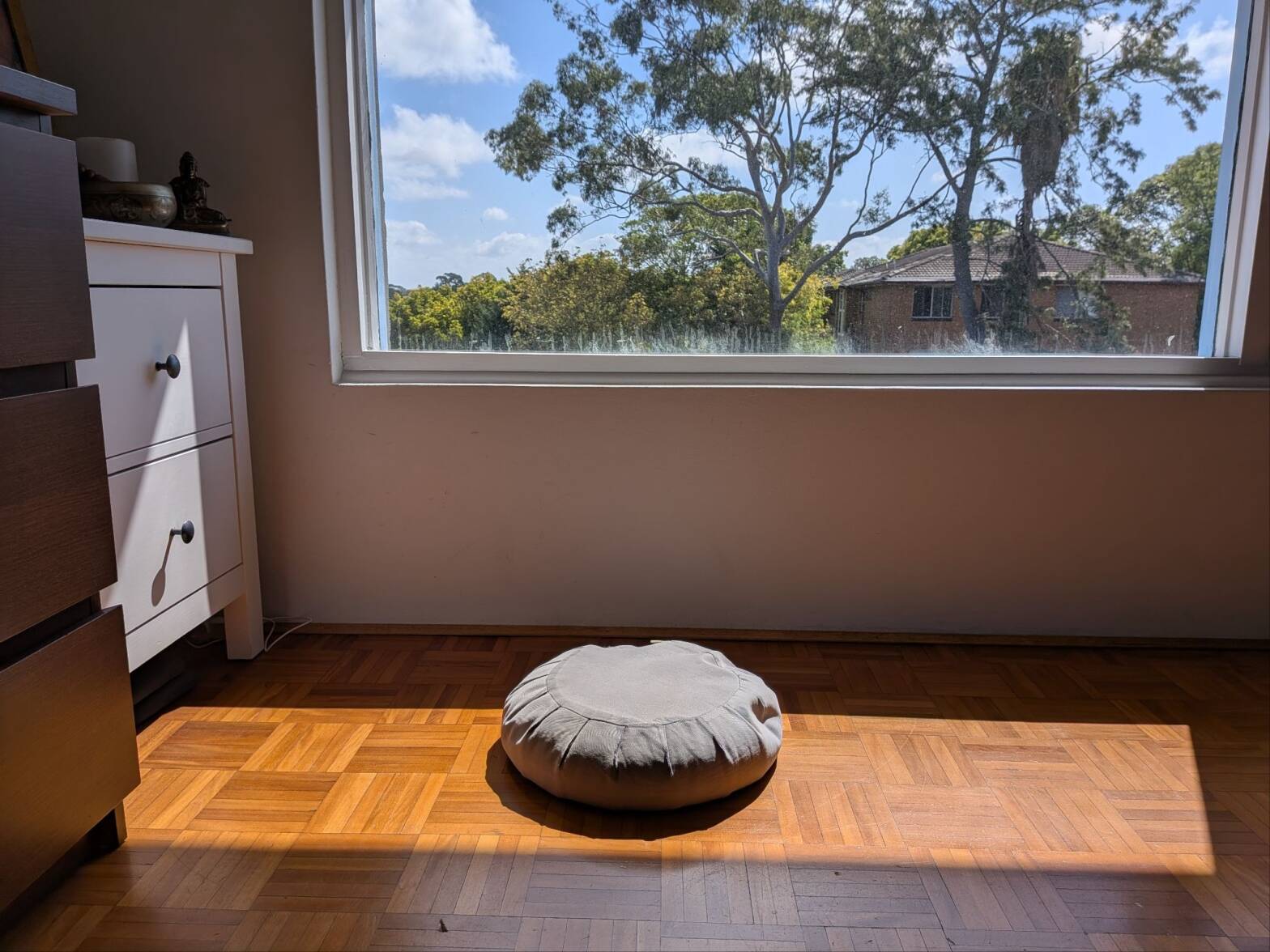
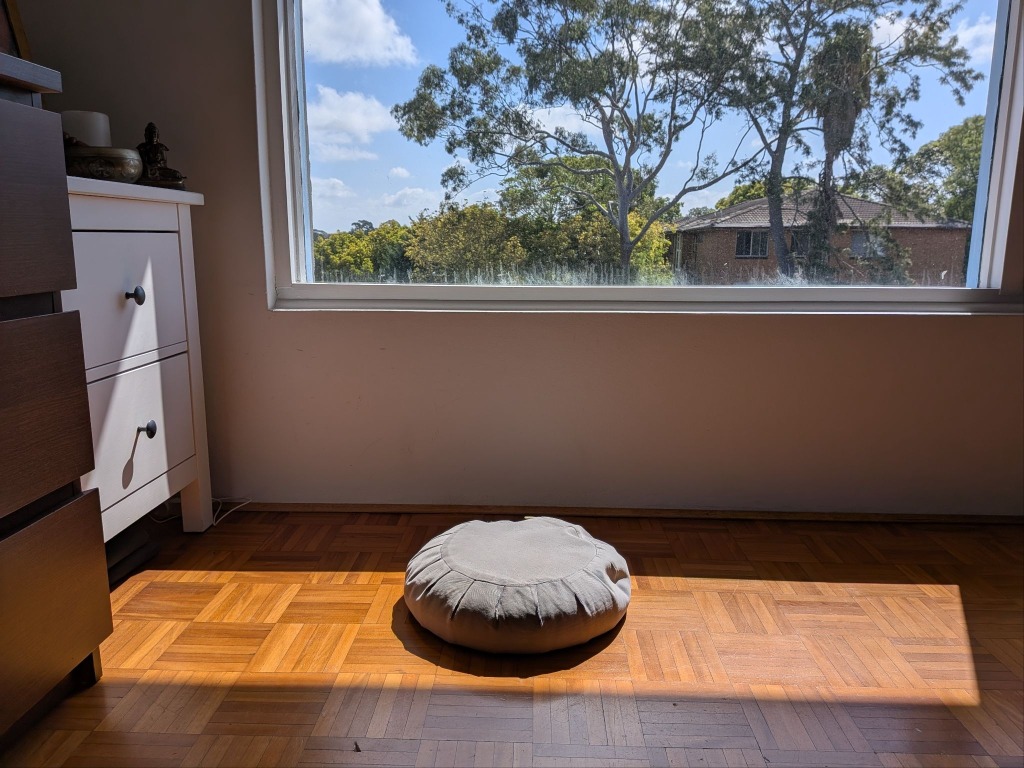
One morning a few months later I’m sitting on a cushion, this time on parquet flooring. I observe the sensations of the body and the breath. I watch thoughts about my unfinished thesis chapter, what to cook for dinner, an idea for an artwork. There’s a gentle sense of calm and comfort. The bell goes off after 45 minutes and I open my eyes to a soft light angled in through the apartment window. I take a moment to appreciate the warmth of the rays in the cool air. I realise that I’m just…fine. It’s another day and my mind isn’t a bad place to be.
Over the months that followed, I knew that I’d never experience the same difficulty with anxiety and depression. Each day, each week, I noticed the patterns of the mind and saw how intention and attention shaped my world.
//
Looking back, it became clear that I was lucky to find a foundational practice that helped make meditation not only function, but also to feel good. The Buddha said that practice should be “good at the beginning, good in the middle, good at the end.” That on its own is a vast beautiful view and a doorway worth opening.
I’m delighted to go back to my roots and to bring this practice to life through a full-day of exploration on the 8th of March. Come join me : )