“If you wish to make an apple pie from scratch, you must first invent the universe.”
– Carl Sagan, Cosmos
Feel the breath. Not just as sensation, but as something arising out of everything else. Lungs. Air. The trees.
This breath leans on all the breaths before it. Thousands upon thousands.
The feeling of sitting. A sound from outside. The mood you’re in. Each one held in a web of causes and conditions. The specifics don’t matter. Feel the web.
Then watch for the next thought. Where did it come from? You didn’t decide to think it. Leave it as it is. It belongs too.
Open out. Spacious, at ease. Look past the separate things.
What if this moment is made in relationship with everything?
When you open your eyes, notice how things appear.
The Great Way is not difficult for those who have no preferences. When love and hate are both absent everything becomes clear and undisguised. Make the smallest distinction, however, and heaven and earth are set infinitely apart.
— Sengcan, Hsin Hsin Ming
Sound and silence. Calm and agitation. Pain, and what is not pain.
Each one known only against the other.
For a while, try having no preferences. No likes, no dislikes. Just being.
Feel what’s here, murky and hard to name. Ask, can I be with this?
Notice the mind wanting stillness, pushing restlessness away. Soften around the wanting.
Then relax the distinction itself. Put it down, like a heavy bag.
No self. No other. All just happening.
When you open the eyes, look for where the meditation ends.
A chariot cannot be said to be different from its parts; it is not identical with the parts, nor does it possess the parts.
– Chandrakirti, Madhyamakāvatāra 6.151
Look for the self the way you’d look for the chariot.
First, call it up. Recall something from today and notice where you held on – this is me, this is mine. Or picture yourself sitting across from you, as in a mirror. Or imagine someone pointing at you and shouting, thief! Something rises to defend. What is it protecting?
Notice how it feels. Continuous. Solid. Standing on its own.
If a self like that were real, you could find it. So search.
Start with sound. Is the bird song you? The hum of the fridge? Then the body: pressure, warmth, the texture of your clothes, the tightness in the shoulder. Then feeling. Call up a little joy, a little sadness. If you were a feeling, which one would you be? Then thought, and the narrator, and whoever the narrator is talking to.
Is there anywhere else to look?
Take each layer slowly, until you’re certain.
Where the self appeared to be, a spaciousness. Rest there.
The self comes back, like a rainbow. Vividly appearing.
Whatever is not yours, let go of it. Your letting go of it will lead to your welfare and happiness for a long time.
– Alagaddūpama Sutta, MN 22
Not me. Not mine. Uncontrollable.
Take up a lens that sees all experience as not-self.
Start with sound. Sounds are just happening – you don’t get much say in them. Listen to the whole soundscape at once, and touch it with the phrase, lightly, like brushing it with a feather.
Then the breath. If you were the breath, which breath would you be? This one? The next one?
Then feeling, the texture of what is felt. Then thought. You didn’t decide for the next thought to be there. It comes from everywhere.
Then turn toward the one meditating. The thinker, the observer, the one sensing. Where is that? How do you actually experience it?
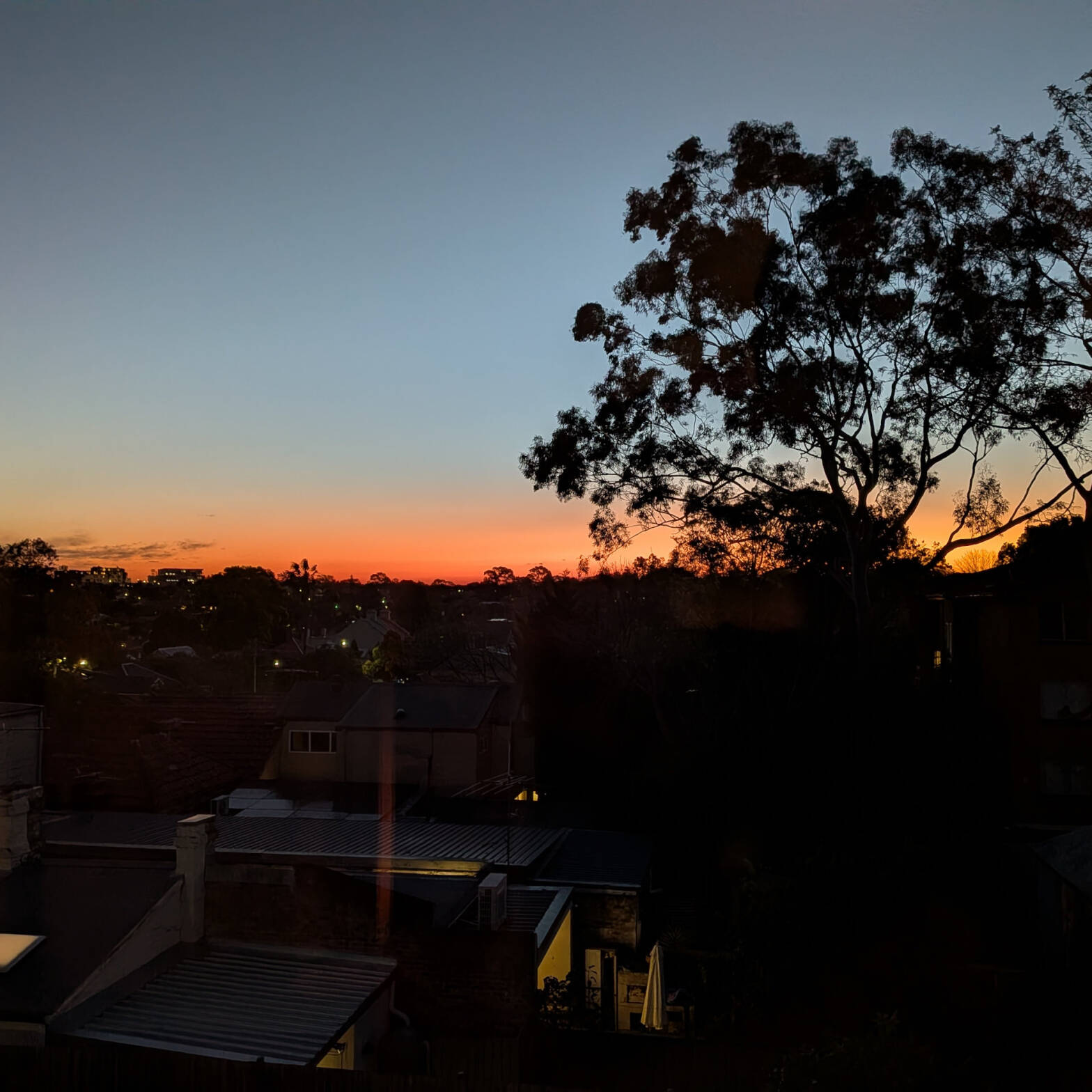
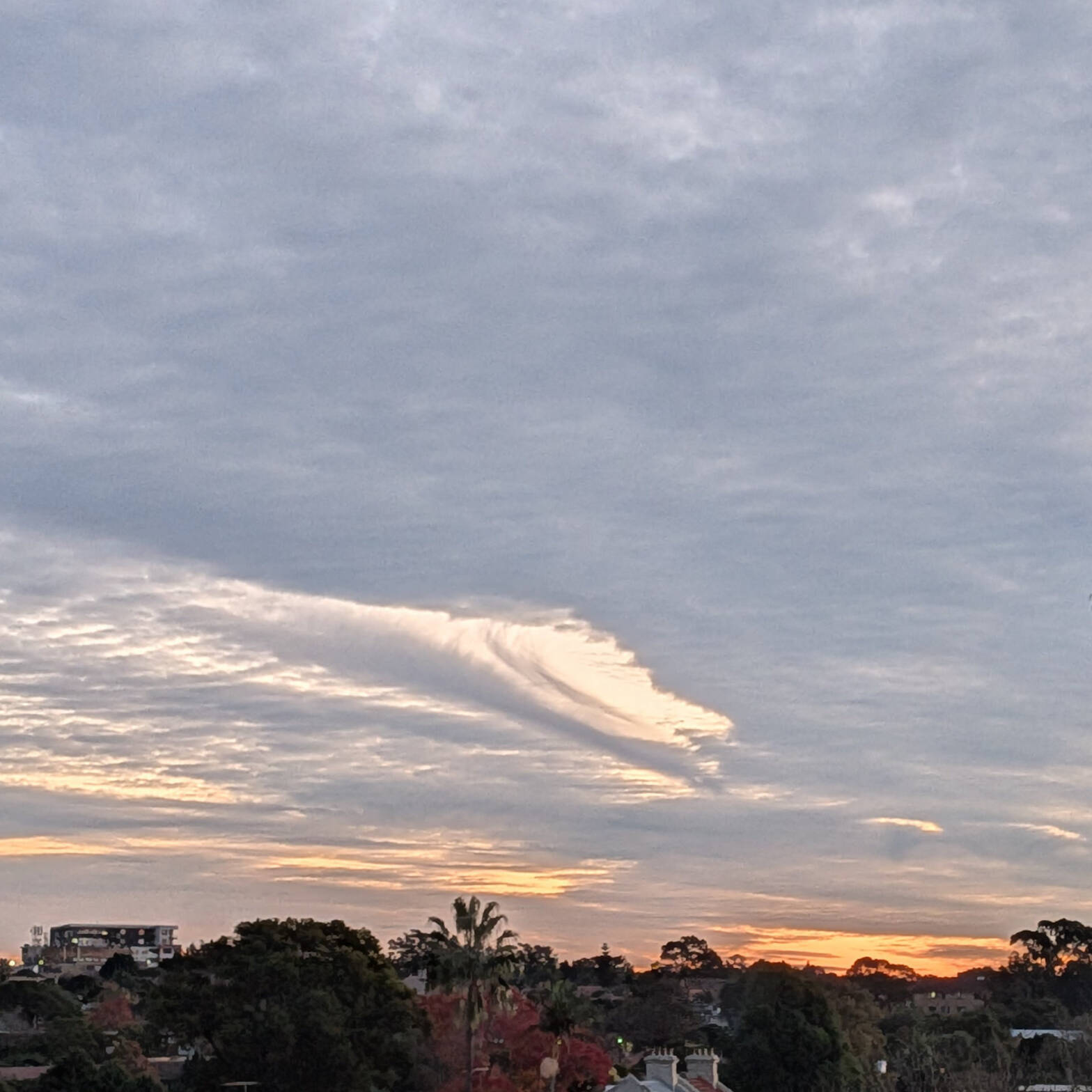
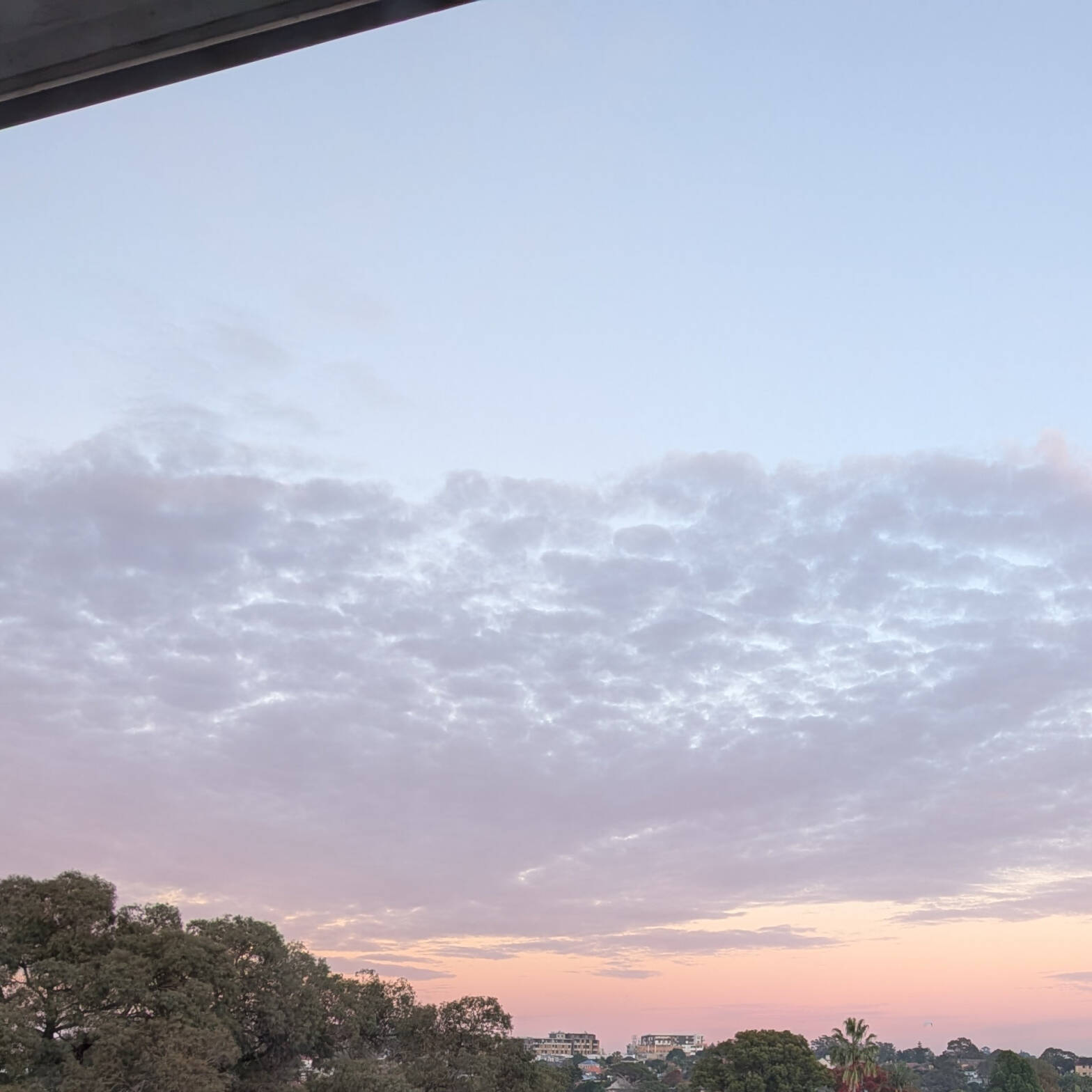
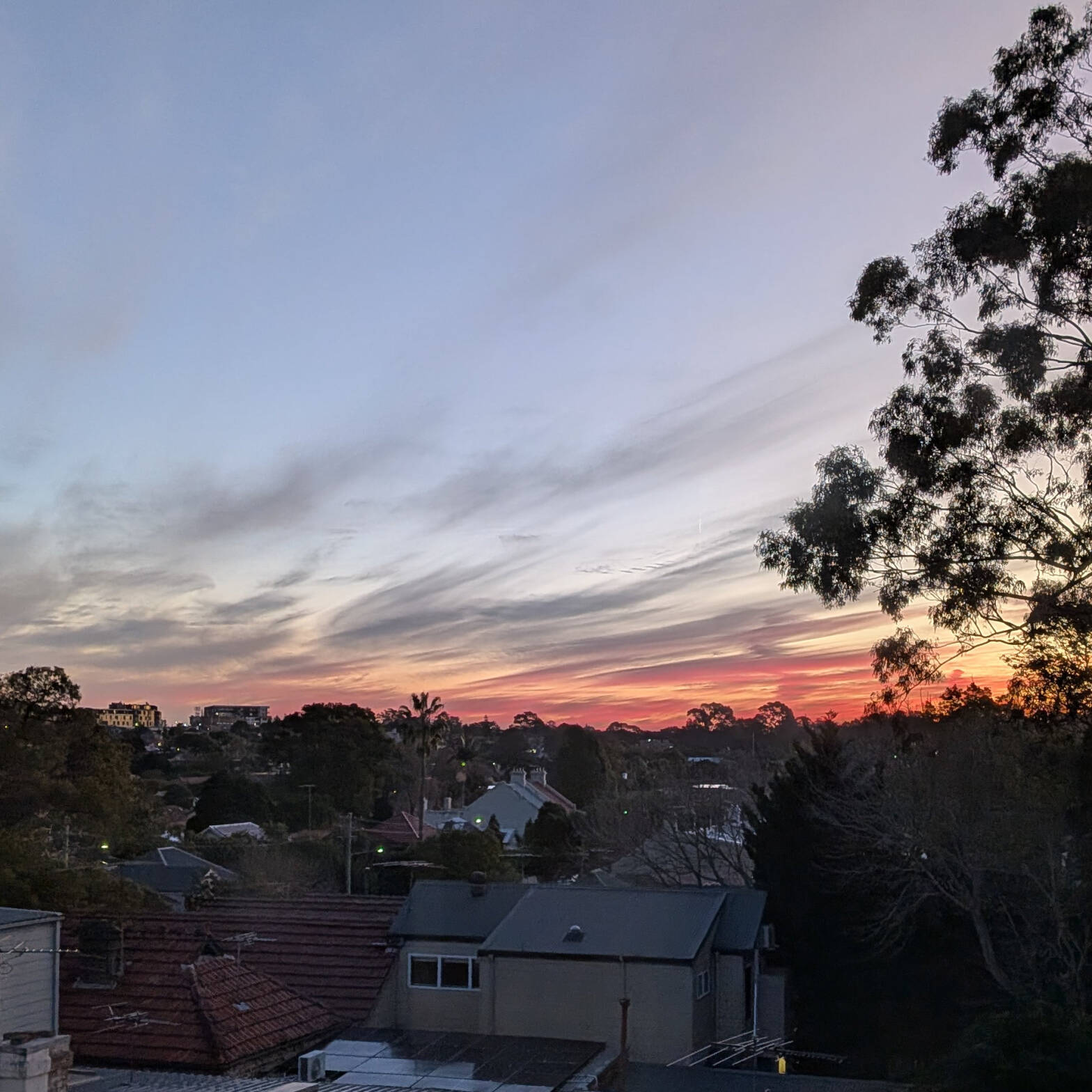
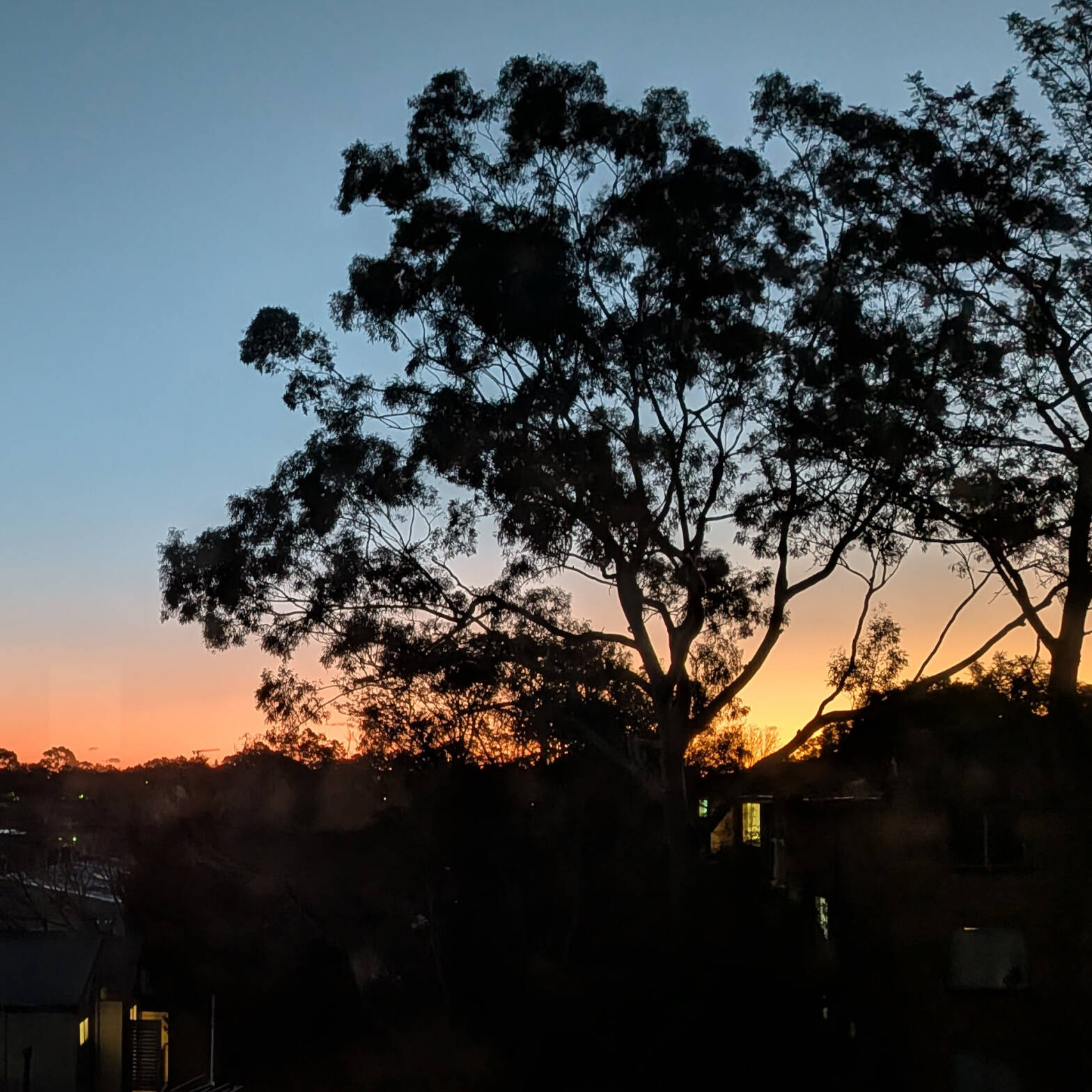
A sunset. Vividly appearing, and you can’t hold onto it. Unhook, and notice what this way of looking does.
There is still knowing, bright and clear. Open the eyes, and notice what things look like now.
No one lives his life. Disguised since childhood, haphazardly assembled from voices and fears and little pleasures, we come of age as masks. Our true face never speaks.
– Rainer Maria Rilke
Before you sit, grab a pen and write down your qualities and roles. Kind, caring, prickly, pedantic. Teacher, parent, neighbour. The ones you have applied to yourself, and the ones that have been applied to you. Then place the list to the side.
Settle. Let the whole body hang off the skeleton, filled with bright awareness. Tune into the gaps, the little space between the sensations, between the thoughts, between the feelings.
What is your sense of self right now? Maybe a thought. Maybe a density, a contraction. Maybe an image of yourself meditating.
Glance at the list. Are you being those things right now? Are you being caring? Are you being a friend?
They vividly appear. Yet there’s no core you can find that really is that.
Unhook. Put it to the side, and notice what happens.
A wooden chair on a bonfire. Flames lap at the frame, a leg falls into the ash, then the whole frame collapses. At what point is it no longer a chair?
Settle first. Let the body be heavy and relaxed, filled with bright awareness. Then bring forward your usual sense of self. Where do you locate it? Behind the eyes, in the heart, somewhere just above the body?
Now, lightly, as an experiment, let your right leg vanish into open space and be replaced by a whole new one. Then the left. The arms. The heart. An eye of a different colour. Half the brain, then all of it. Are you still you?
Look at the screen. Faces, a room, someone talking. Now find one small patch of it and see only colour. Points of light. The mind has to reach in to make those points into a person. Tune into that reaching, and the screen starts to thin. Paper thin.
Settle first. Let the body be heavy and relaxed, filled with bright awareness, until the whole body is held at once. Then notice how things appear now. Whatever you arrived carrying may have a little more room around it. Nothing was removed. It is being built differently.
Try seeing the body as empty. Not as an idea – as a way of perceiving. Notice what happens when the word itself arrives.
Whenever there is belief that things are real, desire and hatred are generated. Without that belief no defilements can occur. And when this is completely understood, all views and afflictions dissolve.
– Nāgārjuna, Yuktiṣaṣṭikā (translated by Rob Burbea)
Something in you may lean towards this. Something else may pull back. Fear, excitement, a voice saying this is too big to begin. Let each of them be here. How do you see yourself, standing in relation to this?
Then take the view, lightly, as an experiment. Everything you are experiencing lacks inherent existence. Vividly appearing, yet insubstantial. Points of sensation, glued by the mind into a self and a world.
In reference to the seen, there will be only the seen. In reference to the heard, only the heard. In reference to the sensed, only the sensed. In reference to the cognized, only the cognized.
— Bāhiya Sutta (Udāna 1.10), translated by Thanissaro Bhikkhu
Nothing added, nothing pushed away. When a sound arrives, note it lightly: hear. Not the car or the voice, just the act of hearing, acknowledged and let go as the next sound comes. With eyes open or closed, see. Light, darkness, colour, shape. Then the body — the contact where you are held up, the hands, the breath. Feel.
Then turn inward and find the same three. A felt sense in the chest, an emotion hard to name: feel in. Rest attention where thoughts seem to happen and wait, as if in the cinema of the mind. A picture of dinner arrives. A voice says you have to cook something. See in, hear in. If you get caught up, replay the last moment. Was it an image, a sound, or a feeling that drew you in?
Is there anything you know that did not come through the senses?
Just seeing, hearing, and feeling, with no you in it. Then open your eyes, and keep looking this way.
You cut your fingernails and brush the clippings away. A moment ago they were you. You don’t go back for them.
Settle. Let the body be heavy, the belly soft, awareness wide enough to hold the whole of it. Then listen. A car, a voice, the hum of an appliance. As each sound arrives, label it silently and lightly: not me, not mine. This one is easy — obviously the sound isn’t you, obviously you can’t keep it. Notice what happens when you say so anyway.
Widen from there. The pressure of sitting, an ache, the rise and fall of the belly. The breath has been going all day without your permission; the air was outside a moment ago and will be outside again. If you were going to possess a breath, which one would it be, and how would you hold it? Then feeling — warmth, unease, whatever tone is here — already shifting as you turn to look. Then thoughts. Where did that one come from? Was there a decision before it arrived? Thoughts happen on their own; we take the credit after the fact.
Then look for your sense of self. It might be tight, everything glued together and about you. It might be loose and open. Either way, it is arising. Not me, not mine.
Nothing here is being got rid of. A rainbow is vividly there and has nothing solid in it. Open your eyes, look around the room, and keep looking that way.
A motorbike starts up in the street. You hear it, and then it is gone. You were never going to hold onto it — you couldn’t have, even if you’d tried.
Settle, and let the mind fall open. Now listen. Traffic, a bird, the hum of an appliance. Let awareness grow until it is big enough to hold all of it, then listen for the silence — in the gaps between sounds, underneath a sound while it is still going. Sounds arise out of that silence and fall back into it. Impressions in awareness.
We start with sound because sound is the easy case. Widen from there. Visual forms, reflections on the surface of a lake. The body sitting and breathing, every sensation arising inside an awareness bigger than the body. The feeling of this moment, whatever tone it has. Thoughts, each with its location and shape, and a glimmer of stillness behind them that they return to.
Then look for your sense of self. It may be subtle, barely more than a feeling that this is you. It may be coarse — craving, aversion, thoroughly identified. Either way it is sensation, feeling, and thought glued together with a label stuck on it. Me. That is just happening too. You do not need to grab any of it. You do not need to hold it still.
Rest as the awareness it all happens in. Then open your eyes, look around the room, and carry the view off the cushion.
A sound arrives. A car in the street, a bird, someone moving in the next room. Can you hear it through love?
Settle first. Let awareness fill the body part by part until the whole space is bright, then rest with the overall feeling of it — rich and complex, or vague and murky, or beyond words. Whatever is here is fine. Keep the body as your base.
Now imagine the space around you as filled with golden light. Awareness itself, warm and bright, as though you were submerged in something viscous and gold that nourishes every cell. Each sensation arises into that warmth, saturated by it, and falls back.
Whatever appears, welcome it. Each sound. Each visual form. Each sensation in the body. May this be welcomed. May this be held in loving presence.
Include the resistance — the agitation, the boredom, the part of you that doesn’t believe this is possible. Welcome that too.
Then take the view that the warmth is not yours to generate. Awareness is doing the loving. It is all around you, through every cell, and it is holding you.
Let yourself be held.
Come back to the felt sense of the body. Notice what has softened, and what has not.
Something has bothered you and the thought will not stop turning. The body is tight, the shoulders drawn in, the world narrowed to the size of the problem. On another day you are out walking and everything is roomy and unhurried. The difference is the grip.
Clinging, craving, aversion, grasping — different words for one movement: taking hold of experience and trying to keep it fixed. It is felt in the body. Which is useful, because what is felt in the body can be released there.
Settle, then let awareness fill the whole body, part by part, until the whole space is bright. Tune into the felt sense of it — the overall tone, like dialling in an analogue radio. Notice the clear sensations, and what is vague and murky. Whatever you find is fine.
Now look for the holding. A contraction somewhere. A pull for this to be other than it is. It is in thought too — the mind solving, fixing, reaching towards something later. Find it. Stay with it a moment.
Open, soften, allow.
Take resistance the same way: soften around the sleepiness, the agitation, the doubt. Let it be here. Take the pleasant that way too. Released from the grip, what is pleasant tends to open further; what is unpleasant tends to dissipate.
Then feel the whole body again. Tight, or roomy. Solid, or moving.
You do not let go. You stop holding on.
Drawn from Rob Burbea’s teaching on ways of looking.
A sound wakes you in the night. Nothing much has happened, and within a minute the body is tight and the mind is looping — what was that, who caused it, why this, why me. Hours later you are walking in the sun and everything is fine. The body is open. There is nothing to cling to. Same person, same day.
Place a number between zero and ten on what is being felt. Zero: the self-sense faint, thin, perhaps completely gone. Ten: contracted, fixated, everything is about you. Most of the time you are drifting somewhere in the middle without noticing.
Sensation first: what you can hear, see, feel. Then feeling — not the story of the emotion, just its energy in the body. Then thought: distinct images and inner sounds, or a stream bubbling away.
Then ask: what is my self-sense right now?
It’s a strange question. It doesn’t land the first time.
Now watch how the mind binds it all together. A sound, an agitation, a thought about who did this — glued into a solid, fixed, “you”. When the gluing runs unwatched, the contraction is strongest. See it clearly, and relax.
Suppose a magician were to hold a magic show at the four crossroads, and a keen-sighted person were to see it, reflect on it, and examine it radically. Even as they see it, they would find it empty; they would find it hollow; they would find it void of essence.
— Pheṇapiṇḍūpama Sutta, SN 22.95
Examine the self-sense that closely and release clinging. Not gone — vividly appearing, but without the solidity it seemed to have. Rest as what knows this.
See through the lens of change. Sounds arise out of silence and disappear back into it, and even the constant ones waver. Bring the body forward: look at the edge of a sensation that feels solid, and find the flicker there. You never take the same breath twice. Then thoughts — each with a beginning and an end, or one stream, flowing, never the same for long.
The mind gives solidity to what has none. Look this way for a while and notice what loosens. There is often relief in it: nothing here to hold.
Then open your eyes, and notice what lens you are looking through now.
— Vajrachedikā (Diamond) Sūtra, translated by Rob Burbea
When your experience of life deviates from life as it objectively is, the lens is revealed. Between the world as it is and the world as you meet it, there is a way of looking. It involves everything: from how you have slept to your beliefs and emotions. Like squeaky-clean glass, you look straight through without noticing it.
Sense what is here now. A warmth, a tension, a sound, a passing thought. With each, notice its tone: is this pleasant, or unpleasant? Stay for the small movement that follows — the mind leaning in toward what it likes, drawing back from what it doesn’t, quietly sorting the world into good and bad.
That leaning is the lens. When you catch it, relax. Let the pleasant be pleasant without chasing it, the unpleasant be unpleasant without turning away. If resistance comes, let the resistance be here too. Then take one step back toward the thing itself, before the mind decides what to make of it. Even here, the lens is shaping what appears.
Find one steady thing. Your seat, the uprightness of the body, or an object across the room. Notice the solidity already present. Rest your attention there. Borrow its steadiness, and let it spread.
Thoughts will come, wanting to be solved, wanting to carry you off. You don’t have to feed them. Each time you notice, that noticing is a fork in the road — be glad you caught it, and choose to come back to what is steady. It doesn’t matter how many times.
This is a way of looking: not something you force, but a stance you take, and then wait. Give the body, the heart, the mind their time. Peace of mind is only a short way off, on the other side of habit. Get out of your own way and the system settles on its own. The steadiness was always its birthright.
Someone I loved once gave me a box full of darkness.
It took me years to understand that this, too, was a gift.
— Mary Oliver
We learn early to feel the good emotions and put the rest away, so that we are easy to be around. Fear, anger, sadness — set aside, the lid held down.
Here we lift the lid. From a ground of stillness — the weight of the body, the breath, somewhere in you that feels stable — we turn towards a feeling we would rather not feel. Not somewhere safe, exactly. Somewhere brave enough to feel it.
Evoke a scene. Recall a memory. Let the feeling come, and let it be here — not pushed away, not acted out, but received as a signal, something deep in you speaking for a reason not yet clear.
Then look closely. Where does it live in the body — warmth, pressure, weight? Notice it is already changing. Search for the anger, the sadness, the fear itself, and find only sensation, shifting. Search for the one who feels it, and find no one there.
9:00 – 5:00 pm Sydney time Sunday 6 September 2026 Online via Zoom
Description
You’ve been practising meditation and cultivating some calm and stability. You can sense that practice is doing something real. After sitting, you feel better. Somewhere along the way you heard that insight is where the deeper, longer-term shifts happen — the seeing-through that changes how you experience yourself and the world. But insight has stayed opaque. It’s hidden in dense books, unfamiliar terms, and pointing that never quite lands as something you can do yourself.
This workshop is a way into insight meditation as a practice you can understand and work with directly. The ground is a simple reframe, drawn from the teaching of Rob Burbea: meditation as a way of looking. How you attend shapes what appears. When you learn to look through particular lenses, experiences that felt solid and fixed begin to soften and loosen.
We’ll work with a map of how experience gets built — a spectrum running from tight and contracted to open and spacious. The Buddha’s four noble truths give the why: where there’s clinging, more is fabricated; as clinging releases, experience loosens and frees. From there you’ll practise two ways of looking, seeing through the lenses of impermanence and unsatisfactoriness. Turned towards the sense of self, these same lenses start to loosen how solid “you” feel — the first openings of not-self. The way you’ll know it’s working is bodily: a felt sense of relief, of release, as things become less solid. These are the foundational practices that open doorways towards emptiness — the deeper freedom the traditions point to.
The aim is that you leave able to practise this yourself: a map, a handful of tools, and enough of a taste in your own experience to keep going. Through curiosity and experimentation you’ll test these ways of looking and gain confidence from directly recognising how insight is practised and the difference it makes.
About this format
This workshop is taught through embodied experience: guided meditations that point out key insights, supported by talks, Q&A, grounding movement and breathwork, and group exercises.
You are asked to participate by engaging in the practice for first-hand, direct experience. You are also asked to bring your questions and practice experiences to group activities and to listen generously as part of the community.
The event is structured as a full day to provide the opportunity for deep focus, while you temporarily put aside other concerns.
Please attend for the whole day. It can be highly beneficial to be in silence for the day, and especially to minimise technology usage. However, full silence is not a requirement. We encourage you to do what you can to create a supportive environment for your practice.
This is an online event. You will need a device with Zoom installed. Please ensure you have a stable internet connection.
This workshop is suitable for practitioners with some experience of meditation. This work can open up some challenging territory — please consider your own situation in terms of feeling grounded and stable.
Happiness, love, delight. Don’t hold back — let one of them in. Recall the feeling in the body and give yourself permission to feel it fully.
Bring a scene to mind, remembered or imagined — the delight of slowly making coffee, the easy company of a friend — and let it carry the feeling forward. Take a deeper breath. Can I be with this?
Now look closely. Start with the sensations — where there’s warmth, lightness, an upwelling of energy — and notice they won’t hold still. They are already shifting, patterns of light dancing on water. Give the feeling its name, happiness or contentment, then search for the thing the name belongs to. You can feel it moving through you, but you can’t land on anything solid. Look for the one who feels it. Only more shifting sensation, a sense of density that also can’t quite be found.
What remains is simply presence — a knowing beneath the feeling. Here you can rest. The feeling doesn’t need anything from you but to be known. Let it move through, like light dancing on the surface of a pond.
A family holiday, and the thing I didn’t want to feel
I’m on holiday, staying with my family. I realise that I’m drifting in all the activity. I chat with others, go to the beach, eat food, play Settlers of Catan. Occasionally I’ll get stuck on my phone, but overall it’s pretty wholesome stuff. In the midst of all this I sense that I’m losing something of myself. I’m gradually disconnecting from my feelings. I’m sliding into going through the motions. I haven’t had much time alone, not to mention sitting quietly. On the one hand it feels like time by myself isn’t what’s needed right now, that sitting silently would be going against what I came here to do. On the other hand I’m starting to feel an itch not scratched, a vague and shadowy undercurrent of feeling beneath all of this that isn’t allowed to surface.a
I’m sitting on the couch as we watch a movie. It begins in comfort with cosiness and snacks. Then I get a little restless and fidgety. I sink into the couch, unable to move. It’s like I’ve turned into a log, dead inside. I’ve gone past boredom into zoned out; I stare at the screen like a zombie. When that becomes too much, I pull out my phone and stare at a smaller screen. All the while I’m drifting further into a mire. Eventually there’s a sinking feeling deep in my body, like a void or black hole, the sense of something being really wrong but I don’t know what. It’s a sense of missing something. A wave of tiredness pulls me out of this, and I get up from the couch, only to get stuck scrolling in bed.
All of these are pretty standard ways to be busy and to not pause and feel. There’s a move here of turning away from feeling and immersing in doing. Even when sitting on the couch there’s a lot of doing happening — choosing to direct attention to the external: the TV, scrolling on the phone. It’s a fairly mild form of the second arrow. However, in these mundane actions is something more profound, hiding in plain sight.
The move away from feeling is trying to get away from something. This is why sitting still is so hard for so many people — sitting and being with themselves leaves little room for escape. Being human sometimes requires feeling things that are unpleasant and even painful. The natural tendency is to turn away from this — moving towards what is more pleasant, getting rid of the unpleasant experience, or zoning out.
There’s a tendency to take a feeling as saying something final about who we are. Not just that I am experiencing a feeling of sadness, but that I’m a sad person. I’m not just feeling a sense of hopelessness — I am hopeless. I am broken, incapable, unlovable. From this perspective it makes sense that this is unbearable, and that moving away from the experience seems like the only option. It seems to say something about who we ultimately are. The second arrow is a reaction to feeling like the first arrow means something permanent and solid about us. The feeling becomes a life sentence.
Yet feeling something is not the same as being it. The feeling is the weather, not the sky. The clouds move, rain comes and goes, the sun shines and then doesn’t. All the while the sky remains.
I take a pause in the guest bedroom, creating a makeshift meditation cushion from a stack of pillows on the fold-out bed. I stop doing and sit still. I notice the urges to check my phone and to go out and see what other people are up to. I set the intention to be with this, just as it is. There are waves of restlessness and stress. I yawn and feel my shoulders release as the tension begins melting.
I discover a thread of feeling that bubbles up. It’s indistinct, murky, amorphous. I explore it, like a deep-sea diver sinking down past the well-lit shallows. I navigate a layer of distraction, then agitated worry. I steady my breath and stay with it. I follow a glimmer of sadness to a feeling that lives deep inside my chest. There’s a sense here of something being wrong, of just not being okay. It’s a yucky, grating experience, like a bodily feeling of nails on a chalkboard. I acknowledge the part of me that is bracing against this, and open to what is here as fully as I can. If I can feel it, then it cannot be me. I let go into it, each moment of surrender a little death. I allow the feeling, and it unfolds itself. The resistance gives way. The feeling empties out; my being is hollowed out. The feeling shifts — fading, then disappearing completely.
I breathe a deep sigh and notice that my sense of being feels different. There’s an awareness that is present and clear. I open my eyes to the space and feel ease with everything around me. The space, the objects I see, the activities we have planned, the feeling in the body — all a coherent field. I get up with a sense of trust and okayness. I surface once again, having let myself go through the feeling to find that I was still whole.
Feeling is both what we are scared of and the opening to a different sense of being. Feeling calls us to inhabit the depths, to feel all of it, then to return to the surface. Then it becomes possible to rest in this sense of being. After all, you don’t have to do anything to be what you already are. The feeling I couldn’t bear wasn’t something to be removed or replaced — feeling itself was the way in to presence.
This Sunday I’m leading an online workshop, Liberating Feeling, on exactly this — turning towards what we’d rather not feel, together, in a space made for it. Come explore with me if it calls to you.
The Buddha asked his monks: What happens when you drop a spoonful of salt into a glass of water? It turns undrinkable. How about the same spoonful into the Ganges? You can’t taste the salt at all.
This is something awareness can do. Open it wide enough and there is room for anything: the leftover charge of the day, an emotion you’d rather not feel, a discomfort you’ve been carrying since this morning. Nothing has to be solved. Held in a space this big, the feeling diffuses and shifts on its own. Awareness itself does the holding, with warmth and tenderness.
Begin with sound. Listen for the most distant noise, then notice the field that holds it — open, roomy, extending in every direction. Let the body appear inside that field. Then gently let whatever you are feeling come forward to be met.
Stay with it, and the feeling loosens. Where you thought there was a solid thing — sadness, or fear — you find movement, a shifting texture. Look for the one who is feeling it, and that too can’t quite be found.
What’s left is spacious knowing. Let the feeling move through it like a ripple through water.
It’s late, you’re winding down, and a notification arrives on your phone. Nothing serious. But there’s a flicker of irritation, a small charge moving through the body against the quiet you were just resting in.
The nervous system is always moving like this — across a spectrum of activation and rest, energy and ease. All of it is good. The charge that sets a boundary, the rest that restores, even the freeze that was once trying to keep you safe: each has its place, just as every part of the mind does. When nothing blocks the way, the system regulates itself. It rises into activation and on its own it settles again.
In this practice we bring a little activation in on purpose, in order to watch it shift and settle. Swing the arms for a minute, then stop. Feel the warmth, the quickened heart, the breath. Notice what happens as you pause and get out of the way.
Then bring something to mind — something small and irritating, an email you didn’t want, whatever brought a bit of feeling. Hold it in whole body awareness and tune into how it feels for you. Stay with the heart, the breath, the charge, with no need to change a thing.
I will face my fear. I will permit it to pass over me and through me. And when it has gone past I will turn the inner eye to see its path. Where the fear has gone there will be nothing. Only I will remain.
— Dune, Frank Herbert
Life is uncertain. There are things we can’t know, things we can’t control — the body ageing, the world shifting through change with no clear path ahead.
Begin by settling. Ease in, collect the mind, find an anchor that feels stable and grounding. Then open to the whole body and let the mind rest into it. Notice the felt sense — the overall tonality of this space, vague and murky, more than words.
Now bring to mind something uncertain: a situation, an area of life where there’s turbulence, unknowns, something out of your hands. Small or large, whatever feels alive. Doing this on purpose lets you meet it on your own terms. Let the fear, the worry, the concern arise, and find where it lives in the body.
Open, soften, allow. Don’t brace against the feeling — go towards it. Every cell of your body dilating to accommodate this texture of experience. Let it move through you, shifting and changing, a trickle from a deep well.
Let it fully envelop you, and you’ll emerge on the other side. What remains is the one who can hold all of it. Untouched. Whole. Nothing missing.
In a moment of reactivity, there’s a part of you that jumps into the driver’s seat. It stresses you out with anxiety, defends you with anger, or entices you to reach for that coping strategy. It’s so sure it has an important job to do, trying so hard to protect you. However, there’s a cost to that strategy.
Most of meditation invites us to see through and deconstruct. Instead we let the part stay solid, and turn towards it with loving attunement — the way you might turn towards someone who’s been carrying something heavy by themselves, weary and alone.
First ground into the weight of the body as a steady anchor that you can return to. Bring the part to mind. See it as a part of you, not the whole of you. Notice its cost. Then, rather than trying to change it, sense how it’s been trying to help.
Ask how it feels. Let it answer — in sensation, in an image, in words. Ask how it protects you. Acknowledge the effort: “I see this is how you protect me.” Then offer your thanks.
Met like this, a part will often soften on its own. As it settles back, you are more than the part — you’re the awareness holding it.