A Box of Darkness

(In my sleep I dreamed this poem)

Someone I loved once gave me
a box full of darkness.

It took me years to understand
that this, too, was a gift.

— Mary Oliver

We learn early to feel the good emotions and put the rest away, so that we are easy to be around. Fear, anger, sadness — set aside, the lid held down.

Here we lift the lid. From a ground of stillness — the weight of the body, the breath, somewhere in you that feels stable — we turn towards a feeling we would rather not feel. Not somewhere safe, exactly. Somewhere brave enough to feel it.

Evoke a scene. Recall a memory. Let the feeling come, and let it be here — not pushed away, not acted out, but received as a signal, something deep in you speaking for a reason not yet clear.

Then look closely. Where does it live in the body — warmth, pressure, weight? Notice it is already changing. Search for the anger, the sadness, the fear itself, and find only sensation, shifting. Search for the one who feels it, and find no one there.

Only space remains, and energy moving through it.

The box, opened, was always a gift.

Meditation Workshop: Lenses of Insight

Meditation Workshop: Lenses of Insight

~ A full-day Dharma Deep Dive ~

Event details

9:00 – 5:00 pm AEDT (Sydney time)
Sunday 6 September 2026
Online via Zoom

Description

You’ve been practising meditation and cultivating some calm and stability. You can sense that practice is doing something real. After sitting, you feel better. Somewhere along the way you heard that insight is where the deeper, longer-term shifts happen — the seeing-through that changes how you experience yourself and the world. But insight has stayed opaque. It’s hidden in dense books, unfamiliar terms, and pointing that never quite lands as something you can do yourself.

This workshop is a way into insight meditation as a practice you can understand and work with directly. The ground is a simple reframe, drawn from the teaching of Rob Burbea: meditation as a way of looking. How you attend shapes what appears. When you learn to look through particular lenses, experiences that felt solid and fixed begin to soften and loosen.

We’ll work with a map of how experience gets built — a spectrum running from tight and contracted to open and spacious. The Buddha’s four noble truths give the why: where there’s clinging, more is fabricated; as clinging releases, experience loosens and frees. From there you’ll practise two ways of looking, seeing through the lenses of impermanence and unsatisfactoriness. Turned towards the sense of self, these same lenses start to loosen how solid “you” feel — the first openings of not-self. The way you’ll know it’s working is bodily: a felt sense of relief, of release, as things become less solid. These are the foundational practices that open doorways towards emptiness — the deeper freedom the traditions point to.

The aim is that you leave able to practise this yourself: a map, a handful of tools, and enough of a taste in your own experience to keep going. Through curiosity and experimentation you’ll test these ways of looking and gain confidence from directly recognising how insight is practised and the difference it makes.

About this format

This workshop is taught through embodied experience: guided meditations that point out key insights, supported by talks, Q&A, grounding movement and breathwork, and group exercises.

You are asked to participate by engaging in the practice for first-hand, direct experience. You are also asked to bring your questions and practice experiences to group activities and to listen generously as part of the community.

The event is structured as a full day to provide the opportunity for deep focus, while you temporarily put aside other concerns.

Please attend for the whole day. It can be highly beneficial to be in silence for the day, and especially to minimise technology usage. However, full silence is not a requirement. We encourage you to do what you can to create a supportive environment for your practice.

This is an online event. You will need a device with Zoom installed. Please ensure you have a stable internet connection.

This workshop is suitable for practitioners with some experience of meditation. This work can open up some challenging territory — please consider your own situation in terms of feeling grounded and stable.
Light Dancing on a Pond

Happiness, love, delight. Don’t hold back — let one of them in. Recall the feeling in the body and give yourself permission to feel it fully.

Bring a scene to mind, remembered or imagined — the delight of slowly making coffee, the easy company of a friend — and let it carry the feeling forward. Take a deeper breath. Can I be with this?

Now look closely. Start with the sensations — where there’s warmth, lightness, an upwelling of energy — and notice they won’t hold still. They are already shifting, patterns of light dancing on water. Give the feeling its name, happiness or contentment, then search for the thing the name belongs to. You can feel it moving through you, but you can’t land on anything solid. Look for the one who feels it. Only more shifting sensation, a sense of density that also can’t quite be found.

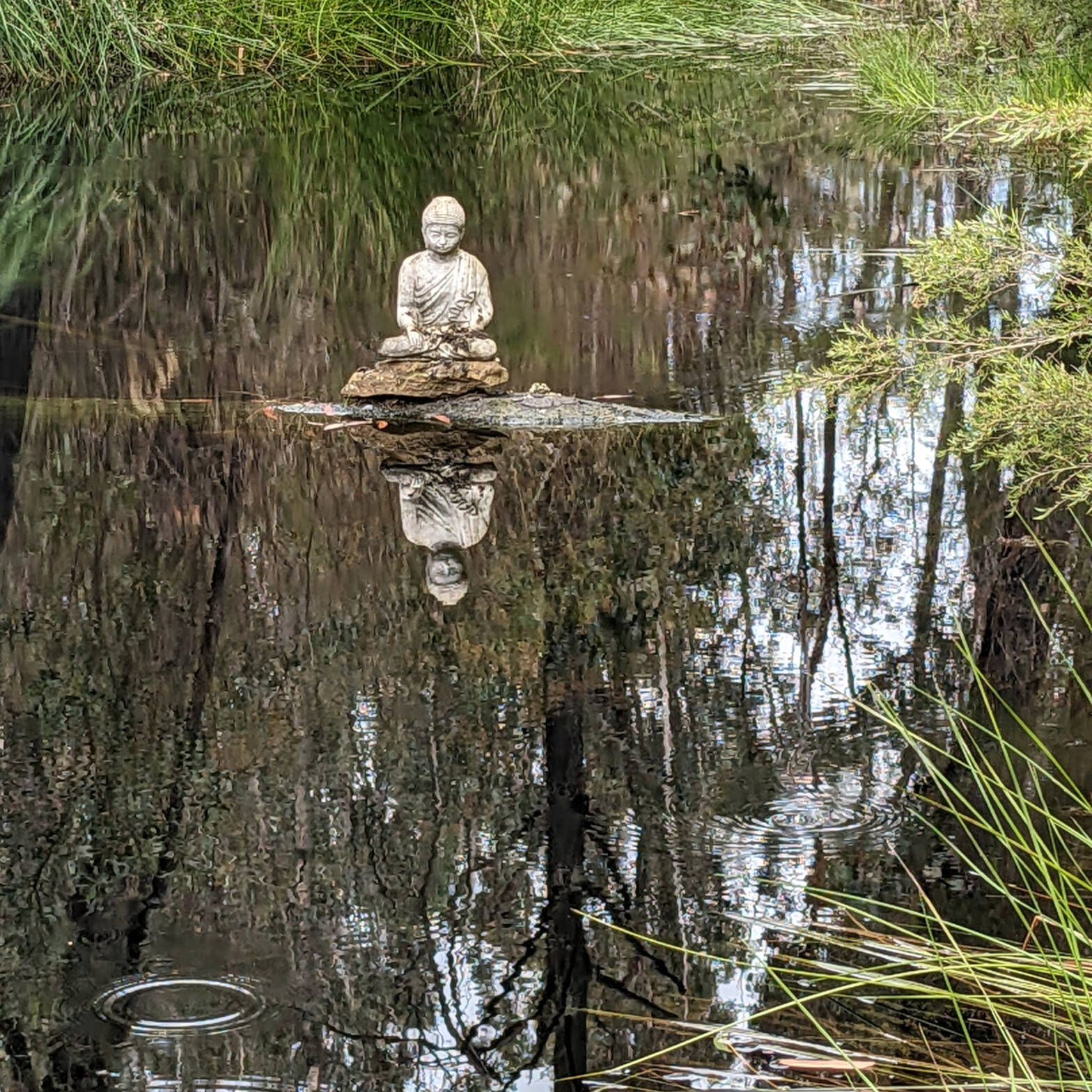
What remains is simply presence — a knowing beneath the feeling. Here you can rest. The feeling doesn’t need anything from you but to be known. Let it move through, like light dancing on the surface of a pond.

A Grain of Salt in the Ganges

The Buddha asked his monks: What happens when you drop a spoonful of salt into a glass of water? It turns undrinkable. How about the same spoonful into the Ganges? You can’t taste the salt at all.

This is something awareness can do. Open it wide enough and there is room for anything: the leftover charge of the day, an emotion you’d rather not feel, a discomfort you’ve been carrying since this morning. Nothing has to be solved. Held in a space this big, the feeling diffuses and shifts on its own. Awareness itself does the holding, with warmth and tenderness.

Begin with sound. Listen for the most distant noise, then notice the field that holds it — open, roomy, extending in every direction. Let the body appear inside that field. Then gently let whatever you are feeling come forward to be met.

Stay with it, and the feeling loosens. Where you thought there was a solid thing — sadness, or fear — you find movement, a shifting texture. Look for the one who is feeling it, and that too can’t quite be found.

What’s left is spacious knowing. Let the feeling move through it like a ripple through water.

Attuning to Activation

It’s late, you’re winding down, and a notification arrives on your phone. Nothing serious. But there’s a flicker of irritation, a small charge moving through the body against the quiet you were just resting in.

The nervous system is always moving like this — across a spectrum of activation and rest, energy and ease. All of it is good. The charge that sets a boundary, the rest that restores, even the freeze that was once trying to keep you safe: each has its place, just as every part of the mind does. When nothing blocks the way, the system regulates itself. It rises into activation and on its own it settles again.

In this practice we bring a little activation in on purpose, in order to watch it shift and settle. Swing the arms for a minute, then stop. Feel the warmth, the quickened heart, the breath. Notice what happens as you pause and get out of the way.

Then bring something to mind — something small and irritating, an email you didn’t want, whatever brought a bit of feeling. Hold it in whole body awareness and tune into how it feels for you. Stay with the heart, the breath, the charge, with no need to change a thing.

Stay with it, and it moves on its own.

Opening to Uncertainty

I will face my fear. I will permit it to pass over me and through me. And when it has gone past I will turn the inner eye to see its path. Where the fear has gone there will be nothing. Only I will remain.

Dune, Frank Herbert

Life is uncertain. There are things we can’t know, things we can’t control — the body ageing, the world shifting through change with no clear path ahead.

Begin by settling. Ease in, collect the mind, find an anchor that feels stable and grounding. Then open to the whole body and let the mind rest into it. Notice the felt sense — the overall tonality of this space, vague and murky, more than words.

Now bring to mind something uncertain: a situation, an area of life where there’s turbulence, unknowns, something out of your hands. Small or large, whatever feels alive. Doing this on purpose lets you meet it on your own terms. Let the fear, the worry, the concern arise, and find where it lives in the body.

Open, soften, allow. Don’t brace against the feeling — go towards it. Every cell of your body dilating to accommodate this texture of experience. Let it move through you, shifting and changing, a trickle from a deep well.

Let it fully envelop you, and you’ll emerge on the other side. What remains is the one who can hold all of it. Untouched. Whole. Nothing missing.

How do you protect me?

In a moment of reactivity, there’s a part of you that jumps into the driver’s seat. It stresses you out with anxiety, defends you with anger, or entices you to reach for that coping strategy. It’s so sure it has an important job to do, trying so hard to protect you. However, there’s a cost to that strategy.

Most of meditation invites us to see through and deconstruct. Instead we let the part stay solid, and turn towards it with loving attunement — the way you might turn towards someone who’s been carrying something heavy by themselves, weary and alone.

First ground into the weight of the body as a steady anchor that you can return to. Bring the part to mind. See it as a part of you, not the whole of you. Notice its cost. Then, rather than trying to change it, sense how it’s been trying to help.

Ask how it feels. Let it answer — in sensation, in an image, in words. Ask how it protects you. Acknowledge the effort: “I see this is how you protect me.” Then offer your thanks.

Met like this, a part will often soften on its own. As it settles back, you are more than the part — you’re the awareness holding it.

An Ocean of Compassion

Open your awareness as an ocean of compassion.

Vast. Receptive. Able to hold anything that arises.

Bring to mind something that hurts. Let it come close. Notice what surfaces.

Notice too the impulse to move away. To fix the feeling, to cover it over.

Instead, let it rest in the ocean. Let it be held, fully, just as it is. Nothing to change.

To hold any feeling tenderly is an act of compassion.

Sitting Down to Tea with a Part of You

If you could have a cup of tea with one part of you, which one could use the company? Is it the part that gets anxious you’ve forgotten something every time you leave the house? Or perhaps the part of you that is always trying to find the next problem to solve?

All parts of the mind are wholesome, just not all of them are skilful. The inner critic is driving you to achieve your greatest aspirations. The part that is stressed wants to make sure things get taken care of so you don’t let others down.

Realising this, you can offer genuine kindness and appreciation for just how hard this part is working for you — even when it seems to cause difficulty. Embracing it just as it is lets this part feel appreciated. When truly seen, the part relaxes.

Archetypes of Self and Path

There is always an image at work in how we hold ourselves – running below the surface, shaping what we can do, what we can’t, what we even let ourselves want. This practice brings some of that into the light by trying on other images, one at a time, and noticing what stirs.

Settle. Let the mind rest into the whole of the body – steady, collected, unhurried. Tune into the texture and tonality of how you are right now. Then, one at a time, drop into each archetype like trying on a new coat in a mirror. Amplify it. Let it move into the body. Notice what resonates. Notice where something in you resists. Notice what surfaces. Each movement is its own kind of discovery.

The disciple – in reverential study of a tradition.
The artist – endlessly making, combining, evoking.
The outsider – inhabiting the in-betweens and the undercommons, outside of systems, speaking truth to power.

Each brings a quality of presence. Try them on. See what they make of you.

For further reflection, see Rob Burbea’s talk In Love with the Way.