~4 minute read
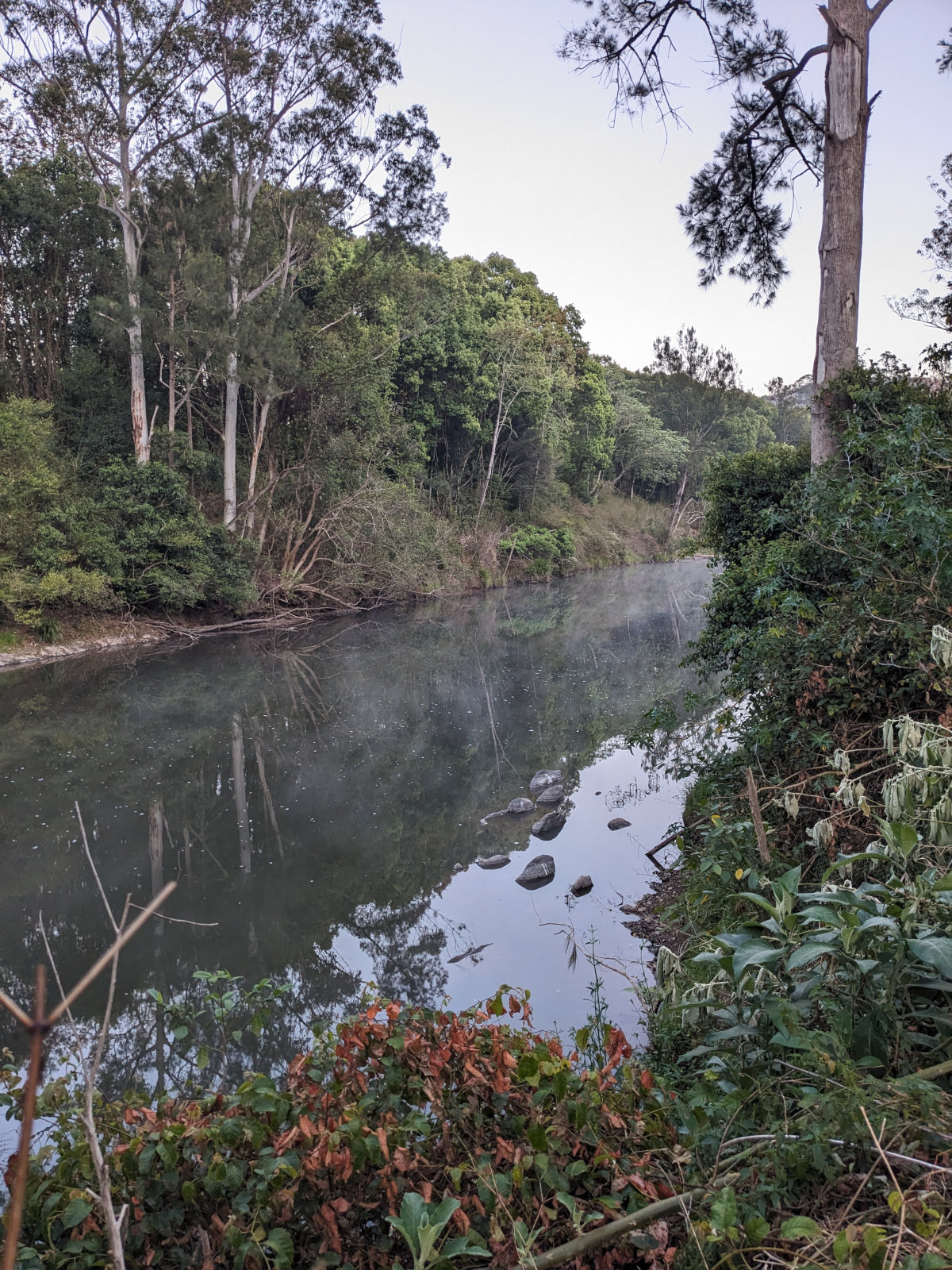
I’m 10 days into a 21 day silent retreat. Here with one dear friend, at another friend’s property on Birpai land. Each dawn and dusk my friend and I quietly make our way to the riverbank to try to get a glimpse of the platypuses playing in the water. They are shy and smaller than I expect – while keeping our distance we can only just make out their beaks and heads as they coast along the water, dive under, and resurface.
My friend leaves in the morning and we share a warm goodbye. I spend the rest of the day in a daze. Night falls and I settle in to sit. I reach for my shawl and find my friend has left me a parting gift: a block of vegan chocolate and a note of encouragement. I break down into tears, an overwhelming sense of being lost, lonely, and undeserving of such kindness.
The following day I stumble around. I question what I’m doing there on retreat. I wonder why I needed to leave my life in order to go be quiet somewhere far away. I doubt the value of practice and my own place on the path. I lose interest in the birds, the trees, the animals. My mind becomes a solipsistic, harsh desert. I realise I’m in a mini existential crisis. I hope it stays mini.
For solace, I turn to Rob Burbea’s Dharma talks. I bring my headphones and a cup of tea to the riverbank and find a stable rock to sit on, carefully watching for snakes. Rob’s soft, kind voice reaches across space and time, carried by scratchy audio recording. He speaks of being “in love with the way”, of cherishing the path itself, and how there are many different fantasies and myths of the path that we inhabit and take on. These images form the sacred ground of practice. We move between images of being healed, to the reverence of tradition, to being a scientific researcher, to seeing all of the path and life as art. I sense into how my own sense of the path had become small and contracted, not able to hold what was asking to come through. I sit with this, testing out different images of myself on the path.
I am an explorer of consciousness.
I am a student of Dharma.
I am a lover and mystic.
I am an artist, creating a life.
I am a servant of the divine.
I see all of these as true, as false, as empty, as image. They are vivid like rainbows in the sky, appearing but without solidity or fixed location. They have no independent existence, no basis of their own, yet they are alive and animating. They shift my way of looking. Each time I reorient myself I notice a different North Star, a different direction to head, new aspects to love and cherish about this life and path.
This immediately moves something deeply in me. I rediscover a love of practice. I see myself in a different light and realise that I don’t want to be nobody, and that my attempts have obviously failed.
In the years following the retreat, I continue unfolding imaginal practice. I notice that practitioners each have their own unique fantasy and myth of the path. To a large degree this image influences, if not determines, their engagement, fire, dedication, and passion for practice. It sets up how they will respond to difficulty, uncertainty, and suffering. I see students grind away, stuck between traditions, as well as those who happily dwell in the in-between spaces, letting their fantasy shift and grow.
I realise I’m being called to teach imaginal practice. I recognise that teaching this is challenging, and perhaps even disturbing for many people. However, the response has also shown that it is validating – confirming that people already encounter the imaginal in practice, without a name for it. There’s already a sense of the beauty and love available when allowing this in. The practice and teaching of the imaginal becomes part of my own image and sense of my own path. I want to point to something, to gesture towards this, to make something visible that is quite likely unexamined and unexplored.