You cut your fingernails and brush the clippings away. A moment ago they were you. You don’t go back for them.
Settle. Let the body be heavy, the belly soft, awareness wide enough to hold the whole of it. Then listen. A car, a voice, the hum of an appliance. As each sound arrives, label it silently and lightly: not me, not mine. This one is easy — obviously the sound isn’t you, obviously you can’t keep it. Notice what happens when you say so anyway.
Widen from there. The pressure of sitting, an ache, the rise and fall of the belly. The breath has been going all day without your permission; the air was outside a moment ago and will be outside again. If you were going to possess a breath, which one would it be, and how would you hold it? Then feeling — warmth, unease, whatever tone is here — already shifting as you turn to look. Then thoughts. Where did that one come from? Was there a decision before it arrived? Thoughts happen on their own; we take the credit after the fact.
Then look for your sense of self. It might be tight, everything glued together and about you. It might be loose and open. Either way, it is arising. Not me, not mine.
Nothing here is being got rid of. A rainbow is vividly there and has nothing solid in it. Open your eyes, look around the room, and keep looking that way.
Something has bothered you and the thought will not stop turning. The body is tight, the shoulders drawn in, the world narrowed to the size of the problem. On another day you are out walking and everything is roomy and unhurried. The difference is the grip.
Clinging, craving, aversion, grasping — different words for one movement: taking hold of experience and trying to keep it fixed. It is felt in the body. Which is useful, because what is felt in the body can be released there.
Settle, then let awareness fill the whole body, part by part, until the whole space is bright. Tune into the felt sense of it — the overall tone, like dialling in an analogue radio. Notice the clear sensations, and what is vague and murky. Whatever you find is fine.
Now look for the holding. A contraction somewhere. A pull for this to be other than it is. It is in thought too — the mind solving, fixing, reaching towards something later. Find it. Stay with it a moment.
Open, soften, allow.
Take resistance the same way: soften around the sleepiness, the agitation, the doubt. Let it be here. Take the pleasant that way too. Released from the grip, what is pleasant tends to open further; what is unpleasant tends to dissipate.
Then feel the whole body again. Tight, or roomy. Solid, or moving.
You do not let go. You stop holding on.
Drawn from Rob Burbea’s teaching on ways of looking.
A sound wakes you in the night. Nothing much has happened, and within a minute the body is tight and the mind is looping — what was that, who caused it, why this, why me. Hours later you are walking in the sun and everything is fine. The body is open. There is nothing to cling to. Same person, same day.
Place a number between zero and ten on what is being felt. Zero: the self-sense faint, thin, perhaps completely gone. Ten: contracted, fixated, everything is about you. Most of the time you are drifting somewhere in the middle without noticing.
Sensation first: what you can hear, see, feel. Then feeling — not the story of the emotion, just its energy in the body. Then thought: distinct images and inner sounds, or a stream bubbling away.
Then ask: what is my self-sense right now?
It’s a strange question. It doesn’t land the first time.
Now watch how the mind binds it all together. A sound, an agitation, a thought about who did this — glued into a solid, fixed, “you”. When the gluing runs unwatched, the contraction is strongest. See it clearly, and relax.
Suppose a magician were to hold a magic show at the four crossroads, and a keen-sighted person were to see it, reflect on it, and examine it radically. Even as they see it, they would find it empty; they would find it hollow; they would find it void of essence.
— Pheṇapiṇḍūpama Sutta, SN 22.95
Examine the self-sense that closely and release clinging. Not gone — vividly appearing, but without the solidity it seemed to have. Rest as what knows this.
See through the lens of change. Sounds arise out of silence and disappear back into it, and even the constant ones waver. Bring the body forward: look at the edge of a sensation that feels solid, and find the flicker there. You never take the same breath twice. Then thoughts — each with a beginning and an end, or one stream, flowing, never the same for long.
The mind gives solidity to what has none. Look this way for a while and notice what loosens. There is often relief in it: nothing here to hold.
Then open your eyes, and notice what lens you are looking through now.
— Vajrachedikā (Diamond) Sūtra, translated by Rob Burbea
When your experience of life deviates from life as it objectively is, the lens is revealed. Between the world as it is and the world as you meet it, there is a way of looking. It involves everything: from how you have slept to your beliefs and emotions. Like squeaky-clean glass, you look straight through without noticing it.
Sense what is here now. A warmth, a tension, a sound, a passing thought. With each, notice its tone: is this pleasant, or unpleasant? Stay for the small movement that follows — the mind leaning in toward what it likes, drawing back from what it doesn’t, quietly sorting the world into good and bad.
That leaning is the lens. When you catch it, relax. Let the pleasant be pleasant without chasing it, the unpleasant be unpleasant without turning away. If resistance comes, let the resistance be here too. Then take one step back toward the thing itself, before the mind decides what to make of it. Even here, the lens is shaping what appears.
Find one steady thing. Your seat, the uprightness of the body, or an object across the room. Notice the solidity already present. Rest your attention there. Borrow its steadiness, and let it spread.
Thoughts will come, wanting to be solved, wanting to carry you off. You don’t have to feed them. Each time you notice, that noticing is a fork in the road — be glad you caught it, and choose to come back to what is steady. It doesn’t matter how many times.
This is a way of looking: not something you force, but a stance you take, and then wait. Give the body, the heart, the mind their time. Peace of mind is only a short way off, on the other side of habit. Get out of your own way and the system settles on its own. The steadiness was always its birthright.
I recall being on a meditation retreat and seeing someone who was practising diligently but continually running up against a wall in their practice. Over and over they raised their hand and asked what they should do if they weren’t at the level of understanding emptiness. They appeared defeated. Their tone communicated a sense of self-deficiency — that they were failing at the practice. The teacher patiently asked them about their experience, explained the instruction to them again, and tried to give them pointers of what to try next. They praised them for continuing to attend so many of these retreats and tried to encourage them by framing it positively as dedication and perseverance. But I felt like something important was missed. There was an obstacle arising that couldn’t be addressed through insight practice. That felt experience couldn’t be seen through with emptiness practice. I could sense there was a better way, in which the doubt could be explored and felt into, related to differently. I wanted to offer attunement and compassion for their sense of being stuck. My sense was that something wasn’t being touched by the meditation practice; a part of their experience was crying out to be acknowledged and kept being met with silence.
Contemplative traditions, Buddhism among them, offer something genuinely liberating and beautiful in the move from the mundane to the profound. These ways of practising can radically shift how we experience being alive. But the way most traditions and lineages operate falls short for a human being in the world today. This largely comes from setting life and practice in opposition. It sets up a dichotomy that separates and contains rather than integrates.
We might hear this distinction between the ultimate and relative levels of experience. On the ultimate side we place the universal, transcendent, nondual, unconditioned, and “pure”. On the relative side we place the specific, everyday, conditioned, and messy. We can also see this when an experience is taken to belong to the domain of psychology rather than meditation — some content arises and it is thought to be something to ignore, or deal with another time and through different means, such as in therapy.
This separation can be immensely helpful. We need distinctions to make practices clear and usable. At times, skilful ignoring of the content of the mind allows for a powerful deepening and opening. The limitation is that integration is stifled when these are seen as separate concerns, without overlap, and without common ground for bringing practice forward.
—
The image I want to put forward is the double helix. Picture DNA. Two strands spiral around each other as they move forward. They are connected by rods at intervals, lines that bridge and bind them together. The structure is two distinct strands that have a pattern of movement and points of connection.
The ultimate strand is the path of insight. This is insight into emptiness — opened through doorways such as impermanence, unsatisfactoriness, and not-self. This path of insight develops through ways of seeing in which the solidity of experience begins to shift and melt, dropping us down into a different sense of existence. These practices reduce fixation and solidity. Eventually, this opens up into recognising that our own nature is beyond what we conventionally experience as mundane existence.
The relative strand is the path of content. This includes feelings, emotions, psychological content, conditioning and upbringing, patterns and behaviours. Rather than being universal, this refers to something specific about our individual experience. It includes our likes and dislikes. It’s also the ways we react and get triggered. It is our style of being, what we are in our humanity, and what it means to be you rather than somebody else (or no one). The side of content also includes the things we desire, that we engage with most deeply, and what we love. These practices contribute to a healthy sense of self that is grounded and stable.
There’s a way of relating to both that brings them onto the meditative path, so that all of experience can be integrated. Sometimes we frame meditation only as the fair-weather practice, when the body, heart, and mind are amenable. A meditator might be cruising along until things start surfacing and they’re left saying “I can’t meditate any more!” The implication here is that we are meditating until we run into something too difficult, then we have to stop and take that into a different domain. Instead, I’m proposing that from the beginning we can learn to relate well to whatever comes up, so that working with content actually deepens our practice. Rather than being a detour or a sidetrack, this is the path.
To do this, we find connections across the spiral. There are moments in practice where we jump from one side of the spiral to the other. We might be practising a specific meditation technique, such as śamatha (calm abiding), and realise that there’s something in our experience that needs tender care rather than to be ignored or calmed. Or we may be engaged in trying to understand our psychology, and realise we’ve become fixated on our past and the self-image that came from it — recognising that we can instead use insight to see through it and find space and relief. We find a bridge to the other strand of the helix and it allows us to deepen.
Eventually this opens to a smooth flow between insight and content, between ultimate and relative. In this sense, we flow along in the centre of the helix, with both sides arcing and spiralling, allowing us to unfold more and more. To do this, bring a loving attunement to your present-moment experience. All content is seen as practice.
—
An example. I was practising the śamatha meditation technique according to The Mind Illuminated. I’d been chipping away diligently, increasing my sitting duration, gradually working on ignoring distractions and coming back to my object. Eventually I had a taste of stability — a clearing where the mind settled and I could stay with the meditation object for a while, able to return quickly when distraction arose. It was really nice! I thought to myself: “Finally, some fruits from all the time I’d put into the practice.”
I wanted to get back to that state and was excited to return the next day. When I sat down, I found myself at Stage 2. The mind was completely off track, wandering like a box of frogs, or like a wild elephant. I found this incredibly frustrating. Where was all this stability I had so carefully cultivated? What did I do wrong here?
In this stark contrast I cognitively recognised that this was the experience of not-self that I’d read about, taking place before my eyes. I could see how I’d been mistaken in thinking the mind existed independently, something I could control and identify with as a self. Rather than relief, this insight brought up frustration. It kicked up old stuff and spun me into a loop. At this point the teachings became an annoyance rather than a source of wisdom. Upon seeing the frustration, I recognised that my experience was also coloured by a kind of sadness. I intuitively let go of my meditation object and went towards the frustration and sadness. I opened to them and let them be there.
This was a great sadness at not being able to control the mind, to will something into existence. I was coming to terms with the fact that even in my own mind, I didn’t have agency. I had lost control of what had felt like the only thing I could control. I’d lost what had felt like me. For the first time, I saw it clearly. I felt the grief of not being able to make something happen through will. As I opened to those feelings and emotions, the grief crystallised as this loss.
I felt into the grief as it appeared in my body. I fully allowed it to open and unfold. Then something shifted. The mind, which had been scattered and restless, settled into a state of calm. A wave of emotion passed through and left a clear space in its wake.
As I continued meditating, I recognised that I’d dropped down into a deeper level of experience. I no longer felt like I was a separate self meditating and controlling the mind. All experience was unfolding on its own. I rested in this state. Everything became so easy and clear, with no sense of needing to do or control anything. Awareness had become spacious and open. Afterwards I realised I’d dropped past Stage 4 into something more like the effortless stability of Stage 8.
Surprised at the efficacy of this, I realised that insight becomes embodied and integrates through these mismatches of experience and opening to emotions. Not only did I shift my way of being and access that resource, but the insight into non-controlling also deepened and became more available.
—
This also works in the other direction from content to insight. I’m thinking back to my first call with an experienced coach who was working in Aletheia,[1] the system I am currently studying. Aletheia is a methodology that integrates psychological modalities such as parts work with the tenets of nondual meditation.
To begin the session, I brought in that I’d been feeling stressed and that there was a “get things done” part of me that I associated with a sense of pressure and tension in my head. We worked on this in real-time direct experience as a form of meditation. We felt into the present-moment experience and contacted this part through the sensations, emotions, and thoughts. We got to know it, asking some gentle questions, making sure we were relating to it from presence with a welcoming, kind attunement. This took some navigating as even just contacting this part of me brought up other parts, including a sense of frustration and a concern that this pattern of stress was causing me difficulty. We acknowledged and felt these, waiting for their okay before going on.
Once the “get things done” part felt seen and understood, there was a turn. Gradually the pressure shifted toward sadness. Underneath was a sense of hopelessness, as if all my efforts are futile. After I stayed with the sadness for a few minutes, a hole opened in my chest like a dark void, an absence. I felt as if I were slowly imploding, sucked into a black hole at the centre of my being. Acknowledging the fear that arose, I stayed with this absence, gently opening to it.
Suddenly it shifted. Instead of an absence, it was a presence of stillness and peace. Rather than a bleak vacuity, there was openness. I rested in this spaciousness. It was serene and profound. I felt a wave of calm and contentment. I distinctly remember sitting and watching the birds outside the window afterwards, in awe of the coexisting movement and serenity. I felt whole and complete. Gratitude spontaneously arose. My life was totally fine. The stress of existing in this world couldn’t damage the core stillness and peacefulness of my being. I could be stillness and also live and act in the world.
I was amazed that in a 50-minute call I’d dropped into what had previously taken me three days of silent retreat to reach. Since then this stillness has become more and more accessible, not by cultivating perfect conditions for silent meditation, but by going through the content and emotions.
—
Aletheia names this as the cycle of deepening and surfacing. When we drop down in depth of being, content often surfaces. Parts of us arise that have concerns, or don’t feel comfortable without a job. When we work with these parts and patterns of mind by allowing the emotions, we can drop further into our depth. Surfacing happens repeatedly in meditation. It also happens just by going about life. To see this as surfacing and deepening is to appreciate that all experience is unfolding meaningfully.
Seen this way, the two movements have names. The deepening is wisdom — dropping into a depth where we recognise that we are Presence. The surfacing is love — turning toward what arises to meet and hold it. Life takes place in between.
This is the flow Nisargadatta points to: “Love says: ‘I am everything.’ Wisdom says: ‘I am nothing.’ Between the two my life flows.”[2] If we think of this flow as the unfolding of life through the double helix, we move between love and wisdom, we connect them, we find the union. When we open to emotions and difficulty with love, it brings forward wisdom; when we open to wisdom, it brings forward compassion.
Integration isn’t a phase of practice — the practice is integration. It only asks that we learn to relate to our experience in new ways. We can honour the liberating power of the traditions and still bring nuance and care to the full range of human experience.
This path lets us open to and choose the direction we move in — to be both released and integrated, to find freedom and meaning, and to discover new dimensions of being right here in this life, in this world
Warmly, Kynan
This is the work that matters most to me. Where I can do it most fully is one-to-one. If something here speaks to you, I’d be glad toexplore it together.
P.S. Retreats are currently being planned for the rest of the year — save the dates! Look out for registration opening in the coming weeks.
4 days, 10-13 September
10 days, 6-15 November
Aletheia is a coaching method founded by Steve March that brings psychological work together with nondual meditation. Its teaching centres on unfolding — letting experience open and integrate as a way of being. I’ve found it deeply helpful. You can learn more here: https://integralunfoldment.com/learn-more↩︎
Sri Nisargadatta Maharaj, I Am That (The Acorn Press, 1973), 269.
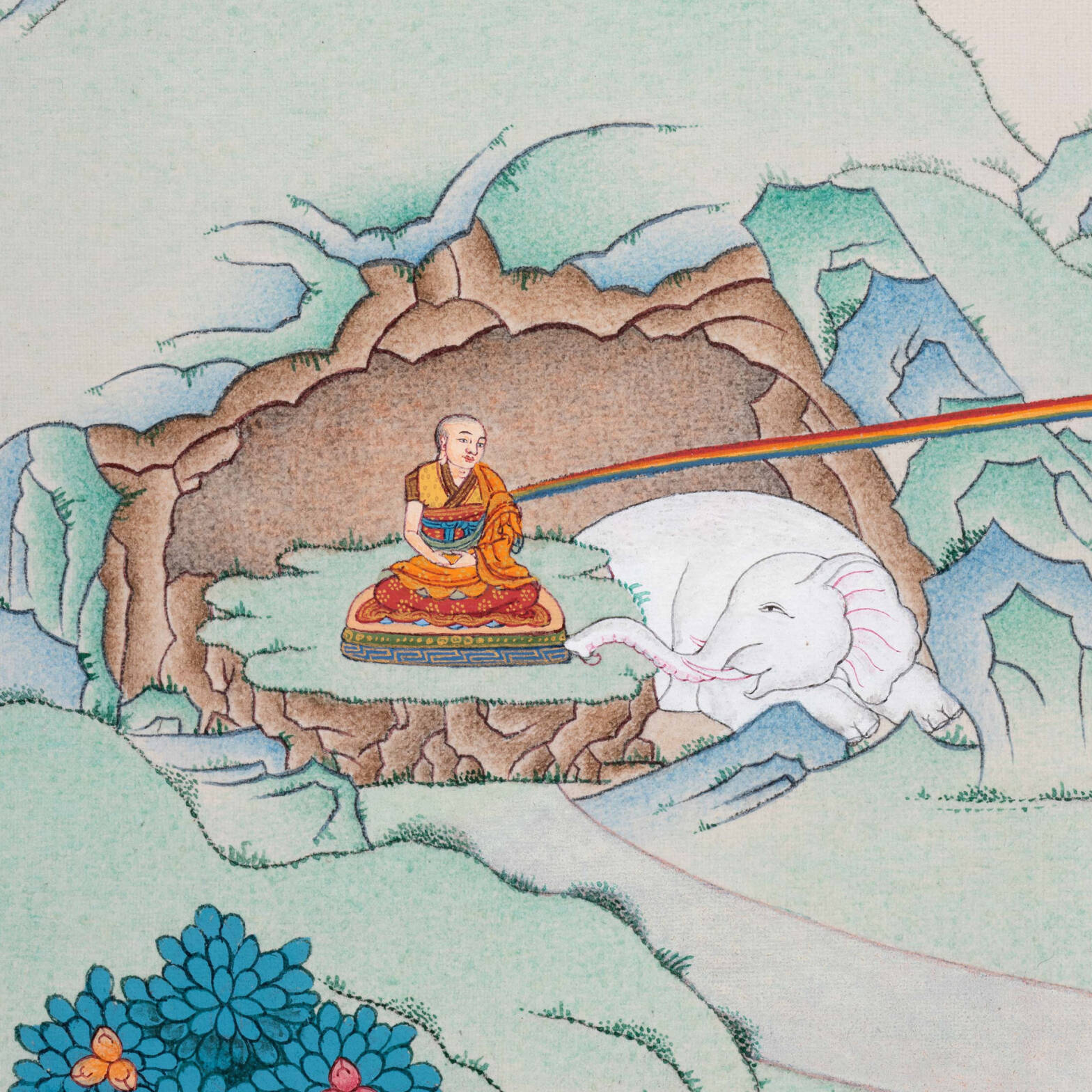
The Elephant Path is an ancient meditation teaching, believed to be a transmission from the Buddha-to-be Maitreya and written out by Asanga in around 500 CE. It describes the Nine Stages of Calm Abiding — a map of how experience shifts as the mind deepens in meditation. In this meditation, we traverse all the stages, using the appropriate antidotes and techniques at each stage to progress to the next. Through this we move from scattered monkey mind all the way to effortlessly stable attention. By practising The Elephant Path, you learn how to navigate the mind and how to cultivate different states of mind. This makes the mind a nice place to be — not only from landing in calm and clarity, but also from the confidence of knowing how to move the mind appropriately to whatever is present at any given moment.
The practice of calm abiding culminates in effortlessly stable attention — you sit and focus, returning again and again, until it becomes automatic. There’s also a way to begin with effortlessness. Start by opening to effortless spacious awareness. Release the body and mind. Drop all effort, relax to the max, give up. Rest as the awareness that is already here and knowing. From that place of spacious ease, gently intend to care about the body. Through just the slightest intention, the body appears brightly and vividly in the foreground. Attention is stable without tension nor doing. Let go of everything and rest into the body.
The path of calm abiding leads to effortlessly stable attention with equanimity and tranquility. A key to this part of practice is first building up to complete staying and then, when the time is right, easing up in effort. This easing up is a releasing, softening, and relaxing in such a way that the practice starts to flow by itself. Because of all the work done to establish stable attention and bright metacognitive awareness, the mind can, with only the slightest intention, rest into the body. This occurs at stage seven of the elephant path. You will ease up gradually, bit-by-bit, noticing if distractions again interrupt your continuity. When this works, it feels like the less you do the more focused you become, that there is no difference between meditation and non-meditation, and that there is a profound background stillness.