The Whole Universe in a Grain of Rice

“If you wish to make an apple pie from scratch, you must first invent the universe.”

– Carl Sagan, Cosmos

Feel the breath. Not just as sensation, but as something arising out of everything else. Lungs. Air. The trees.

This breath leans on all the breaths before it. Thousands upon thousands.

The feeling of sitting. A sound from outside. The mood you’re in. Each one held in a web of causes and conditions. The specifics don’t matter. Feel the web.

Then watch for the next thought. Where did it come from? You didn’t decide to think it. Leave it as it is. It belongs too.

Open out. Spacious, at ease. Look past the separate things.

What if this moment is made in relationship with everything?

When you open your eyes, notice how things appear.
No Preferences

The Great Way is not difficult
for those who have no preferences.
When love and hate are both absent
everything becomes clear and undisguised.
Make the smallest distinction, however,
and heaven and earth are set infinitely apart.

— Sengcan, Hsin Hsin Ming

Sound and silence. Calm and agitation. Pain, and what is not pain.

Each one known only against the other.

For a while, try having no preferences. No likes, no dislikes. Just being.

Feel what’s here, murky and hard to name. Ask, can I be with this?

Notice the mind wanting stillness, pushing restlessness away. Soften around the wanting.

Then relax the distinction itself. Put it down, like a heavy bag.

No self. No other. All just happening.

When you open the eyes, look for where the meditation ends.

The Unfindable Self

A chariot cannot be said to be different from its parts;
it is not identical with the parts,
nor does it possess the parts.

– Chandrakirti, Madhyamakāvatāra 6.151

Look for the self the way you’d look for the chariot.

First, call it up. Recall something from today and notice where you held on – this is me, this is mine. Or picture yourself sitting across from you, as in a mirror. Or imagine someone pointing at you and shouting, thief! Something rises to defend. What is it protecting?

Notice how it feels. Continuous. Solid. Standing on its own.

If a self like that were real, you could find it. So search.

Start with sound. Is the bird song you? The hum of the fridge? Then the body: pressure, warmth, the texture of your clothes, the tightness in the shoulder. Then feeling. Call up a little joy, a little sadness. If you were a feeling, which one would you be? Then thought, and the narrator, and whoever the narrator is talking to.

Is there anywhere else to look?

Take each layer slowly, until you’re certain.

Where the self appeared to be, a spaciousness. Rest there.

The self comes back, like a rainbow. Vividly appearing.

Unhooking the Self-sense

Whatever is not yours, let go of it.
Your letting go of it will lead to your welfare and happiness for a long time.

– Alagaddūpama Sutta, MN 22

Not me. Not mine. Uncontrollable.

Take up a lens that sees all experience as not-self.

Start with sound. Sounds are just happening – you don’t get much say in them. Listen to the whole soundscape at once, and touch it with the phrase, lightly, like brushing it with a feather.

Then the breath. If you were the breath, which breath would you be? This one? The next one?

Then feeling, the texture of what is felt. Then thought. You didn’t decide for the next thought to be there. It comes from everywhere.

Then turn toward the one meditating. The thinker, the observer, the one sensing. Where is that? How do you actually experience it?

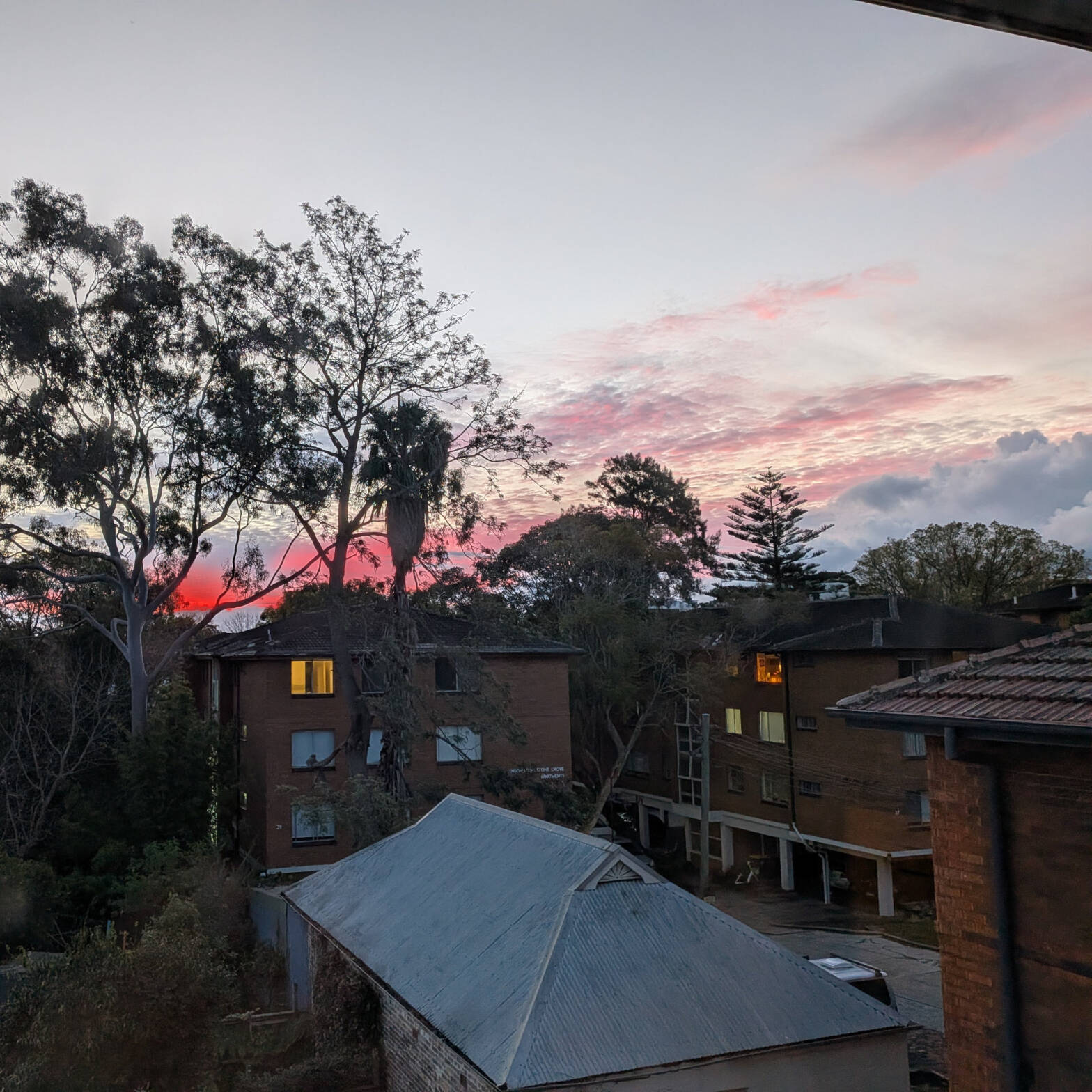
A sunset. Vividly appearing, and you can’t hold onto it. Unhook, and notice what this way of looking does.

There is still knowing, bright and clear. Open the eyes, and notice what things look like now.

Personality, Haphazardly Assembled

No one lives his life.
Disguised since childhood,
haphazardly assembled
from voices and fears and little pleasures,
we come of age as masks.
Our true face never speaks.

– Rainer Maria Rilke

Before you sit, grab a pen and write down your qualities and roles. Kind, caring, prickly, pedantic. Teacher, parent, neighbour. The ones you have applied to yourself, and the ones that have been applied to you. Then place the list to the side.

Settle. Let the whole body hang off the skeleton, filled with bright awareness. Tune into the gaps, the little space between the sensations, between the thoughts, between the feelings.

What is your sense of self right now? Maybe a thought. Maybe a density, a contraction. Maybe an image of yourself meditating.

Glance at the list. Are you being those things right now? Are you being caring? Are you being a friend?

They vividly appear. Yet there’s no core you can find that really is that.

Unhook. Put it to the side, and notice what happens.

The Ship of Theseus

A wooden chair on a bonfire. Flames lap at the frame, a leg falls into the ash, then the whole frame collapses. At what point is it no longer a chair?

Settle first. Let the body be heavy and relaxed, filled with bright awareness. Then bring forward your usual sense of self. Where do you locate it? Behind the eyes, in the heart, somewhere just above the body?

Now, lightly, as an experiment, let your right leg vanish into open space and be replaced by a whole new one. Then the left. The arms. The heart. An eye of a different colour. Half the brain, then all of it. Are you still you?

Where exactly are you?

Standing at the Edge of the Void

Look at the screen. Faces, a room, someone talking. Now find one small patch of it and see only colour. Points of light. The mind has to reach in to make those points into a person. Tune into that reaching, and the screen starts to thin. Paper thin.

Settle first. Let the body be heavy and relaxed, filled with bright awareness, until the whole body is held at once. Then notice how things appear now. Whatever you arrived carrying may have a little more room around it. Nothing was removed. It is being built differently.

Try seeing the body as empty. Not as an idea – as a way of perceiving. Notice what happens when the word itself arrives.

Whenever there is belief that things are real,
desire and hatred are generated.
Without that belief no defilements can occur.
And when this is completely understood,
all views and afflictions dissolve.

– Nāgārjuna, Yuktiṣaṣṭikā (translated by Rob Burbea)

Something in you may lean towards this. Something else may pull back. Fear, excitement, a voice saying this is too big to begin. Let each of them be here. How do you see yourself, standing in relation to this?

Then take the view, lightly, as an experiment. Everything you are experiencing lacks inherent existence. Vividly appearing, yet insubstantial. Points of sensation, glued by the mind into a self and a world.

Open your eyes and look at the screen again.