In a moment of reactivity, there’s a part of you that jumps into the driver’s seat. It stresses you out with anxiety, defends you with anger, or entices you to reach for that coping strategy. It’s so sure it has an important job to do, trying so hard to protect you. However, there’s a cost to that strategy.
Most of meditation invites us to see through and deconstruct. Instead we let the part stay solid, and turn towards it with loving attunement — the way you might turn towards someone who’s been carrying something heavy by themselves, weary and alone.
First ground into the weight of the body as a steady anchor that you can return to. Bring the part to mind. See it as a part of you, not the whole of you. Notice its cost. Then, rather than trying to change it, sense how it’s been trying to help.
Ask how it feels. Let it answer — in sensation, in an image, in words. Ask how it protects you. Acknowledge the effort: “I see this is how you protect me.” Then offer your thanks.
Met like this, a part will often soften on its own. As it settles back, you are more than the part — you’re the awareness holding it.
I recall being on a meditation retreat and seeing someone who was practising diligently but continually running up against a wall in their practice. Over and over they raised their hand and asked what they should do if they weren’t at the level of understanding emptiness. They appeared defeated. Their tone communicated a sense of self-deficiency — that they were failing at the practice. The teacher patiently asked them about their experience, explained the instruction to them again, and tried to give them pointers of what to try next. They praised them for continuing to attend so many of these retreats and tried to encourage them by framing it positively as dedication and perseverance. But I felt like something important was missed. There was an obstacle arising that couldn’t be addressed through insight practice. That felt experience couldn’t be seen through with emptiness practice. I could sense there was a better way, in which the doubt could be explored and felt into, related to differently. I wanted to offer attunement and compassion for their sense of being stuck. My sense was that something wasn’t being touched by the meditation practice; a part of their experience was crying out to be acknowledged and kept being met with silence.
Contemplative traditions, Buddhism among them, offer something genuinely liberating and beautiful in the move from the mundane to the profound. These ways of practising can radically shift how we experience being alive. But the way most traditions and lineages operate falls short for a human being in the world today. This largely comes from setting life and practice in opposition. It sets up a dichotomy that separates and contains rather than integrates.
We might hear this distinction between the ultimate and relative levels of experience. On the ultimate side we place the universal, transcendent, nondual, unconditioned, and “pure”. On the relative side we place the specific, everyday, conditioned, and messy. We can also see this when an experience is taken to belong to the domain of psychology rather than meditation — some content arises and it is thought to be something to ignore, or deal with another time and through different means, such as in therapy.
This separation can be immensely helpful. We need distinctions to make practices clear and usable. At times, skilful ignoring of the content of the mind allows for a powerful deepening and opening. The limitation is that integration is stifled when these are seen as separate concerns, without overlap, and without common ground for bringing practice forward.
—
The image I want to put forward is the double helix. Picture DNA. Two strands spiral around each other as they move forward. They are connected by rods at intervals, lines that bridge and bind them together. The structure is two distinct strands that have a pattern of movement and points of connection.
The ultimate strand is the path of insight. This is insight into emptiness — opened through doorways such as impermanence, unsatisfactoriness, and not-self. This path of insight develops through ways of seeing in which the solidity of experience begins to shift and melt, dropping us down into a different sense of existence. These practices reduce fixation and solidity. Eventually, this opens up into recognising that our own nature is beyond what we conventionally experience as mundane existence.
The relative strand is the path of content. This includes feelings, emotions, psychological content, conditioning and upbringing, patterns and behaviours. Rather than being universal, this refers to something specific about our individual experience. It includes our likes and dislikes. It’s also the ways we react and get triggered. It is our style of being, what we are in our humanity, and what it means to be you rather than somebody else (or no one). The side of content also includes the things we desire, that we engage with most deeply, and what we love. These practices contribute to a healthy sense of self that is grounded and stable.
There’s a way of relating to both that brings them onto the meditative path, so that all of experience can be integrated. Sometimes we frame meditation only as the fair-weather practice, when the body, heart, and mind are amenable. A meditator might be cruising along until things start surfacing and they’re left saying “I can’t meditate any more!” The implication here is that we are meditating until we run into something too difficult, then we have to stop and take that into a different domain. Instead, I’m proposing that from the beginning we can learn to relate well to whatever comes up, so that working with content actually deepens our practice. Rather than being a detour or a sidetrack, this is the path.
To do this, we find connections across the spiral. There are moments in practice where we jump from one side of the spiral to the other. We might be practising a specific meditation technique, such as śamatha (calm abiding), and realise that there’s something in our experience that needs tender care rather than to be ignored or calmed. Or we may be engaged in trying to understand our psychology, and realise we’ve become fixated on our past and the self-image that came from it — recognising that we can instead use insight to see through it and find space and relief. We find a bridge to the other strand of the helix and it allows us to deepen.
Eventually this opens to a smooth flow between insight and content, between ultimate and relative. In this sense, we flow along in the centre of the helix, with both sides arcing and spiralling, allowing us to unfold more and more. To do this, bring a loving attunement to your present-moment experience. All content is seen as practice.
—
An example. I was practising the śamatha meditation technique according to The Mind Illuminated. I’d been chipping away diligently, increasing my sitting duration, gradually working on ignoring distractions and coming back to my object. Eventually I had a taste of stability — a clearing where the mind settled and I could stay with the meditation object for a while, able to return quickly when distraction arose. It was really nice! I thought to myself: “Finally, some fruits from all the time I’d put into the practice.”
I wanted to get back to that state and was excited to return the next day. When I sat down, I found myself at Stage 2. The mind was completely off track, wandering like a box of frogs, or like a wild elephant. I found this incredibly frustrating. Where was all this stability I had so carefully cultivated? What did I do wrong here?
In this stark contrast I cognitively recognised that this was the experience of not-self that I’d read about, taking place before my eyes. I could see how I’d been mistaken in thinking the mind existed independently, something I could control and identify with as a self. Rather than relief, this insight brought up frustration. It kicked up old stuff and spun me into a loop. At this point the teachings became an annoyance rather than a source of wisdom. Upon seeing the frustration, I recognised that my experience was also coloured by a kind of sadness. I intuitively let go of my meditation object and went towards the frustration and sadness. I opened to them and let them be there.
This was a great sadness at not being able to control the mind, to will something into existence. I was coming to terms with the fact that even in my own mind, I didn’t have agency. I had lost control of what had felt like the only thing I could control. I’d lost what had felt like me. For the first time, I saw it clearly. I felt the grief of not being able to make something happen through will. As I opened to those feelings and emotions, the grief crystallised as this loss.
I felt into the grief as it appeared in my body. I fully allowed it to open and unfold. Then something shifted. The mind, which had been scattered and restless, settled into a state of calm. A wave of emotion passed through and left a clear space in its wake.
As I continued meditating, I recognised that I’d dropped down into a deeper level of experience. I no longer felt like I was a separate self meditating and controlling the mind. All experience was unfolding on its own. I rested in this state. Everything became so easy and clear, with no sense of needing to do or control anything. Awareness had become spacious and open. Afterwards I realised I’d dropped past Stage 4 into something more like the effortless stability of Stage 8.
Surprised at the efficacy of this, I realised that insight becomes embodied and integrates through these mismatches of experience and opening to emotions. Not only did I shift my way of being and access that resource, but the insight into non-controlling also deepened and became more available.
—
This also works in the other direction from content to insight. I’m thinking back to my first call with an experienced coach who was working in Aletheia,[1] the system I am currently studying. Aletheia is a methodology that integrates psychological modalities such as parts work with the tenets of nondual meditation.
To begin the session, I brought in that I’d been feeling stressed and that there was a “get things done” part of me that I associated with a sense of pressure and tension in my head. We worked on this in real-time direct experience as a form of meditation. We felt into the present-moment experience and contacted this part through the sensations, emotions, and thoughts. We got to know it, asking some gentle questions, making sure we were relating to it from presence with a welcoming, kind attunement. This took some navigating as even just contacting this part of me brought up other parts, including a sense of frustration and a concern that this pattern of stress was causing me difficulty. We acknowledged and felt these, waiting for their okay before going on.
Once the “get things done” part felt seen and understood, there was a turn. Gradually the pressure shifted toward sadness. Underneath was a sense of hopelessness, as if all my efforts are futile. After I stayed with the sadness for a few minutes, a hole opened in my chest like a dark void, an absence. I felt as if I were slowly imploding, sucked into a black hole at the centre of my being. Acknowledging the fear that arose, I stayed with this absence, gently opening to it.
Suddenly it shifted. Instead of an absence, it was a presence of stillness and peace. Rather than a bleak vacuity, there was openness. I rested in this spaciousness. It was serene and profound. I felt a wave of calm and contentment. I distinctly remember sitting and watching the birds outside the window afterwards, in awe of the coexisting movement and serenity. I felt whole and complete. Gratitude spontaneously arose. My life was totally fine. The stress of existing in this world couldn’t damage the core stillness and peacefulness of my being. I could be stillness and also live and act in the world.
I was amazed that in a 50-minute call I’d dropped into what had previously taken me three days of silent retreat to reach. Since then this stillness has become more and more accessible, not by cultivating perfect conditions for silent meditation, but by going through the content and emotions.
—
Aletheia names this as the cycle of deepening and surfacing. When we drop down in depth of being, content often surfaces. Parts of us arise that have concerns, or don’t feel comfortable without a job. When we work with these parts and patterns of mind by allowing the emotions, we can drop further into our depth. Surfacing happens repeatedly in meditation. It also happens just by going about life. To see this as surfacing and deepening is to appreciate that all experience is unfolding meaningfully.
Seen this way, the two movements have names. The deepening is wisdom — dropping into a depth where we recognise that we are Presence. The surfacing is love — turning toward what arises to meet and hold it. Life takes place in between.
This is the flow Nisargadatta points to: “Love says: ‘I am everything.’ Wisdom says: ‘I am nothing.’ Between the two my life flows.”[2] If we think of this flow as the unfolding of life through the double helix, we move between love and wisdom, we connect them, we find the union. When we open to emotions and difficulty with love, it brings forward wisdom; when we open to wisdom, it brings forward compassion.
Integration isn’t a phase of practice — the practice is integration. It only asks that we learn to relate to our experience in new ways. We can honour the liberating power of the traditions and still bring nuance and care to the full range of human experience.
This path lets us open to and choose the direction we move in — to be both released and integrated, to find freedom and meaning, and to discover new dimensions of being right here in this life, in this world
Warmly, Kynan
This is the work that matters most to me. Where I can do it most fully is one-to-one. If something here speaks to you, I’d be glad toexplore it together.
P.S. Retreats are currently being planned for the rest of the year — save the dates! Look out for registration opening in the coming weeks.
4 days, 10-13 September
10 days, 6-15 November
Aletheia is a coaching method founded by Steve March that brings psychological work together with nondual meditation. Its teaching centres on unfolding — letting experience open and integrate as a way of being. I’ve found it deeply helpful. You can learn more here: https://integralunfoldment.com/learn-more↩︎
Sri Nisargadatta Maharaj, I Am That (The Acorn Press, 1973), 269.
If you could have a cup of tea with one part of you, which one could use the company? Is it the part that gets anxious you’ve forgotten something every time you leave the house? Or perhaps the part of you that is always trying to find the next problem to solve?
All parts of the mind are wholesome, just not all of them are skilful. The inner critic is driving you to achieve your greatest aspirations. The part that is stressed wants to make sure things get taken care of so you don’t let others down.
Realising this, you can offer genuine kindness and appreciation for just how hard this part is working for you — even when it seems to cause difficulty. Embracing it just as it is lets this part feel appreciated. When truly seen, the part relaxes.
9:00 – 5:00 pm AEDT (Sydney time) Sunday 5 July 2026 Online via Zoom
Description
After some time in dedicated practice, you’ve seen first-hand that formal meditation and the content of your life cannot be cleanly separated. You sit and realise how dysregulated you are. Or you find yourself still stuck after many silent retreats — the practice hasn’t yet integrated into life. The general instructions — follow your breath, return to the body — don’t quite bridge the gap to the rich and complex specifics of your thoughts and feelings.
To find this integration, you can work directly with feeling as the nexus of life and meditation. There are two primary practices for working with feeling: contacting and being with, and seeing through with insight. In contacting, you offer loving attunement to all parts of yourself. In insight practice, you see feeling as impermanent, flowing energy. Each opens space for the other to deepen.
By practising feeling in different ways, the felt experience of meditation and the felt experience of daily life begin to integrate. Emotions and felt senses become the practice itself as you move toward being fully free and fully feeling.
The foundation of the workshop is awareness of the body — grounding, attuning to felt senses, and creating space to hold the complexity of feeling in awareness. To work with emotions and patterns of mind, we’ll use parts work, drawing on Aletheia and Internal Family Systems. You’ll learn to recognise parts, disidentify from these patterns, and acknowledge their good intentions. Through offering yourself a kind, loving presence, these patterns soften and relax.
Once emotions are allowed to be present, we use insight meditation to open to emptiness and experience emotion as energy, allowing the experience to transform. Contacting and insight deepen each other, like two strands of practice that need each other to spiral open.
About this format
This workshop is taught through embodied experience: guided meditations that point out key insights, supported by talks, Q&A, grounding movement and breathwork, and group exercises.
You are asked to participate by engaging in the practice for first-hand, direct experience. You are also asked to bring your questions and practice experiences to group activities and to listen generously as part of the community.
The event is structured as a full day to provide the opportunity for deep focus, while you temporarily put aside other concerns.
Please attend for the whole day. It can be highly beneficial to be in silence for the day, and especially to minimise technology usage. However, full silence is not a requirement. We encourage you to do what you can to create a supportive environment for your practice.
This is an online event. You will need a device with Zoom installed. Please ensure you have a stable internet connection.
This workshop is suitable for practitioners with some experience of meditation. This work can open up some challenging territory — please consider your own situation in terms of feeling grounded and stable.
What if each meditation practice you did was an act of care? What if, no matter what came up, there was a tender, gentle presence? Can you care for aversion just as you care for love?
Practising care, all in your field are touched by this loving presence.
This caring presence itself turns towards experience. It greets the experience warmly and tenderly, like seeing an old friend, or as candlelight gently illuminates.
All is welcome — even bracing or resistance. Trying to control and manage experience is just what we do. Rather than a problem to be rid of, this too wants care and love. Ask “can I be with this?”
In difficult moments bring in the phrase: “may I hold this lightly.” You can also imagine yourself placing the difficulty next to you so you are sitting next to it. When called for, imagine the Buddha or Quan Yin as a figure of loving presence — giving you the capacity to be with and hold this tenderly.
There is always an image at work in how we hold ourselves – running below the surface, shaping what we can do, what we can’t, what we even let ourselves want. This practice brings some of that into the light by trying on other images, one at a time, and noticing what stirs.
Settle. Let the mind rest into the whole of the body – steady, collected, unhurried. Tune into the texture and tonality of how you are right now. Then, one at a time, drop into each archetype like trying on a new coat in a mirror. Amplify it. Let it move into the body. Notice what resonates. Notice where something in you resists. Notice what surfaces. Each movement is its own kind of discovery.
The disciple – in reverential study of a tradition. The artist – endlessly making, combining, evoking. The outsider – inhabiting the in-betweens and the undercommons, outside of systems, speaking truth to power.
Each brings a quality of presence. Try them on. See what they make of you.
There’s a kind of wanting that moves underneath the everyday wants. It flows like an underground river. This is deeper than the wanting that has an object – the next thing, the better version, the destination. A current. A yearning that animates us. Try as we might, it can’t be ignored.
To be human is to want. To want is, at times, to suffer – to take on the big creative project, to welcome another into the family, to move toward what we love knowing it may also break us. Many traditions offer ways out of this. This meditation moves the other direction: into desire, and then through it.
The practice has three movements.
First, set aside what you’ve been told about desire – that it’s the cause of suffering, that it’s un-spiritual, that it should be renounced. Let those teachings rest for the duration of this sit. Trust that desire is holding something important for you.
Second, find the wanting in your body. Let a particular desire come into focus, whatever it is. Then go further: under the surface want, what’s the deeper need? Under the need, what’s the yearning at the very core?
Third, when you’ve arrived at something true, open to it. Receive it in your whole body. Let it move through you as a current rather than as an idea or a problem to solve.
What’s discovered, met this way, is that the yearning was never really about lack. The quality we were reaching for is already here, already moving through us. The yearning reaches for itself.
You do not have to be good. You do not have to walk on your knees for a hundred miles through the desert, repenting. You only have to let the soft animal of your body love what it loves. Tell me about despair, yours, and I will tell you mine. Meanwhile the world goes on. Meanwhile the sun and the clear pebbles of the rain are moving across the landscapes, over the prairies and the deep trees, the mountains and the rivers. Meanwhile the wild geese, high in the clean blue air, are heading home again. Whoever you are, no matter how lonely, the world offers itself to your imagination, calls to you like the wild geese, harsh and exciting— over and over announcing your place in the family of things.
(emphasis mine)
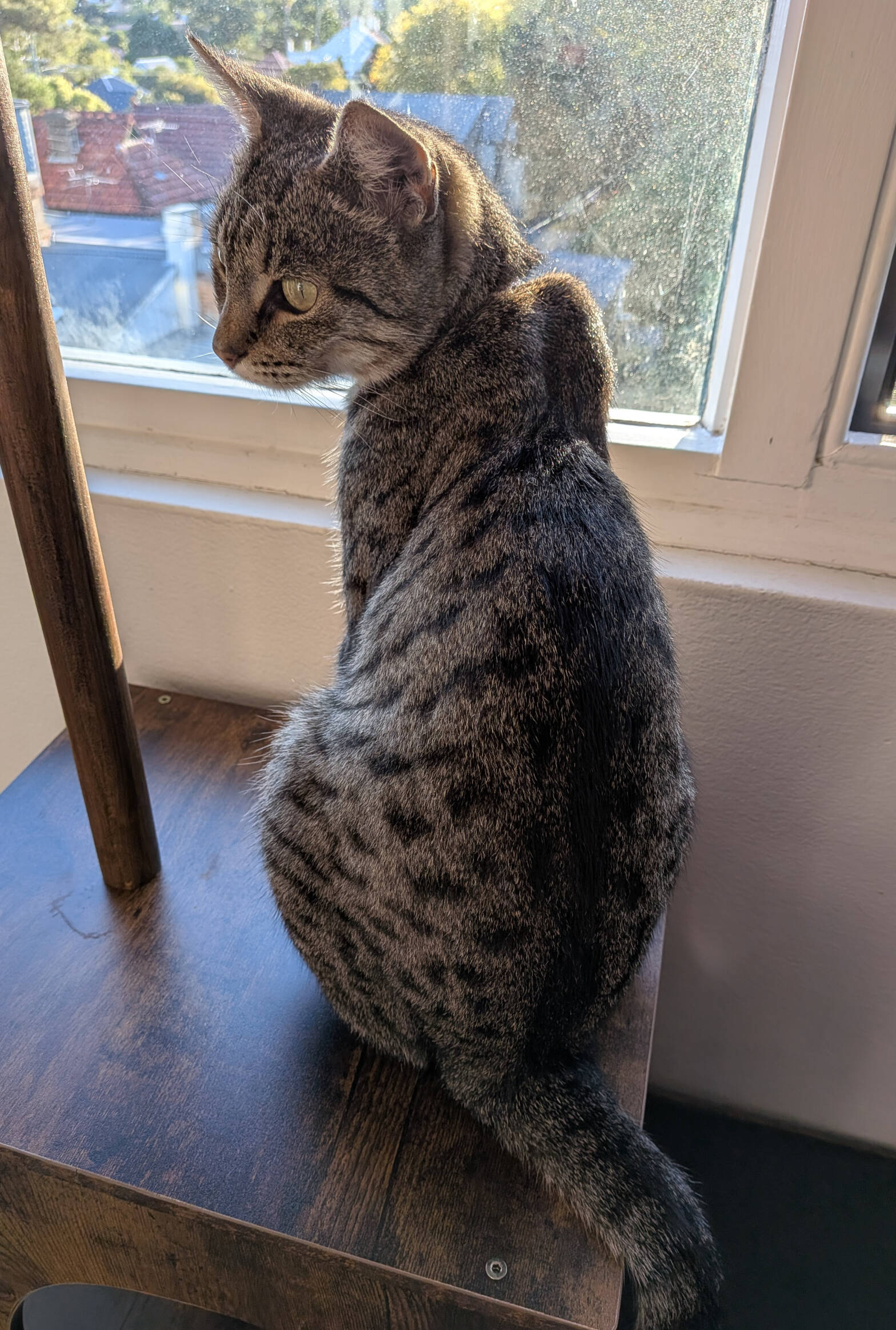
We adopted a cat five weeks ago. Her name is Mimi and we affectionately call her Memes. She celebrated her 1st birthday this week.
I wonder about her life. About her past as a stray on the street. About what she really thinks of this apartment and these two humans that are now her loving companions.
Mimi is vicious when pouncing on a bee soft toy; tender when snuggling to be brushed. She closes her eyes and nudges her head towards the window to smell the outside air. She perches on a shelf and watches us go about our busyness. I bow to her while blinking slowly, doing my best to communicate love and safety.
Since Mimi has come into our lives, I’m moved by her softness and the raw animal of her being. I’m touched by the divine aliveness that fills her graceful movements.
I’m humbled by this creature that depends on me to survive. I come across a reddit thread asking what to do in their cat’s last days. I know it’s likely I’ll outlive Mimi and be witness to her death. The sadness I feel is poignant and clarifying: I choose to move closer and to love her more even though it risks greater pain.
I sit quietly and consider this imaginally. Mimi offers herself to my imagination. The image of self, other, and world has shifted to include her. The threads of my life are now interweaving with Mimi’s. A new meaningfulness unfolds, felt but not named.
Where there is love there is image. When we open to something and find this sense of love, we can recognise that the imaginal is working away in the background, concocting a sense of things, finding our place in the world.
This is a different move from reducing suffering or letting go of clinging. Sometimes it also opens us to grief and pain — there is always that risk. What it promises in return is deep meaningfulness, found in the particulars: softly breathing curled up in a ball, meowing in excited greeting, yawning after a long nap.
—
The meditation workshop on Imaginal Practice I’m leading is coming up next week. If you feel the world offering itself to your imagination, come explore with me.
The body is already image, in the sense that our mind is always creating the sense of the body, holding a way of looking at the body that renders it a certain way. In this practice we intentionally bring in different images to notice what happens in the body space. Sitting as a mountain, as empty space, as a vast sky, or wrapped head to toe in fine cloth — each of these does something to the felt sense of the body, shifts or alters it in some way, even just subtly. Then we open to letting an image form, becoming receptive to whatever might appear in the mind, trusting the image as having meaning. This all points to the insight that images are always occurring and that the way we relate to the body and to image is always intertwined.