The ordinary, lower case “s”, relative self is vividly appearing, yet empty. This emptiness is a lack of inherent, substantial, permanent existence. Seeing through the self means to notice that it isn’t fixed, solid, or permanent and doesn’t have to be where you are coming from. This practice investigates the ways in which you feel the self — body sensation, sense of location, thoughts, inner coach/critic, dialogue, or self image. Then you will look closely and see that there isn’t any substantiality to this, that the mind is gluing together sensations and treating them as solid. You’ll find that the self is ultimately unfindable. Once you reach a sense of conviction here there will be a lightness and relief.
You will also explore how the sensations, thoughts, and emotions don’t encapsulate your being and instead notice how when you put all these aside you are left with either a Presence or Absence, which points to a knowing awareness — an awareness that knows itself by itself, without having to be coming from the small self.
Note: these practices can be somewhat destabilising or lead to a sense of disconnection. If you are feeling under-resourced or unbalanced, please be cautious. If you find the practice leads to disconnection then re-ground yourself by noticing present moment sensations and doing normal activities. Reach out or speak with a qualified teacher if you experience continued difficulty.
There is a short talk at the beginning. Guided meditation begins at 3:15.
Take the view that all sounds are like waves emerging out of an ocean of awareness. Each sound is known the moment it arises, by this awareness — the sensation and the knowing are inseparable. By tuning in to this quality of sound, you can take the view that all sounds are washing over you, known as expressions of this spacious awareness. Then you will turn towards internal experience and see that thoughts, emotions, and the sense of self also all arise within spacious awareness. Seeing this allows all internal experiences to be there, held within this bright ocean of awareness. This leads to a sense of being deeply connected with everything that arises, fully allowing all of these expressions to be there, while not having to be the self that it is happening to. Instead, you can simply be the spacious ocean of awareness.
Meditation presents the opportunity to cultivate both calm and clarity at the same time. This leads to a quality of mind that is, compared to ordinary states of mind, more alert while also being more relaxed. This is a state of deep resource. It allows for nervous system regulation and being connected and engaged. From this collectedness of mind, craving and aversion arises much less intensely. In this practice you will use the sensations of the breath at the belly as a way to ground and settle, allowing experience to simplify. Then you can bring in the practice of focusing on the inhale to bring more energy, drawing upwards; while using the exhale to relax and settle, drawing energy downwards.
Emotions are essential to being human, yet we often aren’t taught emotional literacy or provided models for feeling into and skilfully respond to our emotions. This practice works through different levels of experience — sensations, mind states, and emotions — in order to understand internal experience. Beginning with sensations, you will notice where there is body sensation in terms of warmth, coolness, pressure, texture, tingling, or vibration. Then you will look at mind states: boredom, curiosity, focus, clarity, dullness, sleepiness, etc. You’ll then tune into emotions and see where hearing the words of certain emotions resonates with you — feeling into anger, sadness, happiness, calm, strength, or fear, and the many variations and flavours of these feeling states.
Note: This practice invites you to bring up positive emotions, which can at times also have the effect of bringing up anything that is not that emotion. Be gentle and cautious.
Positive emotions, when freed, become boundless and unconditional. In meditation practice, we can intentionally bring to mind love, compassion, joy, peacefulness, trust, gratitude, kindness, friendliness, humour etc. by intentionally recalling a situation when we felt that way. Through feeling into the felt experience of that emotion, we can notice that the sensations felt in the body, such as warmth, openness, uplifting, groundedness, or connection, don’t have a solid, inherent existence but rather are insubstantial and changing. We can also sense that the self that feels the emotion is insubstantial. The emotion is vividly expressing, without needing to have a solid core, or a separately existing self that is feeling it. This frees up the emotion to be fully expressed and fully felt. The emotions then transform and become boundless and unconditional — compassion for the suffering of all beings, including yourself equally; boundless love for all others; or a deep gratitude for being able to be part of this complex dance of life.
Attunement is picking up on the relational field so that you have an embodied felt sense of what is going on for you, both individually and collectively. It’s about openness and acceptance of another. It’s seeing and hearing the other person, just as they are, without trying to change them. It’s much easier for me be kind and compassionate when I have a sense of what someone else is feeling – this is when I can really understand what they are going through and connect with their suffering, regardless of whether there’s anything I can do about it. By attuning to another, I am meeting the other person’s need for contact, while also allowing my own need for contact to be fulfilled.
For me, I’ve found difficulty with self-attunement, that is, knowing what I’m feeling. Sometimes this is not knowing I’m dysregulated until after the fact. Other times it’s letting frustration or anger build up without being clear about what factors are contributing to it. Sometimes it just takes me some time to realise I’m sad. I also sometimes have had trouble picking up on other people’s emotions, especially if they aren’t communicated explicitly. I just find it hard at times to know whether someone’s body language and slight change in affect means they want something or want to be left alone. The practice of attuned noting has been a great help.
Relationships require attunement. When we are spending time with others, and especially if we are close to someone or spend a lot of time with someone, we pick up on how the other person is feeling and base our actions on that, at least to some degree. The trouble arises if it isn’t so easy to know what the other person is feeling or if we ignore certain cues and signals. There’s three aspects to this: 1) I have my own feelings that I may be more-or-less consciously aware of. 2) I am expressing these feelings in some way. My feelings are influencing the relational field. 3) The person I am with picks up on the relational field.
For a lot of people, knowing your own feelings can be tricky. Feelings shift and change, and your awareness of them comes and goes. This influences what we express, and how skilfully our feelings are expressed in our words and actions. This then influences what the other person will pick up on.
It’s a relatable human experience to be told something about what you are doing and to only in that moment learn that you are feeling a certain way. For example, I didn’t know I was frustrated until my partner pointed out that I’m hunched over and making grrr sounds through gritted teeth while trying to fix a broken electronic device. The expression of feeling and emotion is always happening, even when unconscious.
Ideally, I would know what I’m feeling, I’d express it in skilful ways (appropriate to the situation), and people around me would pick up on this and in turn respond appropriately. This clearly isn’t always the case. It is also an area that can get more and more attuned and refined.
Noting Feeling States Meditation
We can practise noting “feeling states” in order to be more consciously aware of what is arising and to be able to put into language the present moment experience so that it can be picked up on by others.
In this practice the term “feeling state” covers emotion (anger, sadness, joy), mind states (boredom, curiosity), and also the sensory experience in the body that I have that co-arises with emotion or mind states (when feeling anger I feel warm in the face and tension in my arms and hands, or when I notice a mind state of curiosity there’s a lightness in the chest and head). The emotion, mind state, or sensation are all equally valid doorways to knowing what is present for you in that moment.
Importantly this practice held within a container that is agreed upon and made explicit. There’s a set time for the practice and the intention is clear. Try to ensure that the method is understood. This means that it can become a space where there is an appropriate level of intimacy and vulnerability. The goal here is to create a space for simply connecting with how things are right now. It’s not about complaining, or trauma dumping, or oversharing. If it starts to lean towards stories, blame, or trying to understand why a feeling is present, be cautious. Acknowledge what is present on the level of the feeling state (the sensations and emotions are something that you can agree is the present moment experience) – try to bring it back to what is present and how this feels in the body.
This is a practice of out loud labelling, with one person noting their present moment feeling tone and the other person attuning to what they are saying and feeling.
The practice is straightforward once you get the hang of it. Here are the dot point steps:
Instructions for Noting Feeling States – Dyad Practice
Create a container
Find a space that is calm and quiet enough that you can do this without interruption. It helps to face each other, or at least be able to see each other. You might like to sit in a different location from regular activities.
Make sure you both know enough about the practice intention and structure to feel enough safety to proceed, and discuss if there is some hesitation or apprehension. Acknowledge these feelings.
Set an intention together. Something brief tends to work, such as “to find connection”, or “to explore attunement together”, or “to know how we are both feeling right now”.
Decide on a length of time to practice for and the steps to take. Set a timer if that’s helpful. Choose who will note first.
Time in silence – 1 minute
Take some time in silence, optionally with eyes closed. Connect with your internal experience. Notice what is present for you. Allow whatever is there to be there, without exclusion. You may notice physical sensations, thoughts, emotions, and stories or parts of the mind.
Noting and Attuning – 2 minutes each
The noter begins labelling their present moment feeling tone experience out loud (eyes can be open or closed). Aim for a steady pace, around 5 seconds per label tends to work well. You might say things such as: “calm”, “bored”, “agitated”, “happy”, “love”, “anxious”, “humour”, “tender”, “vulnerable”, “frustrated”, “stressed”, “excited”, “joyful”, “murky” etc. There’s always a pressure release option – you can say “don’t know” or “unclear” or “pass” or simply be silent.
While the noter is saying this out loud, the attuner listens and watches, holding space for the noter and connecting with what they are saying and feeling. Tune in to the noter’s tone, rhythm, breath, and subtle facial expressions. The attuner might notice correlations, or they might even intuit what feeling state is arising (there might also be guesses that don’t match up). Notice how it feels to attune and if there is a sense of alignment or misalignment. Listen with presence and allow whatever is taking place to unfold.
Check in and debrief – 3 minutes
Take some time to debrief and talk through the experience. How was that for you? What did you notice? What was challenging? What came more easily? What helped you engage with the practice?
Conclude the practice. Take turns to speak about how you are feeling now, and if there’s anything you need, or some way you will move forward from here.
Extra Tips
The time durations here are just suggestions. Start with something short that is easy to commit to as a low-cost experiment. You can even spend just one minute on each phase.
When noting these feeling states, there’s a few interesting things that occur.
You might find that the states change more rapidly than you expect. This happens because when paying attention to the feeling state it brings more clarity to the emotion and sensation, leading to identifying more complexity and richness, as well as a faster rate of change than you may have previously noted. By saying the label out loud, you are also palpating the feeling state, meaning that you are giving it a little massage that makes it change or shift in some way. The degree of equanimity and acceptance also contributes to this, allowing those present moment states to be there without any need to change them allows them to shift more rapidly. Acceptance leads to change.
The states that you notice might vary wildly, even moment to moment. You might be noting “humour” and then the next second “anger” or “sadness”. There might be “strength” and then shortly after “feeling small”. You might also find it helpful to label things like “thinking”, “story”, “belief”, “remembering”, “planning”, “fantasising”.
There are also a range of labels that are worth familiarising yourself with as they help when you aren’t quite clear on what is there, labels like “something”, “blank”, “vague”, “murky”, “unsure”, “don’t know”. You might also notice that the feeling is changing rapidly, in which case acknowledging this might help, such as “changing”, “shifting”, “flowing”, or “feeling”.
It is normal to find it challenging at first to locate the feeling tone and to note continuously. It’s perfectly fine to say you don’t know or to label “blank”. It might take some time just noting blank before you discover a distinct feeling tone. No problem. The key here is to tune in to what is present for you — the truth of your present moment experience is whatever you are aware of, even if that’s nothing distinct!
For me this has been a high value practice. There have been plenty of times I’ve felt like I didn’t want to do it before we started, but I don’t remember a single time when I didn’t feel glad to have done it afterwards.
Find a friend and try it out – see for yourself if this is valuable. If you are curious and want to try it out in a welcoming space, you can come along to Sit For A Bit, or get in touch with me.
Note: this practice involves intentionally working with challenging emotions. If you are currently not feeling grounded and resourced, you may want to choose a different meditation. If at any point during this practice you feel overwhelmed or disconnected from experience, open your eyes, come out of the meditation, and do something that you find grounding such as gentle movement, walking, eating, or resting.
When related to in skilful ways, all emotions become part of the practice. Here you are asked to bring to mind a challenging emotion of medium intensity (around 5 out of 10), such as frustration, tiredness, sadness, anger, or shame. You can recall a situation or memory when this emotion was activated, using the visualisation in order to bring the experience forward more clearly. You are then invited to look closely at the sensations and thoughts associated with the emotion, seeing them as insubstantial. After searching, you’ll find that there is no substantial, permanent core of the emotion that is inherently existing. You can also search for the self that feels the emotion, also coming to the conclusion that this is ultimately unfindable. In this forge of emptiness, the emotion may then shift and transform, allowing anger to shift into strength, sadness into tenderness, frustration into clarity, tiredness into deep rest, and shame into integrity.
When we experience painful sensation, we generally resist it, want it to change, or otherwise have some form of craving and aversion. This is wanting things to be different from how they are, either by trying to get something better, or by trying to get rid of what is present. The way of non-clinging releases this resistance. You can notice the sense of clinging through detecting contraction, stuckness, or resistance in the body, then you can release this by opening, softening, and allowing. Be present with this experience exactly as it is. This will open up a different way of being, with more lightness, openness, and freedom. Note that this is equanimity in regards to the primary experience in the moment, which still allows for taking action as appropriate to the situation.
In becoming aware of the sense of self, it greatly helps to have a practice that enables shifting out of habitual modes into a more open and spacious awareness. One key to this is noticing the awareness, rather than objects of awareness, which creates a shift towards allowing. The self is known by this awareness (as well as body sensations, thoughts, and emotions). This beholding awareness can know the self as it arises and passes, as the sense of solidity increases and decreases. This also helps us tap into the sense of completeness of being awareness — where there is nothing missing and no self-deficiency.
This practice begins with belly breathing while counting the length of inhales and exhales, moving from equal duration, to longer exhales. This is a powerful practice for quickly calming and grounding.
I’ve just left a Zoom call for a self-organised online meditation group and I’m buzzing with an open tenderness. It’s a small group, four of us chatting tonight for an hour. We take it in turns to speak about our practice and anything dharma-adjacent: sharing our challenges of pain and fear, our celebrations of meditative insights and deepenings, and our contemplations on this complex existence. The group feels like a gift, a treasure. It’s a space of heartfelt connection and playful joking. There’s a tone that is somehow both totally uncontrived and deadly serious about awakening. I feel waves of gratitude and appreciation for these other humans and their willingness to connect.
During the call I share that I’ve been thinking about sangha and how grateful I am to have people who listen and understand when I share the contents of my mind. This has opened up a deeper dimension of friendship than I experienced in my first 20+ years. It has also been invaluable to progressing on the path and in life. I talk about how much it helps to just have people who will listen, and that I trust. Sharing this to the group feels like it folds these threads together, my words are understood and find a palpable resonance. My travel companions nod and smile in joyful agreement.
I’ve been gifted with many great sanghas. This online group has been meeting since 2020. I have a number of teacher friends who offer support and guidance and shared understanding. I have dear friends who are devoted to different aspects of the path that help me to expand my understanding (special shout out to my friends dedicated to the practice of Awakened Connection, for the cherished friendship and the gifts they bring). I also have a growing camaraderie with my classmates in the Aletheia Training Program, which has opened up new doorways. Through online groups, I’ve also developed friends that I will keep for life, that will always have a base of understanding to return to. I’m also so grateful for Coalescence Sangha, for everyone who joins the events I lead, and for the amazing team that has helped me offer retreats!
The lovely retreat team!
I’ll go out on a limb and say that sangha is the most important dimension of meditation practice. Having friends that meditate is a better predictor of whether you’ll stick with the practice and deepen practice than any other measure.
Why is having meditation friends so helpful? Sangha is the convergence of social acceptance with interest and meaningfulness – and meditation, practised deeply, cannot help but touch on the deepest and most meaningful aspects of our lives.
It’s undeniable that we are social creatures. Humans have a social capacity that is deeply ingrained in our biology. We take in the culture that is around us; we absorb what we are surrounded by. We can find so much joy and fulfilment in our relationships. We also find that a lot of our deepest needs are around social qualities: love, acceptance, safety, and value. When these aren’t met in satisfying ways, it leaves us hurt. Unfortunately for many of us the greatest pain and difficulty in our lives tends to come in relationships that failed to meet these needs.
Sangha has the capacity to repair this hurt through the offer of contact and connection. Sounds lofty right! But all great journeys begin with a single step.
For me, it has taken some time. At first, I was shy to open up and often felt like there were parts of my experience that simply weren’t okay to share. It’s been a process of folding this in, beginning with saying when I did feel uncomfortable or uncertain, even if I didn’t know what that was about – and to be seen in exactly that experience.
When I turn up to these groups and I share my experience, I gradually open up, and I am seen and understood. I feel held and appreciated, exactly as I am. It’s a felt experience of the practice coming through in relation: I am becoming more equanimous with my experience as others offer being with. I deepen my contact with myself and with others and in doing so it reveals a depth of experience.
Now I’m going to quote a sutta from the Pāli Canon, because I love hearing this, and I think I’ll keep repeating it until I no longer can.
Ananda said to the Buddha, “This is half of the path: admirable friendship, admirable companionship, admirable camaraderie.”
“Don’t say that, Ananda. Don’t say that. Admirable friendship, admirable companionship, admirable camaraderie is actually the whole of the path. When one has admirable people as friends, companions, & comrades, one can be expected to develop & pursue the noble eightfold path.
— Upaḍḍhasutta, translated by Thanissaro Bhikkhu (with my own adjustments of gender, epithets, and emphasis)
This sutta points to the meaningfulness and significance of having friendship, companionship, and camaraderie – it isn’t an auxiliary to the practice, friendship is the practice. We practice in our relationships, and our relationships sustain our practice.
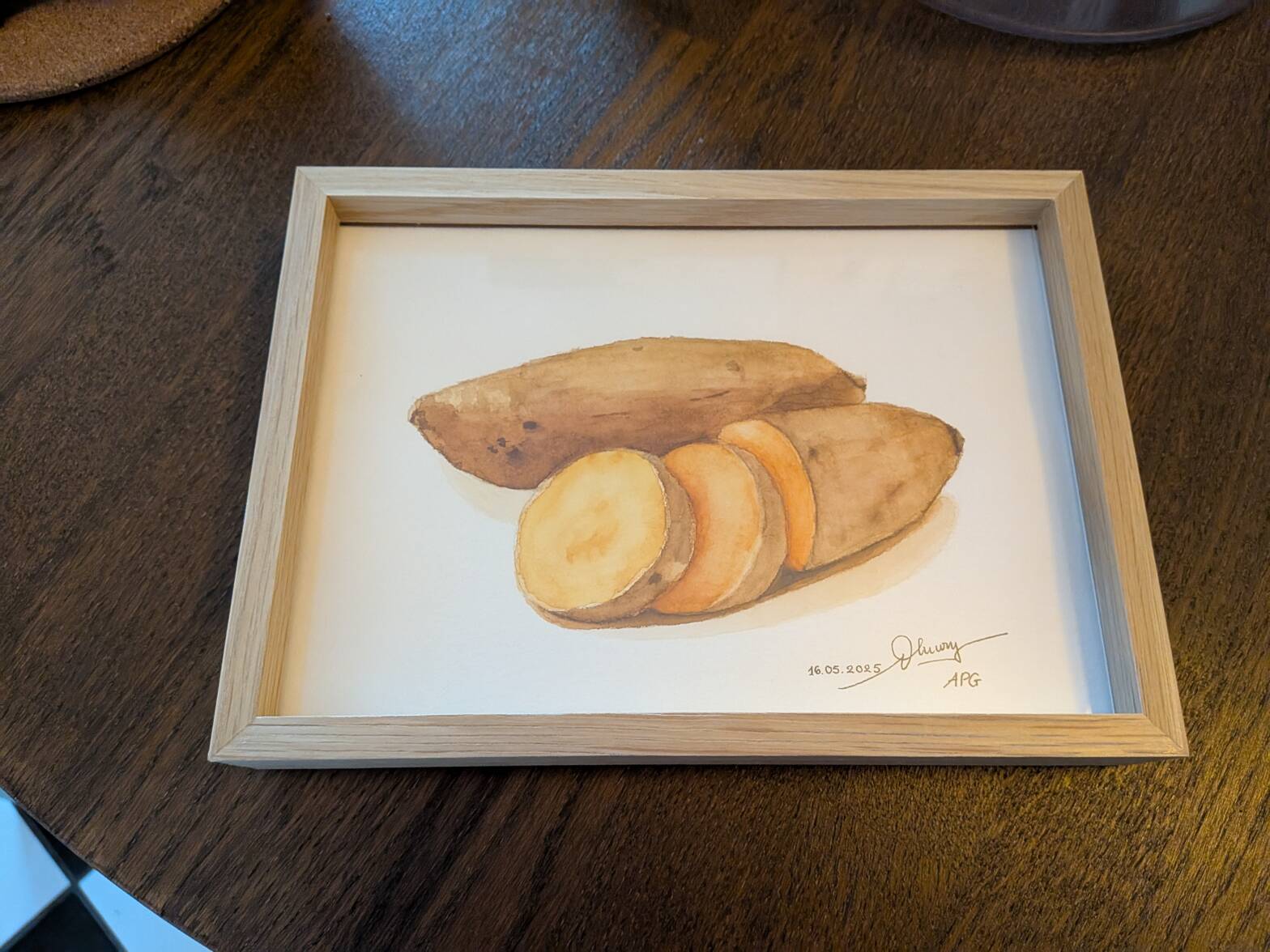
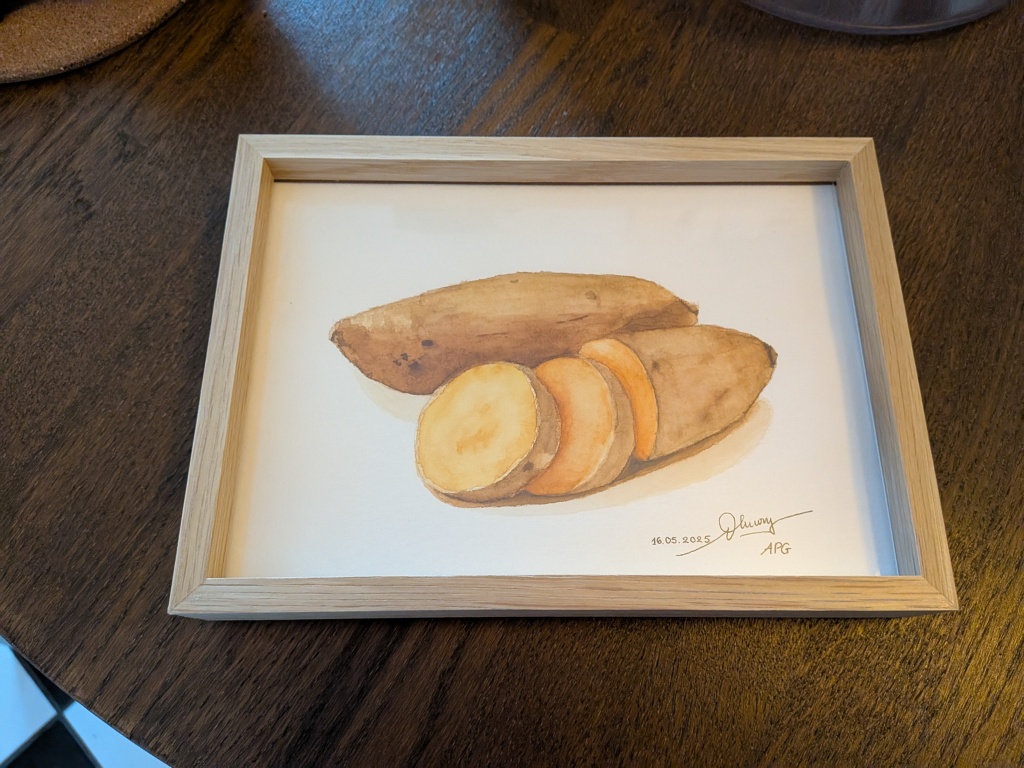
Sweet Potato Sangha — a painting gifted to me by Ju, I don’t know the artist unfortunately!
How can you find sangha? First, reflect on how sangha fits in with your life and if it matches your intentions and values around practice. Maybe you already have some sense of community – this is an invitation to check in and offer contact. If you feel you could do with more connection, start with finding someone you get along with. When you join a class, if you resonate with someone, reach out and see if they want to chat. Find other people online or in-person that share an interest in meditation, and especially if they seem to be exploring in similar ways. Build from there, step by step. You might just have one friend you chat with, a family member you sit with, or a pal who has read the same dharma book as you. You might like to form a practice pod and have others you check in with. Then you begin the process of connecting and gradually finding ways to be with each other in good friendship.
Sit For A Bit has been a beautiful chance to practice with like-minded folks walking distance from my home in the Inner-West of Sydney, a far-off dream when I started meditating and only knew of people on the internet who were interested in this. I hope that it can help foster the kind of community that leads to this admirable friendship and to provide a spark of connection in the practice. Come join some good meditation friendship : )
Reply and let me know what you find most valuable in sangha – I love collecting stories of friendship and hearing people’s appreciation for their meditating friends and communities.