A quick warning and disclaimer: I talk about mental health difficulties and systemic issues here. This writing is without gory details but please consider your state before proceeding. This text is from my perspective and your experience will differ, please take what is useful and leave the rest.
–
This is a series on meditation and burnout. I’m thinking through the causes of burnout, why it is such a challenging experience, what to do in the moment, meditation practices that create important shifts, and developing an understanding that will lead to burnout being done with, for good. This first part sets the view that burnout is sustained by external and internal systems and that self-compassion is the key to beginning practising with this.
Let’s begin with a definition. Burnout arises when demands exceed your capacity. It is a state of depletion that results from an extended period of stress and demand without appropriate support. Burnout is associated with chronic stress, working in caring professions, caring responsibilities, big life events, activist work, or perhaps just witnessing the turmoil of the world with little recourse.
Burnout is a state of emotional exhaustion, depersonalisation, and sense of hopelessness. The phenomenological experience differs person-to-person: it can be felt physically as a heaviness, pain, or tiredness that is not relieved by sleep; emotionally as a sense of misery, flatness, malaise, or depression; or felt existentially as a sense of hopelessness, futility, or worthlessness. Burnout generally comes with a decrease in skills and capabilities: moving and thinking in slow motion, problems seem harder, increased self-criticism, finding the right words becomes a challenge, your memory falters, task-related skills deteriorate.
It brings to mind Samuel Beckett’s refrain: “You must go on. I can’t go on. I’ll go on.” It’s the drive to continue to perform, care, and give effort after the resources have been used up.
So much of being a human is dominated by a sense of separation. There’s an underlying sense of being an individual entity that is somehow outside of the environment. Yet when looked at closely, your being is intimately interwoven with all of existence. You are made of the same minerals as the Earth, a home to bacteria and micro-organisms, your body is sustained by the air and sunlight. Each person you know has affected your existence, and you have affected them, in ways that can be pointed to directly. By resting into a sense of non-separation, you can find a prior sense of relatedness; a sense of the field of relation that comes before separation.
Letting be is a core principle of Buddhist meditation (and perhaps a key tenet of all spiritual practices). To let be means to be with what is experienced, exactly as it is, with no need to change it. In this meditation, you will be guided to bring a curious, welcoming awareness to whatever is arising, gradually including sounds, sights, body sensations, thoughts, and emotions. The key here is welcoming any resistance. To aid this you can visualise resistance by seeing it as a Part of your mind and letting it take a form, or imagining placing it beside you. You can also use the trick of taking whatever is causing difficulty as unchanging — the one permanent thing in the universe — as a way to release the urge to change. Finally you will explore the felt sense of your whole body in this moment as the unfolding experience that is more than words and somehow in excess of what is present. Ask yourself: can I be with this, exactly as it is, with no need to change it?
This is an excerpt from a talk at the Day of Practice. I offer some thoughts on Presence, Buddha Nature, and Awakening. For me, I got into meditation to experience benefits such as relaxing, focusing, and improving my mental health. While these did come, the biggest shifts occurred when the practice opened to something more profound. Here I offer a way of thinking about what we are doing in meditation and where the path leads — towards recognising the interconnectedness and relatedness of all things, and to understanding ourselves as an integral part of the whole.
Meditation practice can be finding methods to get out of your own way. The sense of self and operating as an individual self, while really useful in daily life, is a limiting factor on your sense of existence. By dropping out of your habitual patterns, more opens up. This practice focuses on relaxing and settling through tuning in to the present moment and then following the sensations of the breath. While doing this, you allow all other sensations to come and go in the background of spacious awareness. Then finally you will drop the breath or let it fade into the background and simply be — allowing all the body sensations, sounds, thoughts, and feelings to come and go, without getting caught up. The universe continues on, vividly appearing, without you having to do anything at all.
In this practice you will be gently guided to relax through connecting with the body, feeling into each body part and inviting relaxation. This relaxation is a kind of doing less — there was already some tension or tightness and you are simply intending to release this. You can also relax *around* any tension you find. This relaxing is a mode of allowing the sensations and feelings to be exactly as they are, reducing any clinging or aversion. Finally you will check in with how you are relating to the experience and if there is any resistance, embracing and allowing this. When resistance is fully allowed, it too will shift, soften, or change in some helpful way.
Fully give yourself permission to relax. Allow all of what arises to pass by like clouds in the sky. This guided meditation provides instructions on skilfully ignoring all content that arises by gently bringing attention to a sensation in the present. By keeping close to the present moment, experience simplifies and settles, allowing a sense of well-being to grow. This is a great practice to come back to in times of turbulence or busyness in order to drop into relaxation.
The body itself is made of atoms, which are mostly empty space. You can find a sense of freedom and refuge in the body through tuning in to spaciousness that arises within the body. This practice explores ways of opening to a wide-open, vast, spacious awareness. First you will allow the body to settle by connecting with the breath and then expanding to include the whole body in awareness. From here you can tune into the shifting, changing, flowing, impermanent sense of the body sensations, noticing how the body is open, empty, transparent, and light. Tuning in to the sense of space in the body, you can open to this sense of lightness and openness, and then opening to the sense of a vast, spacious awareness that holds the whole body, and all of experience, bringing tremendous relief.
Reflections on different phases of meditation, what it means to deepen practice, and how an emphasis on trust, confidence, and humility can allow the practice to unfold.
You don’t know what you don’t know
There’s a Deepening Meditation Practice Course coming up in January that Upali and I co-teach (details), which had me pondering who exactly this course is for. We have some text on our website that says it is for “intermediate to advanced practitioners” (the text may have initially been AI-generated ^_^). It got me thinking about whether there really are intermediate meditators and what would be a useful way to self-identify in terms of meditation experience and orientation.
At my talks and Day of Practices (or is it Days of Practice like Days of Our Lives?), I sometimes poll those practitioners I don’t already know by asking how much time they have spent meditating (in their regular formal sits, their consistency of home practice, the number of months or years they’ve practised for, time spent on retreat). I’m using time spent practising as a proxy for how deep they have gone in their practice, which has some utility but obviously doesn’t tell the whole story.
The thing that seems to more reliably point to a high level of experience is to talk to them and see if they have confidence, faith, and trust that the practice does something. This trust is not because they have some high level of skill, but comes with the humility of relating to the practice in such a way that they know it will do what it needs to do. Allow me to expand on this.
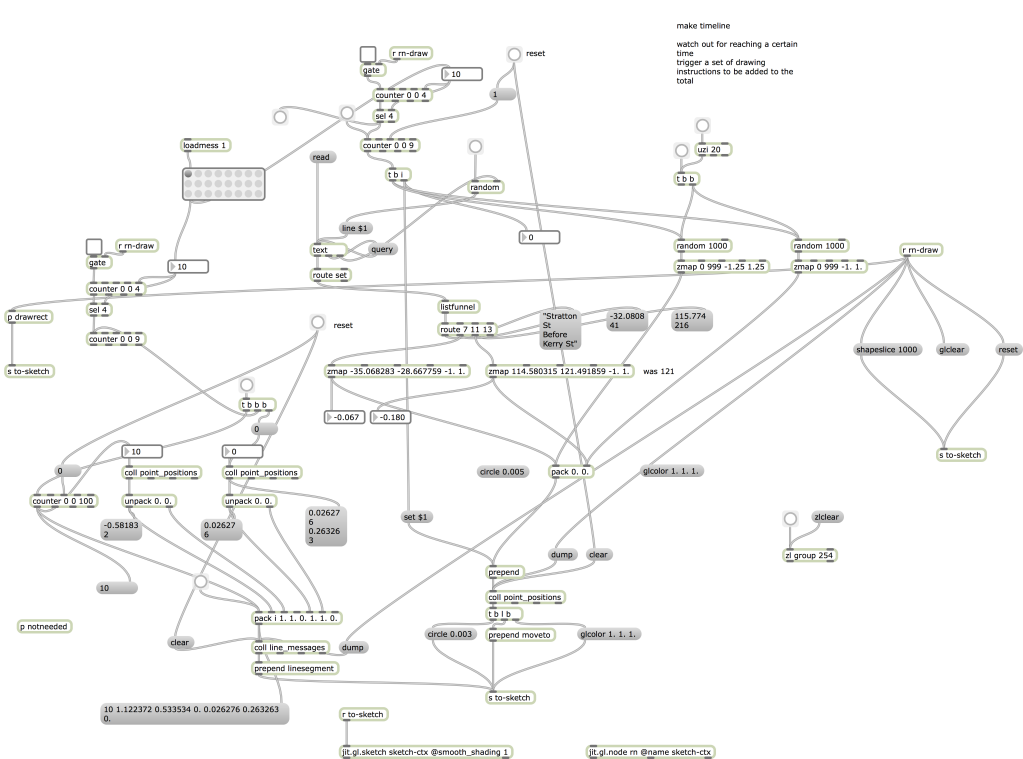
When I was studying music technology, we learned a piece of software called Max/MSP (now known as Max, and yes this was very confusing at a time when everyone was using Apple Mac computers). This is a graphical programming language where the user drops in boxes, types certain commands into them, then links them to other boxes. Some of those boxes generate sounds, some manipulate video frames, some perform mathematical functions or send control information. It was a lot of fun for me. I felt like I learned something key about how to program computers: writing explicit instructions, debugging by checking the output to see what wasn’t doing what I intended, and building up a system by breaking the problem down into small components and building it bit-by-bit. I dove into it. I was obsessed. I completed all the tutorials, started making my own projects, and generally could not get enough of programming — oftentimes to the detriment of my sleep.
An excerpt of a patch of mine that renders graphics based on data.
In the communities around Max/MSP they said that there was no such thing as an intermediate user. That people using the software either were beginners, or if they had given it time, were now serious users. This was partly because of the steep learning curve. People tended to start from a place where they didn’t really have any idea of what to do. Then, if they were able to persevere through a period of confusion and bewilderment where they made mistakes, experimented, and learned how to use the software, they would emerge on the other side with an understanding of how to program and get the computer to do what they wanted. At the time, the developers of Max/MSP explicitly didn’t offer intermediate resources: everything was geared either to beginners to understand how the system worked, or for more experienced users to learn about additional tools and modules they could incorporate to extend their patches. The understanding there was that people who had some experience could then figure things out and didn’t require explicit instruction. They worked it out themselves.
When I found meditation and realised it was something I could learn systematically, I did something similar to when I learned to program. I absorbed the 500 pages of The Mind Illuminated, rereading sections to clarify and motivate myself for practice sessions. I learned as much as I could. I was fascinated by the challenge of getting my mind to move in certain ways, to cultivate skilful qualities, and to understand something about the workings of the mind. It was like trying to program a computer that sometimes would follow the instruction I gave, but mostly it wouldn’t. Plus it had lots of emotions! The outputs of the system were rich and complex in different ways. Whereas with programming I could print the output to a terminal, or watch a graphical interface, with meditation I had to find other ways to troubleshoot, to guide, and to get a sense that the practice was doing something. It was challenging, but the challenge was what kept me interested. Gradually I started to see that I could cultivate helpful qualities of mind, that I could move the mind in certain ways, and that I could work with hindrances and obstacles.
I felt like I went from beginner to intermediate in the sense of developing a set of skills that enabled meditation to have some noticeable effect. The practice started making a difference, particularly in my experience of daily life and the ability calm myself and regulate emotions. But what I didn’t realise at the time, is that I’d actually become overconfident and thought that I could fix any problems I had with meditation. Because meditation worked, it was the answer to everything. This became a problem when I found myself unable to meditate my way out of difficulty, namely the burnout and exhaustion I experienced during COVID lock-downs due to taking on too much activist work, among a few other factors such as career dissatisfaction. I found myself stuck in a place that I thought I could use my skills to meditate out of, but my sits had become marathon sessions of twitching; my days filled with frustration and agitation. What got me out of this was feedback and repeated guidance from a meditation teacher, as well as an intensive process of therapy that helped me see how my approach wasn’t working.
This is where comparing meditation to programming falls a little flat. There is something that happens when working with the mind where it eventually becomes a process of non-doing that arrives at a solution. There’s a realisation there that the problem we have been trying to solve has been stated incorrectly from the beginning — in fact it is exactly this incorrect stating of the problem that causes all the stress and resistance. Meditation eventually becomes a practice of letting go of these preconceptions and formulations. It’s an unbinding that allows us to see a different truth in all of our experience.
I would argue that the difference in outlook as one progresses from beginner, to intermediate, to advanced practitioner is a sense of confidence and an ability to self-guide. At first, this self-guidance is about learning different techniques, learning how to move the mind with intention, and how to navigate hindrances. Figuring out how to use intention (read: mental decisions) rather than forceful, pushy effort is a big one. This phase will also often involve learning about tips and tricks, hearing about how others work through certain experiences, and gaining theoretical or conceptual knowledge to support the practice. There’s often a stage where this works very well and leads to a distinct increase in mental qualities such as calm and clarity.
But this self-guidance isn’t about always figuring it out. Eventually it becomes more of a meta-skill. Knowing that meditation doesn’t always give you what you want, but trusting that it gives you what you need. Or framed another way: being able to see meditation as an intimate connection with the unfolding of experience, just as it is. Knowing that for whatever comes up there is something true and real about that. That there can be an OKness with whatever arises that leads to doing less resisting.
This trusting is actually a bigger space of holding, such that it also allows doing and appropriately responding, without the friction of resisting the experience. I want to be clear here: I’m not saying everyone should practise just letting go. It’s a good idea to use the techniques and tools we have for balancing the mind and cultivating mental qualities. I teach these skills and love talking to people about meditation techniques. What I am saying is that there will be a point where these do not work. There will be a time when we can’t solve the problem, can’t control the situation. Then we need something else.
Another moment from university that stuck with me: I was talking a lecturer about a very skilled musician who I really admired. I was commenting on how on listening to their improvisation, they seemed to have mastered their instrument. The lecturer, who knew this musician well, said that the reason their playing is so skilled is because they know how much they don’t know. While this might point to a Dunning-Kruger effect (overestimating capability in areas we don’t know that much about and then underestimating capability in areas we know more about), I would posit that it also points to a kind of openness, humility, and acceptance in realising that there is always more to unfold. There’s a trust in the process itself, in the exploration and discovery, that is not so reliant on knowing how to do something well right now, of controlling the outcome.
To really trust in the process itself means embracing our own finitude. This trust can be terrifying. To really know that this physical pain, this rumination, this suffering is exactly how it is, right now — this is hard to fathom. To recognise our limited agency and the unreliability of phenomena is difficult. To see that the way we have been viewing reality is at a deep level causing our own suffering is challenging to our whole conception of self and world. Because it is difficult, we practice together.
Experienced practitioners know that they can’t do it on their own. Yes, they have trust in their ability to practise and the skills that they’ve worked on. But they also know that there are some things you can’t know about yourself. In fact, this is one of the core tenets of Buddhism: that all beings who haven’t yet reached full awakening are all operating out of delusion — a fundamental misunderstanding of how things are — that causes suffering. If we knew this delusion, then it wouldn’t be delusion and we wouldn’t be suffering. You don’t know what you don’t know. However, what we don’t know can be revealed in various ways. One of the most expedient ways to reveal delusion is by cultivating calm and clarity, then being in relationship with others in ways where we can inhabit an openness that helps to bring to light these misunderstandings.
In the Deepening Meditation Practice Course, we use the word Deepening because it points in a direction rather than to something specific. There are many qualities that you might want to deepen and it’s quite likely that meditation can help you to do this. It might even be worth asking yourself what qualities you want to deepen. Perhaps more importantly though, deepening also means to deepen your relationship with practice. To deepen your connection. To deepen your trust in the unfolding of practice, happening exactly as it needs to. This then allows for deepening of freedom and meaningfulness. No matter whether you consider yourself new or experienced; beginner, intermediate, or advanced; there is always opportunity to deepen.
This is a reflection on some of the formative moments in the earlier part of my meditation journey.
5 minute read.
I’ve been thinking recently about the moments in my own life and practice when things were not going so well and there was a small shift that put me back on a better course.
These key moments feel pivotal in finding a practice that worked for me and transforming my experience. I’m calling them inflection points because it feels like a moment in time where things could have kept tracking as they were or getting worse, but some event helped to push things in a different direction (I’m not knowledgeable in mathematics so please go easy if I’m using this term incorrectly, the best I could do is Khan Academy and it seems to support this use ^_^).
My background is that I went through an extended period of depression and anxiety and then came to practising meditation to try and shift how my mind operated so that I would not suffer so much. I remember a moment of realising, after coming out of a period of strong depression, that objectively my life was great and subjectively it was terrible. If I wrote down a list of the things in my life, it was great on paper, yet I was miserable. I realised there was something in how I was relating to these experiences, rather than the experiences themselves. I knew then I’d have to work with the mind as the thing that was turning these good things into suffering. So I had strong motivation to practice and a sense that this could work, but it took a number of key moments of support to get on track with practice.
1) Being given a copy of The Mind Illuminated.
I had grown up with Buddhism around (my Dad’s family is culturally Buddhist) and knew that meditation was a thing, I just didn’t know you could actually learn how to do it as a skill. I’d done yoga asana classes where there was a 3-minute meditation. A therapist had told me to meditate but gave me such unclear instructions that I found it basically useless. When depressed I also had an experience of reading about mindfulness, deciding to try it, found that it made things much better for a short period of time, and then being frustrated at being unable to consistently replicate that experience.
I was chatting with a friend about meditation, who knew much more about the topic than I did, and he gave me a copy of The Mind Illuminated. I started reading it and was shocked. I was amazed at the descriptions of stages and the progression of training the mind. More importantly I was glad to finally have some clear instructions on how to get started. Finally there were practical instructions around creating a space, dedicating time, motivations, and preparing for practice. There were clear instructions on how to follow the breath and cultivate stable attention. It was incredibly motivating and inspiring and helped me to first establish a practice.
2) Committing to consistent practice.
After reading The Mind Illuminated I still was only practising for short periods of time, mostly 10-15 minutes. Looking back, I think I just didn’t know any better. This is just what was around me at the time, in yoga classes, when I talked to others, in the meditation apps, etc. I probably thought the advice in TMI to sit for longer didn’t really apply to me.
Reviewing my journal from the time, I can see that I was sitting for short periods of time and judging my practice as good or bad based on whether I felt calm or if I could follow the breath the whole time. It was a frustrating process.
One day while casually cycling to go play pick up basketball, my friend asked me how meditation was going. When I said that I didn’t really feel like much was happening and that I wasn’t clear on what to do, he casually suggested that I sit longer. He said that it might just take more time for the mind to settle and that sitting longer might help to train the mind. This was just the spark I needed. I started sitting longer, although it took a while to take hold, eventually getting to 30 minutes after a couple of months, and then 45 minutes after about eight months of practice. I started noticing changes. It was like the previous meditation didn’t do enough to pass the threshold. Now I was actually seeing changes in the stability of my attention and the clarity of the mind week to week.
Looking back at my journal I can see that there was a shift from judging the practice to appreciating the awareness I was cultivating. I started approaching it more as something I could do each day to train the mind, no matter how the sits went. I started really being glad for the opportunity to practise.
3) Finding community.
It was at this point that meditation started working for me. I was practising more and finding that it helped me to at times feel better throughout the day. I was calmer and my mind was clearer. I started changing how I related to events and situations. My relationships started improving. I became more resolved to practice as I noticed how beneficial it was.
I was doing postgraduate study and decided that when I finished I’d give myself a gift of going on a 10-day retreat (I think most people would go on holiday or buy a Nintendo Switch, which might say something about me 🙃 ). The retreat was highly beneficial but was also somewhat destabilising as the insights were challenging to integrate, so I decided to start trying to learn more about meditation. I thought about getting a teacher. I read more dharma books and started following r/themindilluminated and r/streamentry. I came across Tucker Peck’s posts and found them to be clear and insightful. Perhaps more importantly, they were funny! I thought having a teacher like that would be good for me, so I reached out. I started meeting 1:1 with Tucker and found this to be incredibly helpful. It got me out of some ways that I was stuck or heading the wrong way. There were critical moments where I was practising with Wrong Effort or seeing things in a really deluded way that having a teacher helped to quickly course correct.
I also started going to eSangha (an online class for advanced meditators) regularly and have found that the community there to be totally amazing. I’m so grateful that it is today possible to form deep relationships with people halfway across the world. I made friends that I’ve talked with most weeks for years. For my practice, the friendships here have really encouraged me to be dedicated to practice and be honest with myself and others. It helped to find inspiration from hearing about how other people were practising. It helped to demystify the process and provide support and accountability. The Buddha says that the whole of the path is noble friendships and admirable companions, this seems like good advice to me!
Reflections
Looking back, I can see a number of phases in practice where it would have been easy to drop off. I also feel incredibly grateful that I have continued my practice as it has changed my life for the better in many significant ways. I’m lucky that I found something that helped me and suited my personality at the right time. I’m also super grateful that I had a friend to provide a few helpful tips. Stumbling upon these inflection points of being reoriented into a positive direction helped me to stay on track and find cumulative improvements. I can also see that the whole process would have been easier if I found community and support earlier. Reflecting on this is an encouraging reminder of why I’ve decided to teach and dedicate myself to helping others with their meditation practice.
I’m curious to put the question forward – what have your inflection points been? What moments have been valuable to orient your practice in a positive way? Feel free to write me!
If you’re looking to find ways to go further in your practice, you may be interested in the Deepening Meditation Course that I run with Upasaka Upali.