
The Elephant Path is an ancient meditation teaching, believed to be a transmission from the Buddha-to-be Maitreya and written out by Asanga in around 500 CE. It describes the Nine Stages of Calm Abiding — a map of how experience shifts as the mind deepens in meditation. In this meditation, we traverse all the stages, using the appropriate antidotes and techniques at each stage to progress to the next. Through this we move from scattered monkey mind all the way to effortlessly stable attention. By practising The Elephant Path, you learn how to navigate the mind and how to cultivate different states of mind. This makes the mind a nice place to be — not only from landing in calm and clarity, but also from the confidence of knowing how to move the mind appropriately to whatever is present at any given moment.
Tag: embodiment
Spaciousness with Stability

The practice of calm abiding culminates in effortlessly stable attention — you sit and focus, returning again and again, until it becomes automatic. There’s also a way to begin with effortlessness. Start by opening to effortless spacious awareness. Release the body and mind. Drop all effort, relax to the max, give up. Rest as the awareness that is already here and knowing. From that place of spacious ease, gently intend to care about the body. Through just the slightest intention, the body appears brightly and vividly in the foreground. Attention is stable without tension nor doing. Let go of everything and rest into the body.
Easing Into Effortless Calm Abiding

The path of calm abiding leads to effortlessly stable attention with equanimity and tranquility. A key to this part of practice is first building up to complete staying and then, when the time is right, easing up in effort. This easing up is a releasing, softening, and relaxing in such a way that the practice starts to flow by itself. Because of all the work done to establish stable attention and bright metacognitive awareness, the mind can, with only the slightest intention, rest into the body. This occurs at stage seven of the elephant path. You will ease up gradually, bit-by-bit, noticing if distractions again interrupt your continuity. When this works, it feels like the less you do the more focused you become, that there is no difference between meditation and non-meditation, and that there is a profound background stillness.
Finding a Path Forward
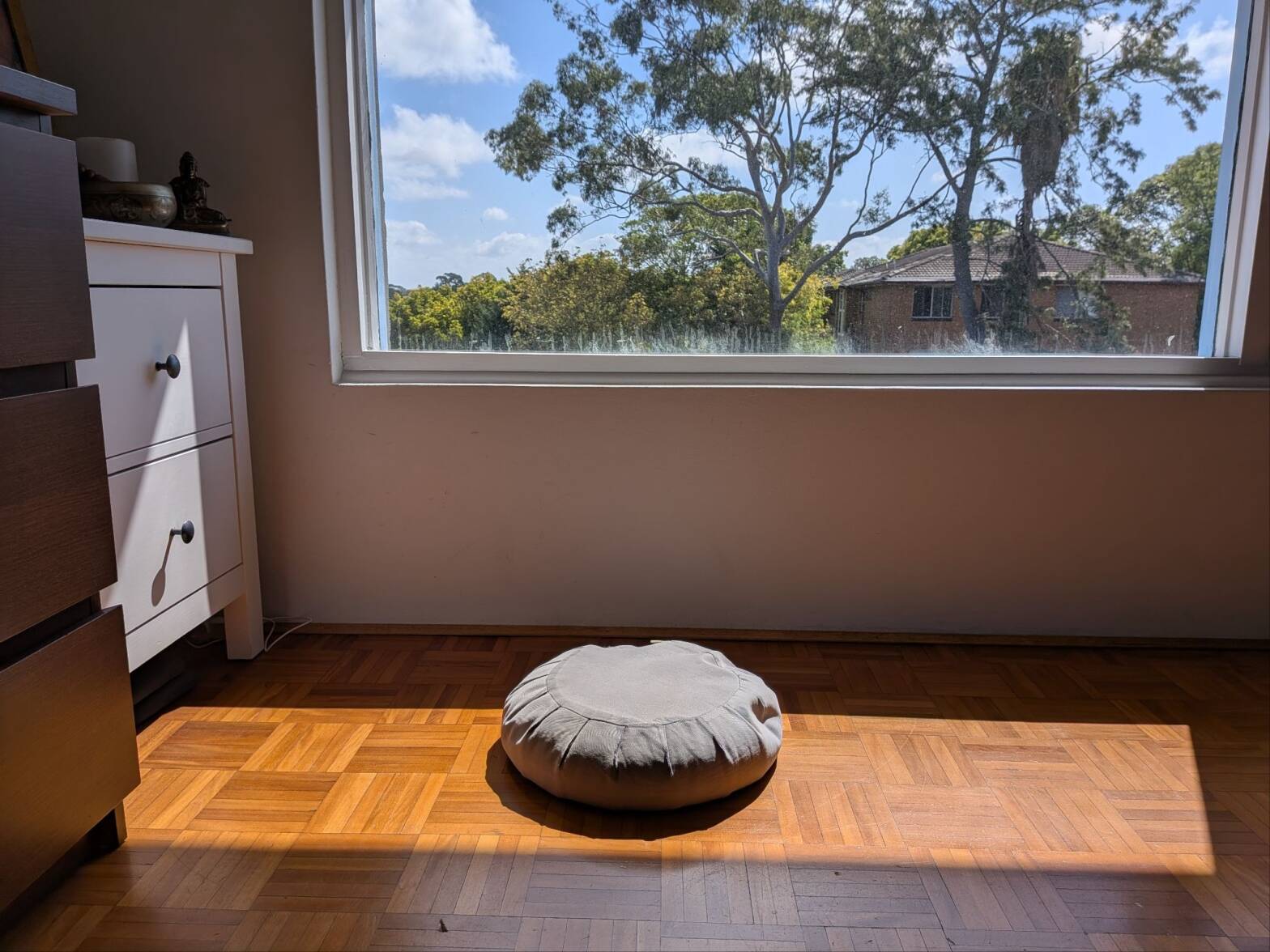
I’m sitting on the beige, scratchy carpet in the spare room of my unit in Maylands, a quaint-yet-growing suburb of Boorloo (Perth). I’m trying to meditate and have a growing sense of failure. I gaze at the light slowly crawling across the carpet. Restless and bored, I get up and do something else. Maybe meditation just isn’t for me.
Much earlier, I’m sitting on another carpet. This time I’m young, maybe nine years old, and Dad has offered to teach me to meditate. I’m thrilled, it’s all so mysterious to me. What happens when Dad goes off and sits quietly in the evenings? It could be anything! We sit on the floor in the front room of the house with the lights dim. Dad guides me to notice the sensations of my breath. I picture it like I’m watching an animation: breath coming into my body like flowing coloured lines moving through my nose, filling my lungs, then releasing on the exhale to rejoin the atmosphere. I enjoy the feeling of being calm, but I get sleepy straight away. I also feel like I’m somehow doing it wrong — I’m picturing something but it feels like I’m making it up, using my highly active imagination instead of doing it “properly.” Is this what meditation is meant to be? In the ensuing years I only meditate when in bed as something to do while waiting for my mind to drift off. I don’t recall us sitting together again.
I’m in a chair gazing over a busy Sydney street on a cloudy weekday afternoon. The recent move has been challenging and I’m in the middle of a spell of depression and anxiety. I can’t seem to break out of feeling this way through my usual methods and I’m starting to feel desperate. I come across a book: “The Mindful Way Through Depression.” While it sounds like it’s just what I need, I’m short of spoons and can’t summon the energy to get further than the title. Instead I read a short article online, remember yoga teachers talking about mindfulness, and try to do a practice. I bring my mind to the present moment sensations. I watch myself from a more objective viewpoint. I see myself drinking tea, walking up the stairs, feeling sad, obsessing about a stressful event. I watch a thought arise and pass and suddenly feel a freedom and relief I haven’t felt in ages: I don’t need to be so caught up. But this is only fleeting, fading away mere moments later. After I stop practising I’m right back to rumination. I know that if I could continue this mindfulness it would help but have no idea how to make it stick. It feels like I opened a doorway to a vast beautiful view that closed again in the blink of an eye. I have no idea what the key is to get the door open again, or to keep it open.
In each of these scenes, I felt like I had started school without books, anything to write with, or language to communicate with others. Without a framework and map, I got lost at every turn.
//
Once I got my head above water from the period of depression, anxiety, and burnout, I had a moment of insight. I realised that I needed to find some way of working with the mind. It was suddenly clear that my mind was turning an objectively good life situation into something miserable. I felt like I was stuck playing a cursed game that I had invented; I was trapped in a prison of my own creation. Something in how I was relating to experiences wasn’t working. I knew I needed something that would help me learn from these experiences.
A friend happened to give me a copy of the book The Mind Illuminated and I began practising consistently. I moved up and down the stages of The Elephant Path. The guidance I received in that book, combined with a few chats with more experienced practitioners, brought the practice to life. As I sat, I felt more calm and clear. I learned how my mind could so easily shift into criticism and place blame on myself, or feel responsible for things I couldn’t control, such as a moment of distraction. I saw, moment-by-moment, how my mind constructed this prison.
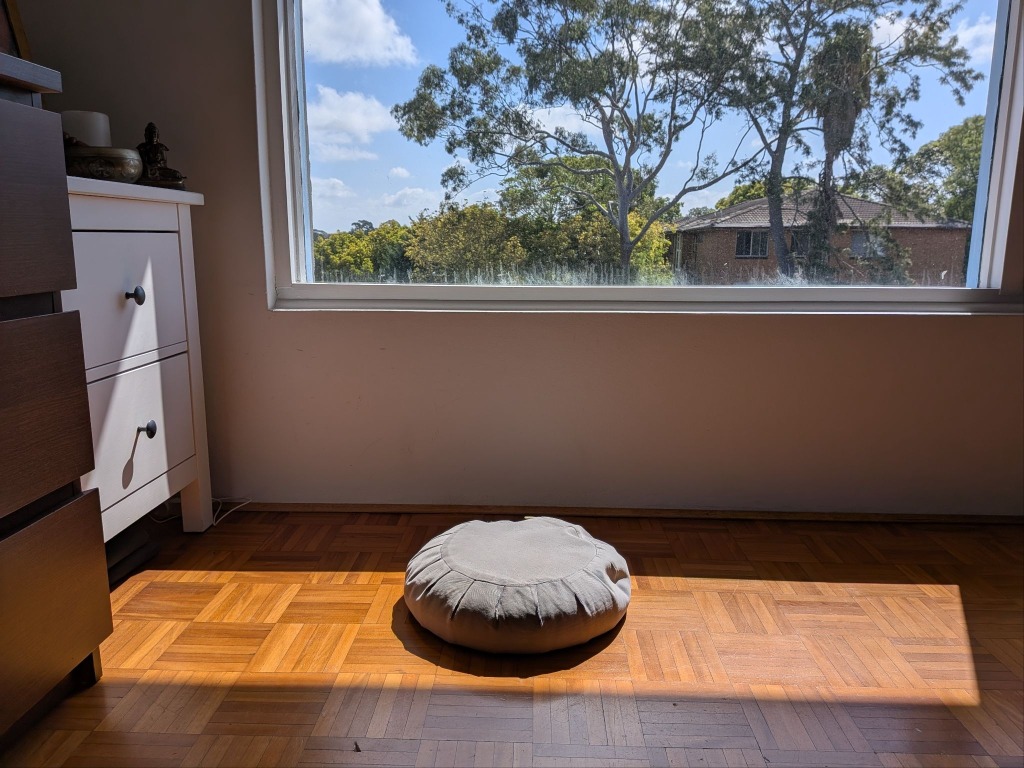
One morning a few months later I’m sitting on a cushion, this time on parquet flooring. I observe the sensations of the body and the breath. I watch thoughts about my unfinished thesis chapter, what to cook for dinner, an idea for an artwork. There’s a gentle sense of calm and comfort. The bell goes off after 45 minutes and I open my eyes to a soft light angled in through the apartment window. I take a moment to appreciate the warmth of the rays in the cool air. I realise that I’m just…fine. It’s another day and my mind isn’t a bad place to be.
Over the months that followed, I knew that I’d never experience the same difficulty with anxiety and depression. Each day, each week, I noticed the patterns of the mind and saw how intention and attention shaped my world.
//
Looking back, it became clear that I was lucky to find a foundational practice that helped make meditation not only function, but also to feel good. The Buddha said that practice should be “good at the beginning, good in the middle, good at the end.” That on its own is a vast beautiful view and a doorway worth opening.
I’m delighted to go back to my roots and to bring this practice to life through a full-day of exploration on the 8th of March. Come join me : )
With mettā,
Kynan
Calm Abiding with Whole Body Breathing

This practice uses the breath in the whole body as a technique to lead to completely staying with the meditation object. In the Stages of Samatha, the transition from Stage 5 to Stage 6 is accomplished through bringing more curiosity (intensifying) until there is an increase in sensory clarity. This then allows for *complete staying* with the meditation object, where there is exclusive attention that no longer scatters or alternates to distractions. Here we use the whole body as the meditation object and then notice the subtle level of sensation, then opening to noticing the breath through the whole body. This leads to a quality of engagement and interest where the body is seen as rich and complex, often becoming a cloud of sensation or waves of energy rather than something solid and fixed. Practising at this level cultivates more calm and clarity than is commonly though possible — the mind becomes both more at ease and brighter than in typical conscious experience.
At Home in the Whole Body (Meditation and Talk)

Guided meditation 30 minutes, talk 4 minutes.
Through meditation practice, we can make the body a comfortable place to be, relating to the body in such a way that the body feels like home, no matter where we are. Even when there is pain, discomfort, or tiredness, the body can be a place to rest and settle. This practice explores using whole body awareness as the meditation object. This whole body awareness includes all of the sensations of the body, as well as tuning into the overall texture or felt sense of the body space that can be rich, complex, murky, and have a more-than-words quality. Use whole body awareness as your practice of calm abiding, or use this as a support to insight, open awareness, or imaginal practice. By opening to the whole body and resting here, you can gradually cultivate a sense of settling, ease, and okness — deeply shifting the state of the body towards rest and nervous system regulation, while also shifting the relationship with the body such that whatever arises can be held in awareness with equanimity.
Balancing Effort

Effort is a key aspect of meditation practice. Too much effort and the practice becomes tight and frustrating; too little effort and practice becomes slack and directionless. Progress, especially in calm abiding (śamatha) practice, is greatly aided by finding the right balance. In the Elephant Path, this is done through phases of intensifying, where more curiosity is brought in and the meditation object is engaged with more and more, then phases where the practice becomes about easing up until a balance is reached. This practice explores alternating between strong effort and ease, gradually settling into an eased up effort that is both calm and clear. The possibility of continued practice is effortless effort — where the mind stays with the meditation object just through the slightest intention and everything arises and ceases brightly and clearly, without any doing or paying attention whatsoever.
The Many Facets of Rest

Rest for the benefit of all beings.
Rest, while under-appreciated in our culture, is an essential part of being human. When we rest, we recover resources and capacity that allows us bring goodness forward. Well-rested, we show up with presence, patience, and kindness. This practice explores this intention and how we can practice towards rest, gradually doing less and less, resting more and more into our deepest nature. Beginning with setting a Presence Anchor and finding a sense of grounding, you will then use the breath as a tool to allow the mind to gradually calm and settle. The breath then becomes a tool to rest more deeply into the body, continuously releasing into this embodied presence. Finally, you rest as awareness — without doing anything, without meditating at all, you can rest in complete effortlessness. Rest as this awareness which is totally eased up yet brightly knowing.
Balancing the Energy of the Mind

Meditation presents the opportunity to cultivate both calm and clarity at the same time. This leads to a quality of mind that is, compared to ordinary states of mind, more alert while also being more relaxed. This is a state of deep resource. It allows for nervous system regulation and being connected and engaged. From this collectedness of mind, craving and aversion arises much less intensely. In this practice you will use the sensations of the breath at the belly as a way to ground and settle, allowing experience to simplify. Then you can bring in the practice of focusing on the inhale to bring more energy, drawing upwards; while using the exhale to relax and settle, drawing energy downwards.
Attuned Noting
Attunement to Feeling States
Attunement is picking up on the relational field so that you have an embodied felt sense of what is going on for you, both individually and collectively. It’s about openness and acceptance of another. It’s seeing and hearing the other person, just as they are, without trying to change them. It’s much easier for me be kind and compassionate when I have a sense of what someone else is feeling – this is when I can really understand what they are going through and connect with their suffering, regardless of whether there’s anything I can do about it. By attuning to another, I am meeting the other person’s need for contact, while also allowing my own need for contact to be fulfilled.
For me, I’ve found difficulty with self-attunement, that is, knowing what I’m feeling. Sometimes this is not knowing I’m dysregulated until after the fact. Other times it’s letting frustration or anger build up without being clear about what factors are contributing to it. Sometimes it just takes me some time to realise I’m sad. I also sometimes have had trouble picking up on other people’s emotions, especially if they aren’t communicated explicitly. I just find it hard at times to know whether someone’s body language and slight change in affect means they want something or want to be left alone. The practice of attuned noting has been a great help.
Relationships require attunement. When we are spending time with others, and especially if we are close to someone or spend a lot of time with someone, we pick up on how the other person is feeling and base our actions on that, at least to some degree. The trouble arises if it isn’t so easy to know what the other person is feeling or if we ignore certain cues and signals. There’s three aspects to this: 1) I have my own feelings that I may be more-or-less consciously aware of. 2) I am expressing these feelings in some way. My feelings are influencing the relational field. 3) The person I am with picks up on the relational field.
For a lot of people, knowing your own feelings can be tricky. Feelings shift and change, and your awareness of them comes and goes. This influences what we express, and how skilfully our feelings are expressed in our words and actions. This then influences what the other person will pick up on.
It’s a relatable human experience to be told something about what you are doing and to only in that moment learn that you are feeling a certain way. For example, I didn’t know I was frustrated until my partner pointed out that I’m hunched over and making grrr sounds through gritted teeth while trying to fix a broken electronic device. The expression of feeling and emotion is always happening, even when unconscious.
Ideally, I would know what I’m feeling, I’d express it in skilful ways (appropriate to the situation), and people around me would pick up on this and in turn respond appropriately. This clearly isn’t always the case. It is also an area that can get more and more attuned and refined.
Noting Feeling States Meditation
We can practise noting “feeling states” in order to be more consciously aware of what is arising and to be able to put into language the present moment experience so that it can be picked up on by others.
In this practice the term “feeling state” covers emotion (anger, sadness, joy), mind states (boredom, curiosity), and also the sensory experience in the body that I have that co-arises with emotion or mind states (when feeling anger I feel warm in the face and tension in my arms and hands, or when I notice a mind state of curiosity there’s a lightness in the chest and head). The emotion, mind state, or sensation are all equally valid doorways to knowing what is present for you in that moment.
Importantly this practice held within a container that is agreed upon and made explicit. There’s a set time for the practice and the intention is clear. Try to ensure that the method is understood. This means that it can become a space where there is an appropriate level of intimacy and vulnerability. The goal here is to create a space for simply connecting with how things are right now. It’s not about complaining, or trauma dumping, or oversharing. If it starts to lean towards stories, blame, or trying to understand why a feeling is present, be cautious. Acknowledge what is present on the level of the feeling state (the sensations and emotions are something that you can agree is the present moment experience) – try to bring it back to what is present and how this feels in the body.
This is a practice of out loud labelling, with one person noting their present moment feeling tone and the other person attuning to what they are saying and feeling.
The practice is straightforward once you get the hang of it. Here are the dot point steps:
Instructions for Noting Feeling States – Dyad Practice
- Create a container
- Find a space that is calm and quiet enough that you can do this without interruption. It helps to face each other, or at least be able to see each other. You might like to sit in a different location from regular activities.
- Make sure you both know enough about the practice intention and structure to feel enough safety to proceed, and discuss if there is some hesitation or apprehension. Acknowledge these feelings.
- Set an intention together. Something brief tends to work, such as “to find connection”, or “to explore attunement together”, or “to know how we are both feeling right now”.
- Decide on a length of time to practice for and the steps to take. Set a timer if that’s helpful. Choose who will note first.
- Time in silence – 1 minute
- Take some time in silence, optionally with eyes closed. Connect with your internal experience. Notice what is present for you. Allow whatever is there to be there, without exclusion. You may notice physical sensations, thoughts, emotions, and stories or parts of the mind.
- Noting and Attuning – 2 minutes each
- The noter begins labelling their present moment feeling tone experience out loud (eyes can be open or closed). Aim for a steady pace, around 5 seconds per label tends to work well. You might say things such as: “calm”, “bored”, “agitated”, “happy”, “love”, “anxious”, “humour”, “tender”, “vulnerable”, “frustrated”, “stressed”, “excited”, “joyful”, “murky” etc. There’s always a pressure release option – you can say “don’t know” or “unclear” or “pass” or simply be silent.
- While the noter is saying this out loud, the attuner listens and watches, holding space for the noter and connecting with what they are saying and feeling. Tune in to the noter’s tone, rhythm, breath, and subtle facial expressions. The attuner might notice correlations, or they might even intuit what feeling state is arising (there might also be guesses that don’t match up). Notice how it feels to attune and if there is a sense of alignment or misalignment. Listen with presence and allow whatever is taking place to unfold.
- Check in and debrief – 3 minutes
- Take some time to debrief and talk through the experience. How was that for you? What did you notice? What was challenging? What came more easily? What helped you engage with the practice?
- Conclude the practice. Take turns to speak about how you are feeling now, and if there’s anything you need, or some way you will move forward from here.
Extra Tips
The time durations here are just suggestions. Start with something short that is easy to commit to as a low-cost experiment. You can even spend just one minute on each phase.
When noting these feeling states, there’s a few interesting things that occur.
You might find that the states change more rapidly than you expect. This happens because when paying attention to the feeling state it brings more clarity to the emotion and sensation, leading to identifying more complexity and richness, as well as a faster rate of change than you may have previously noted. By saying the label out loud, you are also palpating the feeling state, meaning that you are giving it a little massage that makes it change or shift in some way. The degree of equanimity and acceptance also contributes to this, allowing those present moment states to be there without any need to change them allows them to shift more rapidly. Acceptance leads to change.
The states that you notice might vary wildly, even moment to moment. You might be noting “humour” and then the next second “anger” or “sadness”. There might be “strength” and then shortly after “feeling small”. You might also find it helpful to label things like “thinking”, “story”, “belief”, “remembering”, “planning”, “fantasising”.
There are also a range of labels that are worth familiarising yourself with as they help when you aren’t quite clear on what is there, labels like “something”, “blank”, “vague”, “murky”, “unsure”, “don’t know”. You might also notice that the feeling is changing rapidly, in which case acknowledging this might help, such as “changing”, “shifting”, “flowing”, or “feeling”.
It is normal to find it challenging at first to locate the feeling tone and to note continuously. It’s perfectly fine to say you don’t know or to label “blank”. It might take some time just noting blank before you discover a distinct feeling tone. No problem. The key here is to tune in to what is present for you — the truth of your present moment experience is whatever you are aware of, even if that’s nothing distinct!
For me this has been a high value practice. There have been plenty of times I’ve felt like I didn’t want to do it before we started, but I don’t remember a single time when I didn’t feel glad to have done it afterwards.
Find a friend and try it out – see for yourself if this is valuable. If you are curious and want to try it out in a welcoming space, you can come along to Sit For A Bit, or get in touch with me.
Mettā,
Kynan