Note: this practice involves intentionally working with challenging emotions. If you are currently not feeling grounded and resourced, you may want to choose a different meditation. If at any point during this practice you feel overwhelmed or disconnected from experience, open your eyes, come out of the meditation, and do something that you find grounding such as gentle movement, walking, eating, or resting.
When related to in skilful ways, all emotions become part of the practice. Here you are asked to bring to mind a challenging emotion of medium intensity (around 5 out of 10), such as frustration, tiredness, sadness, anger, or shame. You can recall a situation or memory when this emotion was activated, using the visualisation in order to bring the experience forward more clearly. You are then invited to look closely at the sensations and thoughts associated with the emotion, seeing them as insubstantial. After searching, you’ll find that there is no substantial, permanent core of the emotion that is inherently existing. You can also search for the self that feels the emotion, also coming to the conclusion that this is ultimately unfindable. In this forge of emptiness, the emotion may then shift and transform, allowing anger to shift into strength, sadness into tenderness, frustration into clarity, tiredness into deep rest, and shame into integrity.
When we experience painful sensation, we generally resist it, want it to change, or otherwise have some form of craving and aversion. This is wanting things to be different from how they are, either by trying to get something better, or by trying to get rid of what is present. The way of non-clinging releases this resistance. You can notice the sense of clinging through detecting contraction, stuckness, or resistance in the body, then you can release this by opening, softening, and allowing. Be present with this experience exactly as it is. This will open up a different way of being, with more lightness, openness, and freedom. Note that this is equanimity in regards to the primary experience in the moment, which still allows for taking action as appropriate to the situation.
In becoming aware of the sense of self, it greatly helps to have a practice that enables shifting out of habitual modes into a more open and spacious awareness. One key to this is noticing the awareness, rather than objects of awareness, which creates a shift towards allowing. The self is known by this awareness (as well as body sensations, thoughts, and emotions). This beholding awareness can know the self as it arises and passes, as the sense of solidity increases and decreases. This also helps us tap into the sense of completeness of being awareness — where there is nothing missing and no self-deficiency.
This practice begins with belly breathing while counting the length of inhales and exhales, moving from equal duration, to longer exhales. This is a powerful practice for quickly calming and grounding.
I’ve just left a Zoom call for a self-organised online meditation group and I’m buzzing with an open tenderness. It’s a small group, four of us chatting tonight for an hour. We take it in turns to speak about our practice and anything dharma-adjacent: sharing our challenges of pain and fear, our celebrations of meditative insights and deepenings, and our contemplations on this complex existence. The group feels like a gift, a treasure. It’s a space of heartfelt connection and playful joking. There’s a tone that is somehow both totally uncontrived and deadly serious about awakening. I feel waves of gratitude and appreciation for these other humans and their willingness to connect.
During the call I share that I’ve been thinking about sangha and how grateful I am to have people who listen and understand when I share the contents of my mind. This has opened up a deeper dimension of friendship than I experienced in my first 20+ years. It has also been invaluable to progressing on the path and in life. I talk about how much it helps to just have people who will listen, and that I trust. Sharing this to the group feels like it folds these threads together, my words are understood and find a palpable resonance. My travel companions nod and smile in joyful agreement.
I’ve been gifted with many great sanghas. This online group has been meeting since 2020. I have a number of teacher friends who offer support and guidance and shared understanding. I have dear friends who are devoted to different aspects of the path that help me to expand my understanding (special shout out to my friends dedicated to the practice of Awakened Connection, for the cherished friendship and the gifts they bring). I also have a growing camaraderie with my classmates in the Aletheia Training Program, which has opened up new doorways. Through online groups, I’ve also developed friends that I will keep for life, that will always have a base of understanding to return to. I’m also so grateful for Coalescence Sangha, for everyone who joins the events I lead, and for the amazing team that has helped me offer retreats!
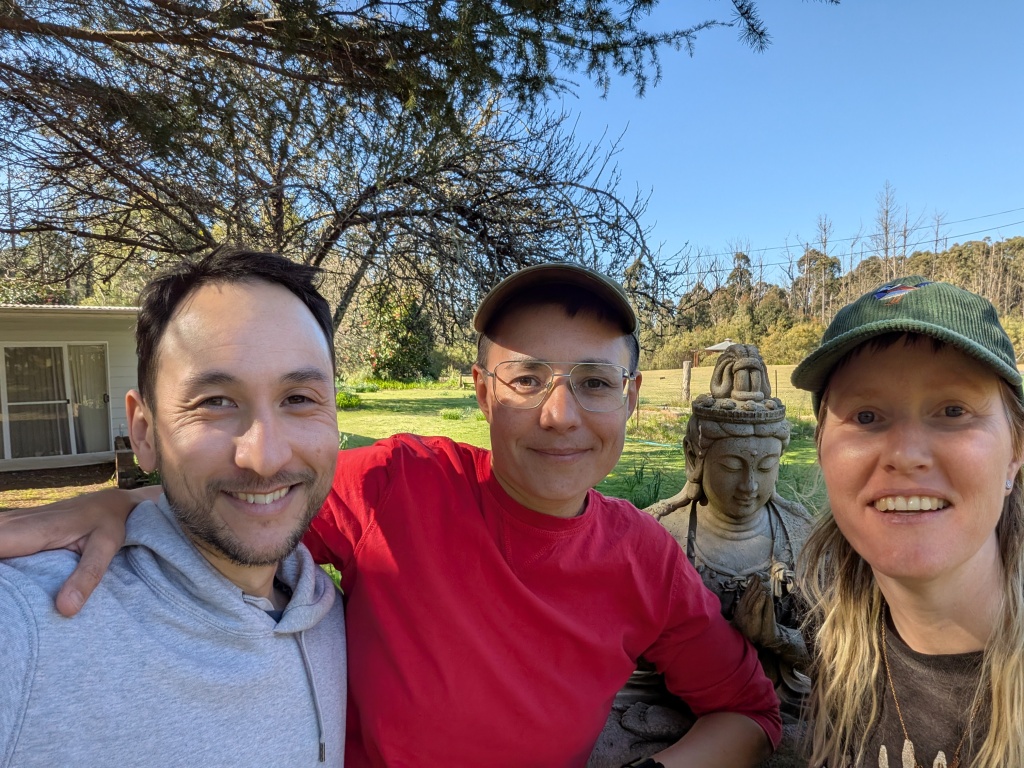
The lovely retreat team!
I’ll go out on a limb and say that sangha is the most important dimension of meditation practice. Having friends that meditate is a better predictor of whether you’ll stick with the practice and deepen practice than any other measure.
Why is having meditation friends so helpful? Sangha is the convergence of social acceptance with interest and meaningfulness – and meditation, practised deeply, cannot help but touch on the deepest and most meaningful aspects of our lives.
It’s undeniable that we are social creatures. Humans have a social capacity that is deeply ingrained in our biology. We take in the culture that is around us; we absorb what we are surrounded by. We can find so much joy and fulfilment in our relationships. We also find that a lot of our deepest needs are around social qualities: love, acceptance, safety, and value. When these aren’t met in satisfying ways, it leaves us hurt. Unfortunately for many of us the greatest pain and difficulty in our lives tends to come in relationships that failed to meet these needs.
Sangha has the capacity to repair this hurt through the offer of contact and connection. Sounds lofty right! But all great journeys begin with a single step.
For me, it has taken some time. At first, I was shy to open up and often felt like there were parts of my experience that simply weren’t okay to share. It’s been a process of folding this in, beginning with saying when I did feel uncomfortable or uncertain, even if I didn’t know what that was about – and to be seen in exactly that experience.
When I turn up to these groups and I share my experience, I gradually open up, and I am seen and understood. I feel held and appreciated, exactly as I am. It’s a felt experience of the practice coming through in relation: I am becoming more equanimous with my experience as others offer being with. I deepen my contact with myself and with others and in doing so it reveals a depth of experience.
Now I’m going to quote a sutta from the Pāli Canon, because I love hearing this, and I think I’ll keep repeating it until I no longer can.
Ananda said to the Buddha, “This is half of the path: admirable friendship, admirable companionship, admirable camaraderie.”
“Don’t say that, Ananda. Don’t say that. Admirable friendship, admirable companionship, admirable camaraderie is actually the whole of the path. When one has admirable people as friends, companions, & comrades, one can be expected to develop & pursue the noble eightfold path.
— Upaḍḍhasutta, translated by Thanissaro Bhikkhu (with my own adjustments of gender, epithets, and emphasis)
This sutta points to the meaningfulness and significance of having friendship, companionship, and camaraderie – it isn’t an auxiliary to the practice, friendship is the practice. We practice in our relationships, and our relationships sustain our practice.
Sweet Potato Sangha — a painting gifted to me by Ju, I don’t know the artist unfortunately!
How can you find sangha? First, reflect on how sangha fits in with your life and if it matches your intentions and values around practice. Maybe you already have some sense of community – this is an invitation to check in and offer contact. If you feel you could do with more connection, start with finding someone you get along with. When you join a class, if you resonate with someone, reach out and see if they want to chat. Find other people online or in-person that share an interest in meditation, and especially if they seem to be exploring in similar ways. Build from there, step by step. You might just have one friend you chat with, a family member you sit with, or a pal who has read the same dharma book as you. You might like to form a practice pod and have others you check in with. Then you begin the process of connecting and gradually finding ways to be with each other in good friendship.
Sit For A Bit has been a beautiful chance to practice with like-minded folks walking distance from my home in the Inner-West of Sydney, a far-off dream when I started meditating and only knew of people on the internet who were interested in this. I hope that it can help foster the kind of community that leads to this admirable friendship and to provide a spark of connection in the practice. Come join some good meditation friendship : )
Reply and let me know what you find most valuable in sangha – I love collecting stories of friendship and hearing people’s appreciation for their meditating friends and communities.
This practice weaves together two threads: relaxing and calming the body by gently bringing attention to the whole body space; and knowing the body from the body. Awareness is effortlessly already aware, without you doing anything or needing to make awareness happen. So too does the body know itself — the body space is filled with bright, clear awareness. In order to get a sense of this, you allow the body and mind to settle through calming and collecting, then tune in to how it feels to inhabit the body, from the body. Allow awareness to drop down into the body space and behold itself.
Sit upright, with care and respect. Sit with dignity. When you sit in meditation practice, you dignify yourself, the community, and the practice. Recognising that each passing moment is constantly changing, you open yourself to the uniqueness of each experience. This body, this breath. The body calms and eases into comfort and stability. As you sit, poised and balanced, you begin to notice this palpable sense of presence, a quality of knowing awareness that is immovable, imperturbable, and fully awake to each passing moment.
Sunday 5 October 2025, 9:00 am – 5:00 pm Buddhist Library, Camperdown, Sydney
The opportunity to go on retreat is special. To have the time and space to focus on practice is an amazing opportunity. Unfortunately, many of us don’t get this opportunity very often, so we try to carve out bits of time that allow us to do this in the midst of a busy life. The Day of Practice is an opportunity to practise deeply in the city, without leaving our lives.
You can look at this as a detox from communications and electronics, or a nervous system reset. It can be a deep exhale and shift towards relaxation. It also fosters time to go deeper in practice and explore what is meaningful to you about meditation and the path. The day becomes a container to hold your practice and assist cultivating different states of mind.
Śamatha – Practices for Deep Nervous System Resourcing
Tuesday 14 October 2025, 7:00 – 8:30 pm Buddhist Library, Camperdown, Sydney
Śamatha (calm abiding) is a meditation practice that leads to degrees of samādhi (collectedness and unification of mind and body). This calming is a powerful resource for regulating and balancing the nervous system. Beyond simply relaxing, these practices open up the possibility of deep states of effortlessness and equanimity – which can be directly linked to states of deep nervous system regulation.
Attuning to the state of the body and mind in the present moment provides clues as to how to navigate both meditation and daily life in a way that leads to more grounding, settling, and the state of energised calm that is both a resource in itself and sets the stage for freeing insight to arise.
This session will include lecture, guided meditation, and discussion to provide a first hand experience of these practices. All levels of experience are welcome. If you are interested in a deeper exploration.
—
Vipassanā – Attuning to the Felt Sense of Freedom
Tuesday 21 October 2025, 7:00 – 8:30 pm Buddhist Library, Camperdown, Sydney
Vipassanā (insight) is the practice of Buddhist meditation that allows for seeing through obscurations to recognise our deepest nature. But how do you know that your insight practice is moving forwards?
As insight practice deepens, there is a felt reduction of clinging and suffering in the moment. You can track this with an awareness of the body and by tuning in to the sense of lightness and openness that is revealed when habitual tendencies relax. We will explore ways of tracking this felt sense of lightness and noticing the fading of perception that reveals deep insights about the fabrication of experience.
This session will include lecture, guided meditation, and discussion to provide a first hand experience of these practices. All levels of experience are welcome, however previous meditation experience is recommended to get benefit from these teachings.
Awareness is knowing, spacious, and welcoming. Awareness allows everything; rejects nothing. Awareness effortlessly holds all experiences within its tender embrace. Here I offer a practice of somatically grounding through movement and breathing, relaxing and stabilising whole body awareness, and then pointing out this awareness that is already here, already knowing. Allow the instructions to be poured in. Notice any shifts that occur in response. Rest as awareness.
Equanimity is being with experience without the push and pull of craving and aversion, without trying to change how things are. To practice equanimity you can shift into a mode of receptive awareness, tuning in to what is present and cultivating a relationship of being with. The phrase “open, soften, allow” can be particularly helpful here as a way to encourage a gentle welcoming of all experiences. Here there is an emphasis on whole body awareness as a way to attune to the present moment that is embodied and direct.
This practice is from the Tending the Fire Retreat in September 2025.
NOTE: In this practice you will intentionally invite an emotion to come forward. It’s best to bring up something that isn’t the most intense or strongest. Choose something that feels of medium intensity and manageable for your current state. The practice begins with 10 minutes of grounding and settling. If at any point you feel either overwhelmed, or disconnected and spaced out, return back to a grounding practice, or stop the meditation.
Emotions are a dimension of experience that occupies a space between physical and mental. These are felt experiences that are tangibly real, yet ephemeral and elusive. It is emotional experiences that make being a human both worth rich and wondrous, as well as difficult and oppressive. Yet we often don’t fully open to the emotional dimension. When we feel into emotions fully and allow them to be there, they will shift on their own. Emotions cease being static or stuck and instead become liquid, flowing, changing experiences that unfold the richness of being alive. Through exploring the emptiness of the emotional experience, it will often transform into an essential quality: sadness becomes love and compassion; anger reveals strength; frustration turns into clarity.